Model Answer:
Talcott Parsons, in his seminal work The Social System, sought to resolve the “Hobbesian problem of order” by synthesizing Max Weber’s focus on social action with Emile Durkheim’s macro-social order. He defined a Social System as a plurality of interacting actors motivated by gratification optimization, whose relations are guided by a culturally structured system of shared symbols.
Parsons’ Conception of the Social System
- AGIL Schema: Parsons argued systems survive by fulfilling four functional prerequisites through specific institutions:
- Adaptation: Economy (extracting resources and wealth creation).
- Goal Attainment: Polity (political decision-making).
- Integration: Law and Religion (maintaining solidarity and coordination).
- Latency (Pattern Maintenance): Family and Education (socializing and transmitting values).
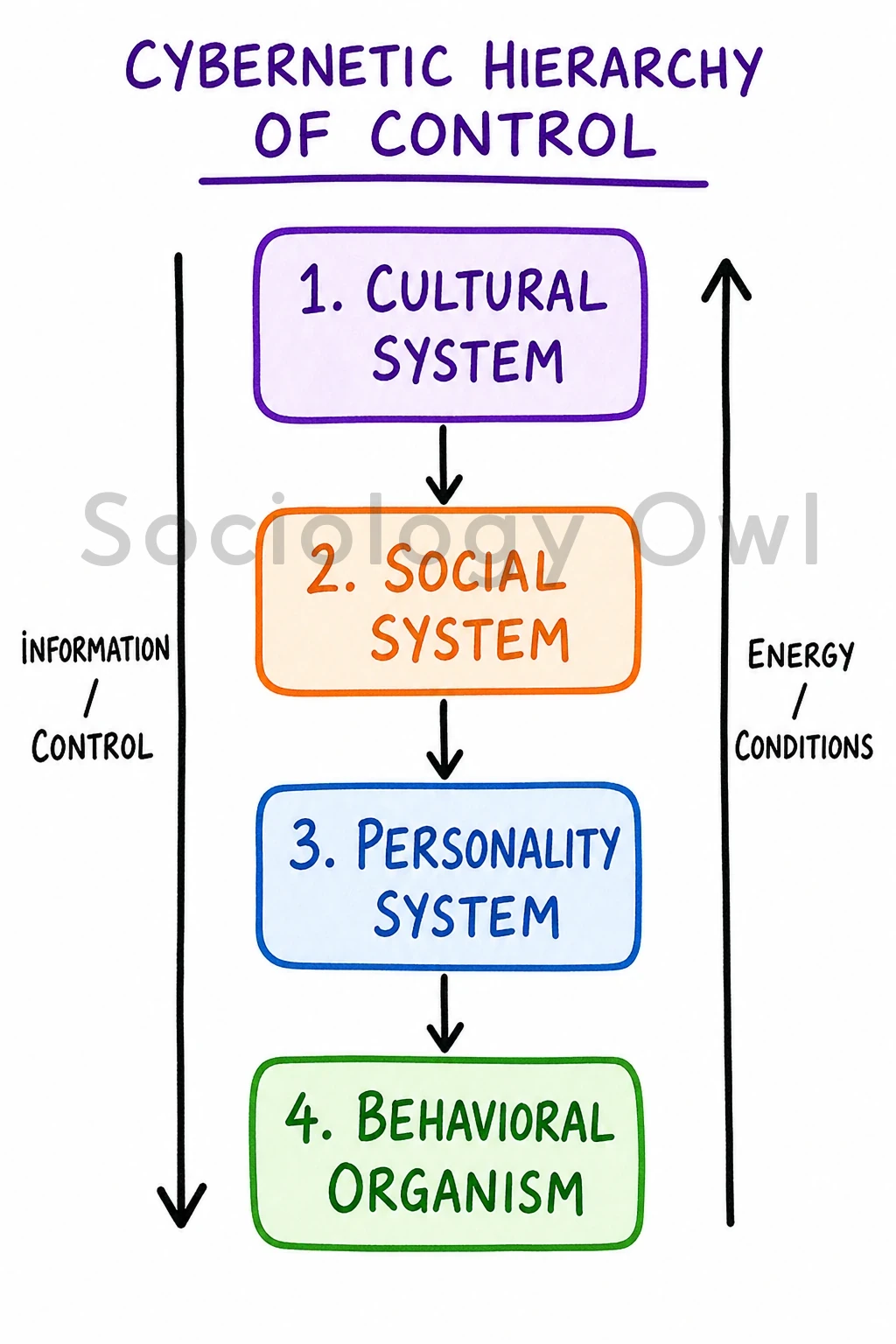
- Cybernetic Hierarchy of Control: Parsons postulated that social systems are regulated by this hierarchy, where systems with high information (culture/values) control systems with high energy (economy/biology).
- Moving Equilibrium: Society is not entirely static; it maintains a “moving equilibrium” through continuous structural differentiation and shared value consensus.
Critical Analysis
- “Grand Theory” Abstraction: C. Wright Mills criticized Parsons’ framework as an overly abstract “Grand Theory” detached from empirical, historical reality.
- Overemphasis on Stability: Conflict theorists like Ralf Dahrendorf argued Parsons ignored coercion, inequality, and the constructive role of conflict, acting as an apologist for the status quo.
- Lack of Agency: Ethnomethodologist Harold Garfinkel critiqued Parsons for treating actors as “cultural dopes” who blindly act out pre-programmed systemic scripts.
- Internal Critique: R.K. Merton rejected Parsons’ postulate of universal functionalism, introducing “dysfunctions” to account for negative systemic consequences.
Contemporary Relevance
Parsons’ AGIL schema elegantly maps systemic responses to modern crises like the COVID-19 pandemic: societies had to Adapt (remote digital economy), set Goals (vaccine deployment by the State), ensure Integration (public health mandates), and rely on Latency (appealing to shared community values).
Conclusion
While classical Parsonian functionalism declined, its quest to understand society as an interconnected whole remains vital. It laid the foundation for Niklas Luhmann’s Systems Theory and Jeffrey Alexander’s Neo-functionalism, proving continuously relevant for analyzing complex, highly differentiated global societies.