Model Answer:
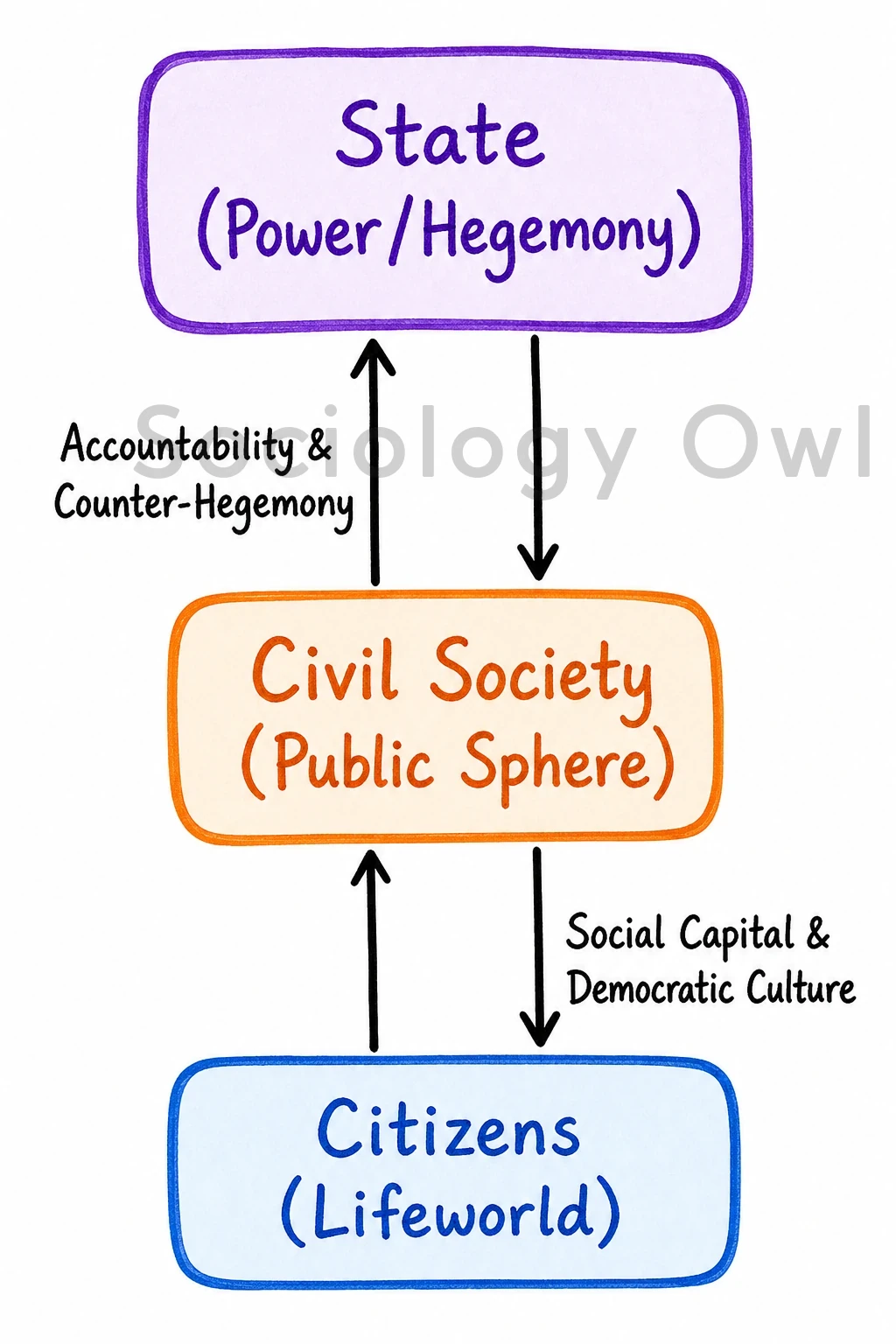
Civil society, the “Third Sector”, comprises voluntary, autonomous associations distinct from the market and government. G.W.F. Hegel conceptualized it as an intermediary sphere mediating between the family and the state.
Sociological Functions and Critiques of Civil Society
- Public Sphere: Jørgen Habermas argues it creates a “Public Sphere” for communicative action and rational-critical debate, articulating marginalized interests.
- Social Capital: Alexis de Tocqueville and Robert Putnam (Bowling Alone) assert that voluntary networks build “Social Capital”, fostering trust and a participatory political culture.
- Counter-Hegemony: Antonio Gramsci viewed it as a space to contest state hegemony, preventing authoritarianism.
- Elite Capture: Neera Chandhoke warns it is a contested terrain susceptible to bourgeois domination.
- Uncivil Society: Non-state actors like hyper-nationalist militias can actively subvert democratic values.
Globally networked movements like Black Lives Matter and Fridays for Future exemplify civil society expanding democratic discourse and demanding accountability.
Conclusion
Despite vulnerabilities, a vibrant civil society remains the “oxygen of democracy” (Larry Diamond), checking majoritarian tyranny and fortifying the socio-political fabric.