Model Answer:
Reference Group Theory
Reference Group Theory, coined by Herbert Hyman and expanded by R.K. Merton, explains how individuals evaluate themselves against aspirational groups. It utilizes Relative Deprivation (Samuel Stouffer, The American Soldier) and Anticipatory Socialization.
Applicability in Diverse Contexts
Traditional Societies: M.N. Srinivas proved RGT functions even in rigid caste structures via Sanskritization, where lower castes emulate upper castes as normative reference groups for mobility.
Critiques of Universal Applicability
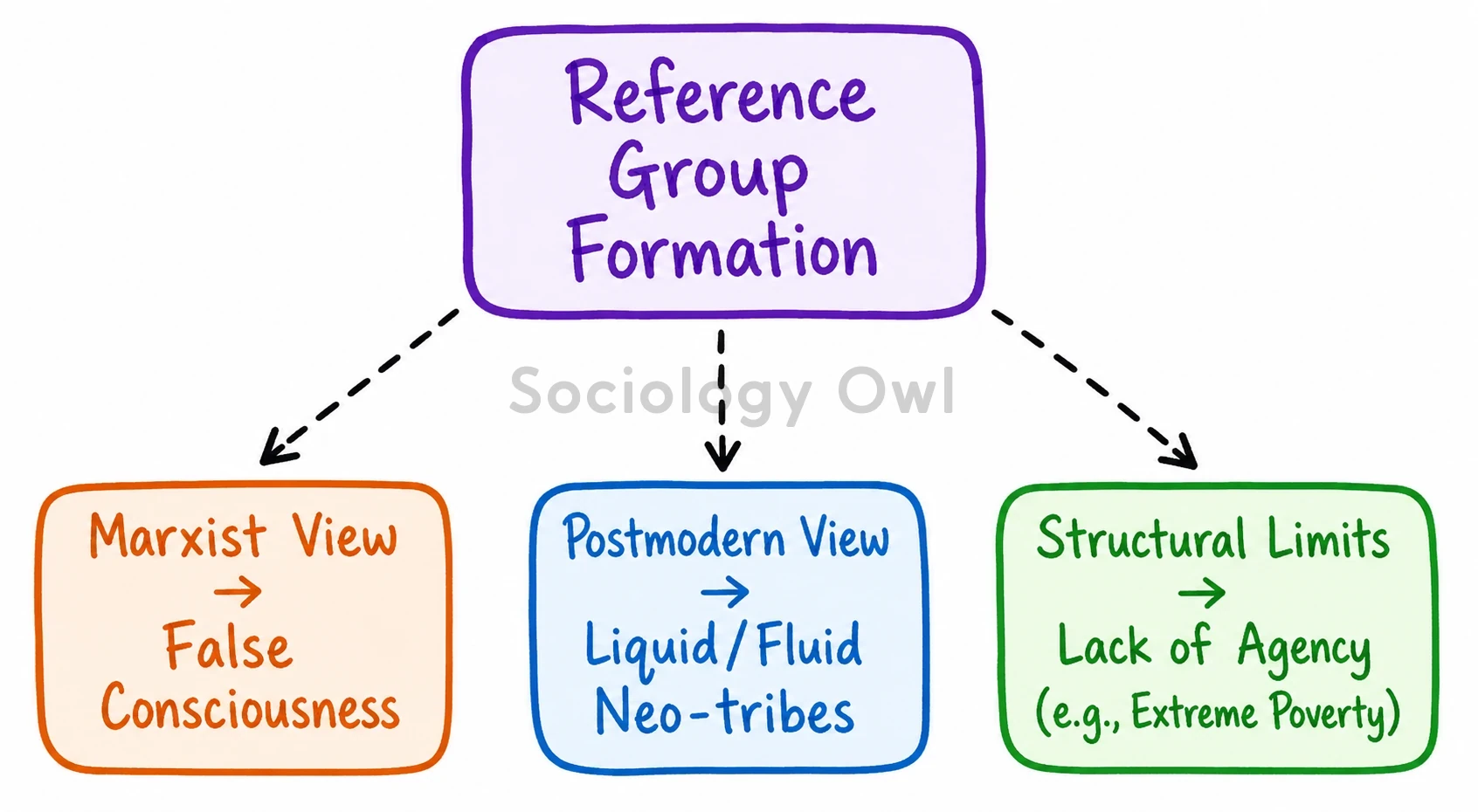
- Marxist Perspective: Aspirational behavior reflects False Consciousness, where the proletariat adopts bourgeois values over actual objective class awareness.
- Postmodern View: Zygmunt Bauman argues that in Liquid Modernity, stable reference groups are replaced by fluid, fragmented “neo-tribes.”
- Structural Limits: RGT assumes agency and free choice; severe totalitarianism or extreme poverty restricts the capacity to form alternative reference groups.
Social media forms borderless Virtual Reference Groups. Algorithmic “Echo Chambers” act as localized normative groups, heavily influencing youth consumerism and political polarization globally.
Conclusion
Though not an absolute universal law, RGT remains a vital heuristic tool to analyze socialization and identity formation across traditional hierarchies and modern digital landscapes.