Model Answer:
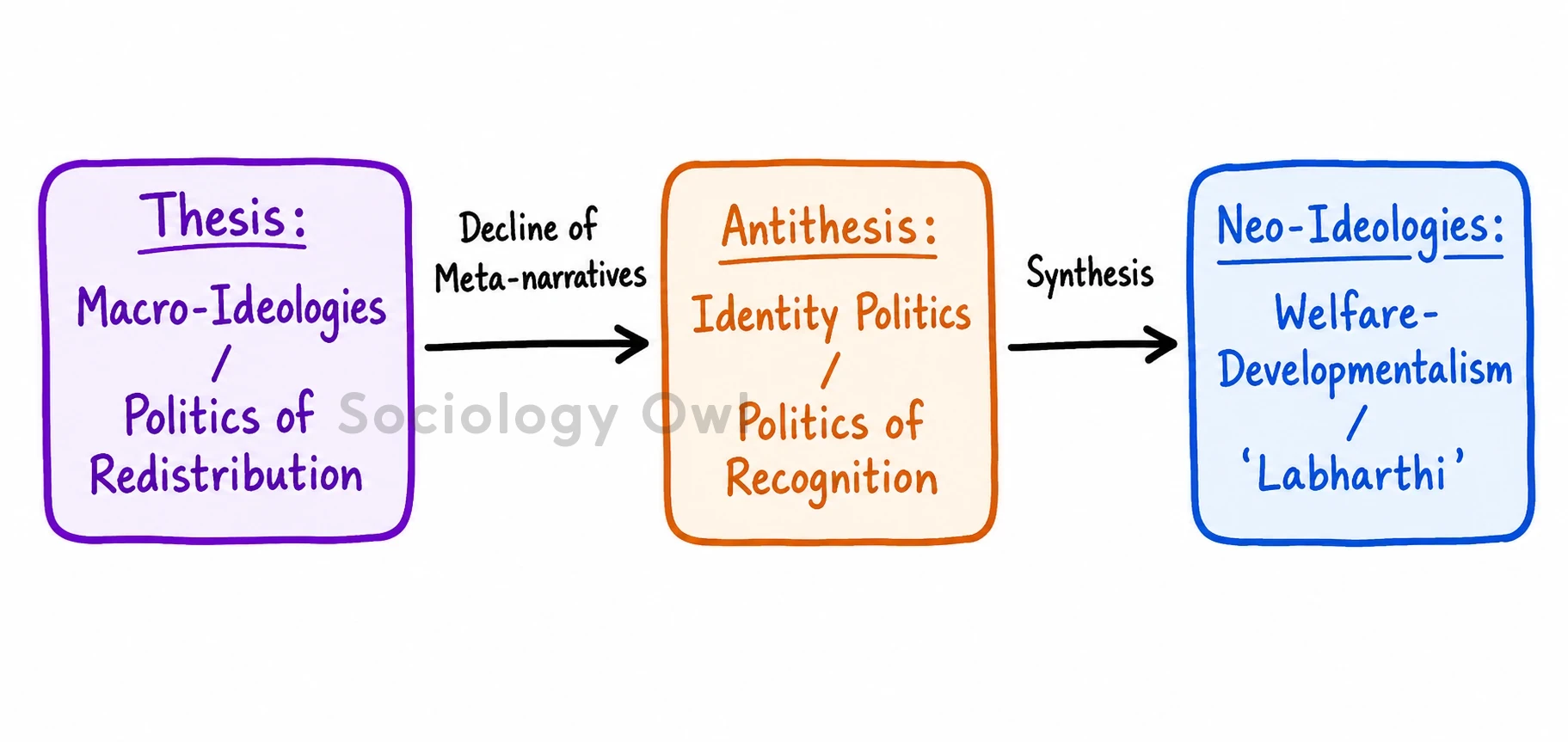
India’s political transition can be understood through Nancy Fraser’s framework as a shift from the “politics of redistribution” (socialism) to the “politics of recognition” (identity). Echoing Jean-Fran007ois Lyotard’s “decline of meta-narratives”, the failure of grand Nehruvian ideologies caused a Weberian shift from Class-based to Status-based political mobilization.
Phases and Nature of Transition
Politicisation of Caste: As the early developmental state failed to resolve structural inequalities, marginalized groups retreated to primordial identities. Rajni Kothari, in Caste in Indian Politics, argues that democracy led to the “Politicisation of Caste”, utilizing status as a modern interest group.
Subaltern Assertion: Christophe Jaffrelot, in India’s Silent Revolution, describes the post-Mandal era as a transfer of power from upper-caste ideological elites to OBC/Dalit identity-based leadership.
Critique: The False Binary and Neo-Ideologies
Identity Fostering Ideology: The shift is not a complete binary. Identity politics often births new ideologies. Dalit assertion created a robust Ambedkarite ideology, while Hindutva utilizes religious identity to forge a broader cultural-nationalist ideology.
Pragmatic Alliances: Dipankar Gupta notes that identity politics increasingly relies on opportunistic caste alliances for political power rather than rigid, singular caste ideologies.
Contemporary Reversal: Indian politics is witnessing a return to overarching neo-ideologies that transcend fragmented identities, notably the emergence of a cross-caste “Labharthi” (beneficiary) class driven by welfare-developmental ideology.
This transition globally mirrors Manuel Castells’ concept of “Resistance Identity”. Just as Indian dominant castes (Jats, Marathas) use identity politics to counter agrarian distress, Western democracies exhibit a similar shift from left-right economic ideologies to cultural identity assertions (e.g., White working-class Trumpism or Brexit).
Conclusion
The transition from ideology to identity reflects a deepening of grassroots democracy in India. However, its future stability relies on synthesizing the “politics of recognition” with the “politics of redistribution” to transform fragmented assertions into a cohesive framework for substantive equality.