Historical Context and Emergence
The functionalist theory of social stratification emerged as a dominant sociological paradigm in mid-20th century America, primarily as a counter-narrative to the Marxist emphasis on class conflict and exploitation. Rooted in the intellectual lineage of Emile Durkheim (division of labor) and Talcott Parsons (social order and integration), Kingsley Davis and Wilbert E. Moore articulated this perspective in their seminal 1945 paper, “Some Principles of Stratification.” They sought to explain not why stratification is inherently unjust, but rather why it is a universal and historically persistent feature of all human societies.
Theoretical Foundation and Core Propositions
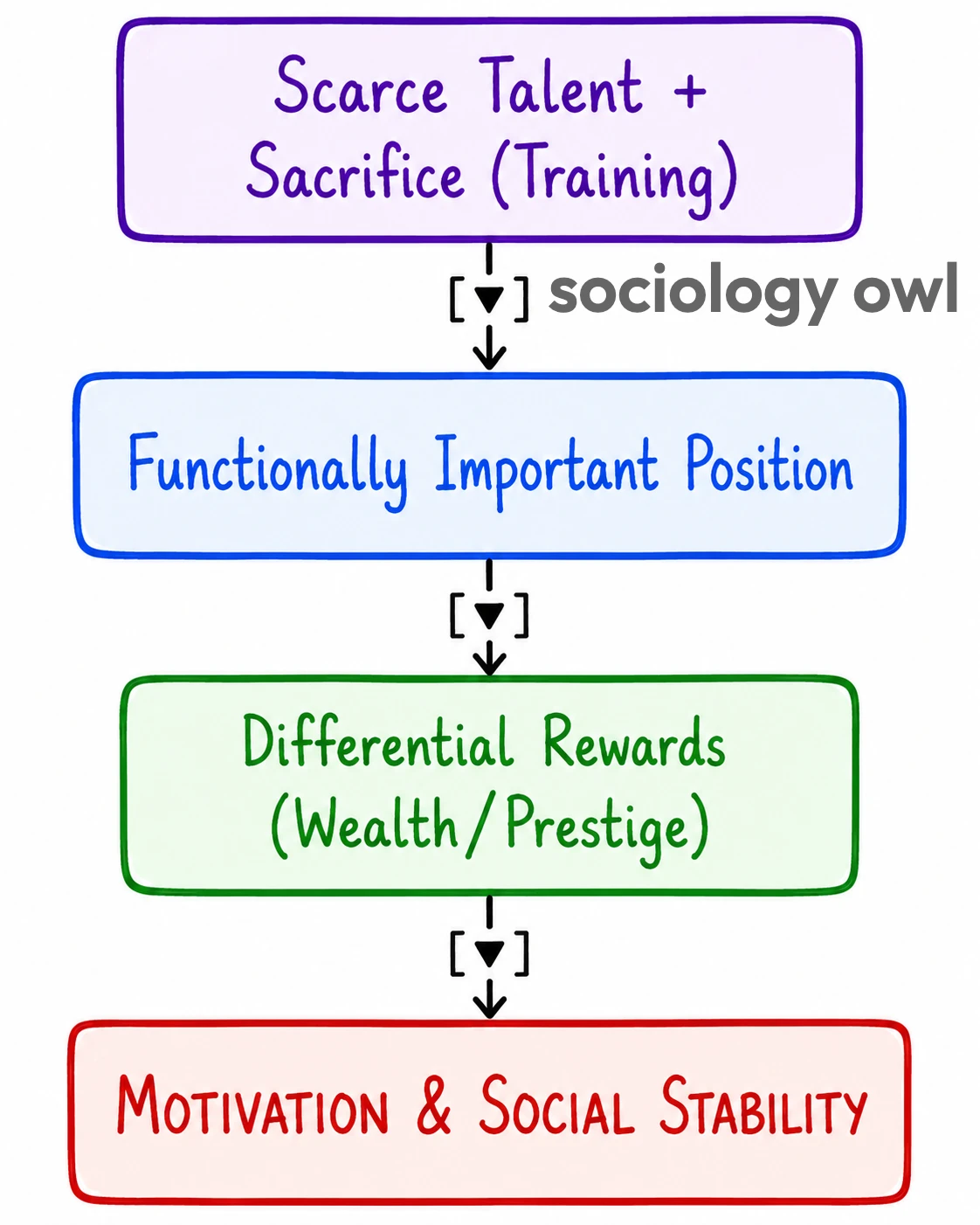
Davis and Moore argued that social stratification is essentially an unconscious, evolved mechanism by which society ensures that its most critical functions are performed by the most qualified individuals. Their theory operates on several functional prerequisites:
- Role Allocation (Sieve Mechanism): Society must possess a mechanism to place individuals into various roles within the social structure.
- Differential Functional Importance: Certain positions are inherently more crucial for societal survival and require a high degree of specialized skills (e.g., doctors, military generals).
- Scarcity of Talent and Competence: Only a limited number of individuals possess the innate talent to acquire the skills necessary for these functionally important roles.
- Training and Sacrifice: The conversion of raw talent into applicable skills requires lengthy training, deferred gratification, and personal sacrifice.
The Mechanism of Differential Rewards
To motivate the most talented individuals to undergo sacrifices and take up functionally important positions, society must attach differential rewards to these roles. These rewards are distributed in three forms:
- Sustenance and Comfort: Economic wealth and material benefits.
- Humor and Diversion: Leisure, vacations, and aesthetic appreciation.
- Self-Respect and Ego Expansion: Social prestige, status, and honor.
Therefore, institutionalized inequality (stratification) is viewed as a functional necessity for social stability and progress.
Critiques and Controversies
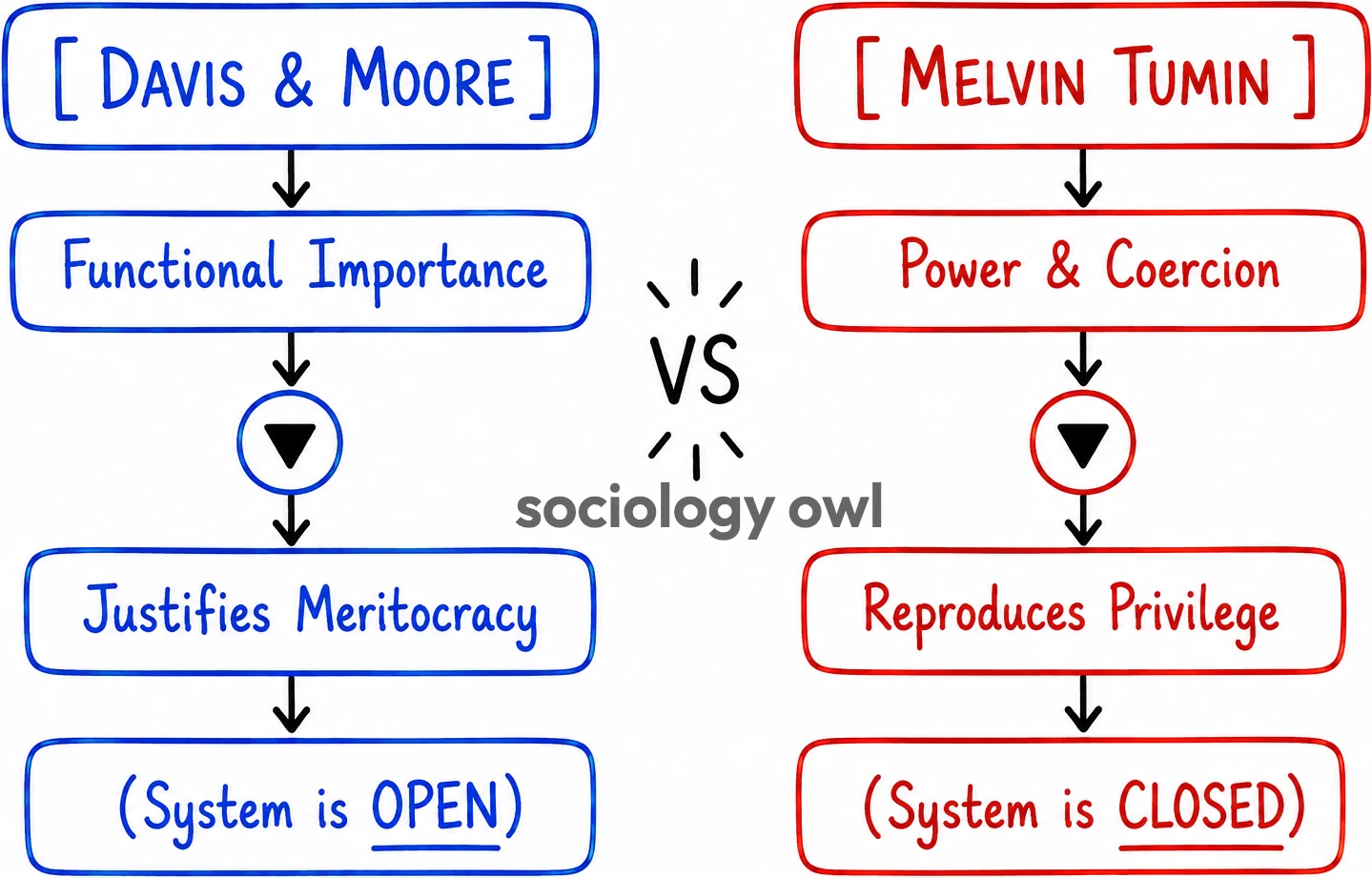
The functionalist view of stratification faced severe backlash, most notably from Melvin Tumin in 1953, who dismantled the theory on several fronts. Other scholars also highlighted its teleological and conservative biases.
| Dimension | Davis & Moore (Functionalist View) | Melvin Tumin & Critics (Conflict/Critical View) |
|---|---|---|
| Measurement of Importance | Importance is based on uniqueness and indispensability to society. | Functional importance is highly subjective. A sanitation worker is as vital to public health as a doctor. |
| Role of Power | Rewards are granted by consensus for societal contribution. | Rewards are often a result of bargaining power and unionization, not societal consensus. |
| Talent and Sacrifice | Talent is scarce; training requires immense sacrifice. | Training is a privilege, not a sacrifice (loss of earnings is compensated by parents). Society is full of undiscovered talent. |
| Function of Stratification | Maintains social stability, integration, and motivates excellence. | Tumin argued it promotes hostility, restricts social mobility, and reproduces generational inequality. |
Additional Sociological Critiques
- Michael Young (The Rise of the Meritocracy): Criticized the assumption of a perfect meritocracy, warning that it leads to a dystopia where the elite justify their dominance as “earned,” leading to arrogance and the alienation of the lower classes.
- Ralf Dahrendorf: Pointed out that the theory ignores the role of coercion and power dynamics in maintaining unequal reward structures.
- Alvin Gouldner: Criticized the theory for being ideologically conservative, essentially providing a moral justification for the unequal capitalist status quo.
The Indian Context: Applicability and Limitations
In the context of Paper 2 of the UPSC Sociology syllabus, applying Davis and Moore’s theory to the Indian social structure—particularly the Caste System—reveals significant theoretical limitations. Indian society has historically been characterized by ascription rather than achievement.
- G.S. Ghurye and Ascriptive Roles: The traditional caste system fundamentally contradicts the “role allocation based on talent” prerequisite. Roles were allocated based on birth (endogamy and hereditary occupation). Thus, stratification in India often suppressed talent rather than nurturing it.
- Andre Beteille (Class, Status, and Power): Beteille notes a shift in India from a harmonic system (where inequalities were accepted as legitimate, akin to traditional caste) to a disharmonic system (where modern constitutional values emphasize equality, but massive inequalities persist). While modern urban India shows signs of Davis and Moore’s merit-based stratification, caste continues to act as a structural barrier to equal opportunity.
- M.N. Srinivas (Sanskritization): The drive for Sanskritization shows that people at the lower end of the hierarchy actively desire higher status and rewards, proving Davis and Moore’s point about human motivation. However, the rigidity of the caste system prevents true structural mobility, rendering the functionalist “open system” assumption invalid.
- Dipankar Gupta: Argues that the Indian caste system is based on “difference” and “discrete categories” rather than a continuous hierarchy of functional importance. Ritual purity, not functional necessity, historically determined rewards.
Contemporary Relevance in a Globalized World
In the contemporary, hyper-globalized world, the Davis-Moore theory offers both insights and paradoxes:
- The Knowledge Economy: The theory partially explains the high salaries of specialized professionals (AI engineers, top-tier CEOs, neurosurgeons) whose skills are scarce and functionally critical in a digital economy.
- The Gig Economy and Essential Workers: The COVID-19 pandemic severely challenged the theory. “Essential workers” (delivery agents, nurses, sanitation staff) were proven to be of the highest functional importance, yet they received the lowest economic rewards and prestige, proving Tumin’s critique that power and market forces dictate rewards, not societal importance.
- Corporate Stratification: Scholars like Joseph Stiglitz (The Price of Inequality) argue that the astronomical CEO-to-worker pay ratios today are driven by rent-seeking behavior and corporate board monopolies, not by genuine functional indispensability.
Conclusion
While the Davis and Moore theory elegantly captures the ideal-type mechanics of a meritocratic society, it suffers from a teleological fallacy—assuming that because stratification exists, it must be beneficial. In reality, as Anthony Giddens suggests, stratification systems are deeply embedded in power relations and historical advantages. To fully understand social inequality, the functionalist perspective must be synthesized with conflict theory, recognizing that while differential rewards can motivate, structural inequalities often limit the very life chances (as Max Weber termed it) required to compete for those rewards in the first place.