Model Answer:
Village Studies in India & Their Challenges
Village studies shifted Indian sociology from Indology’s “Book View” (G.S. Ghurye) to the empirical “Field View” (M.N. Srinivas, The Remembered Village), but this transition faced major hurdles.
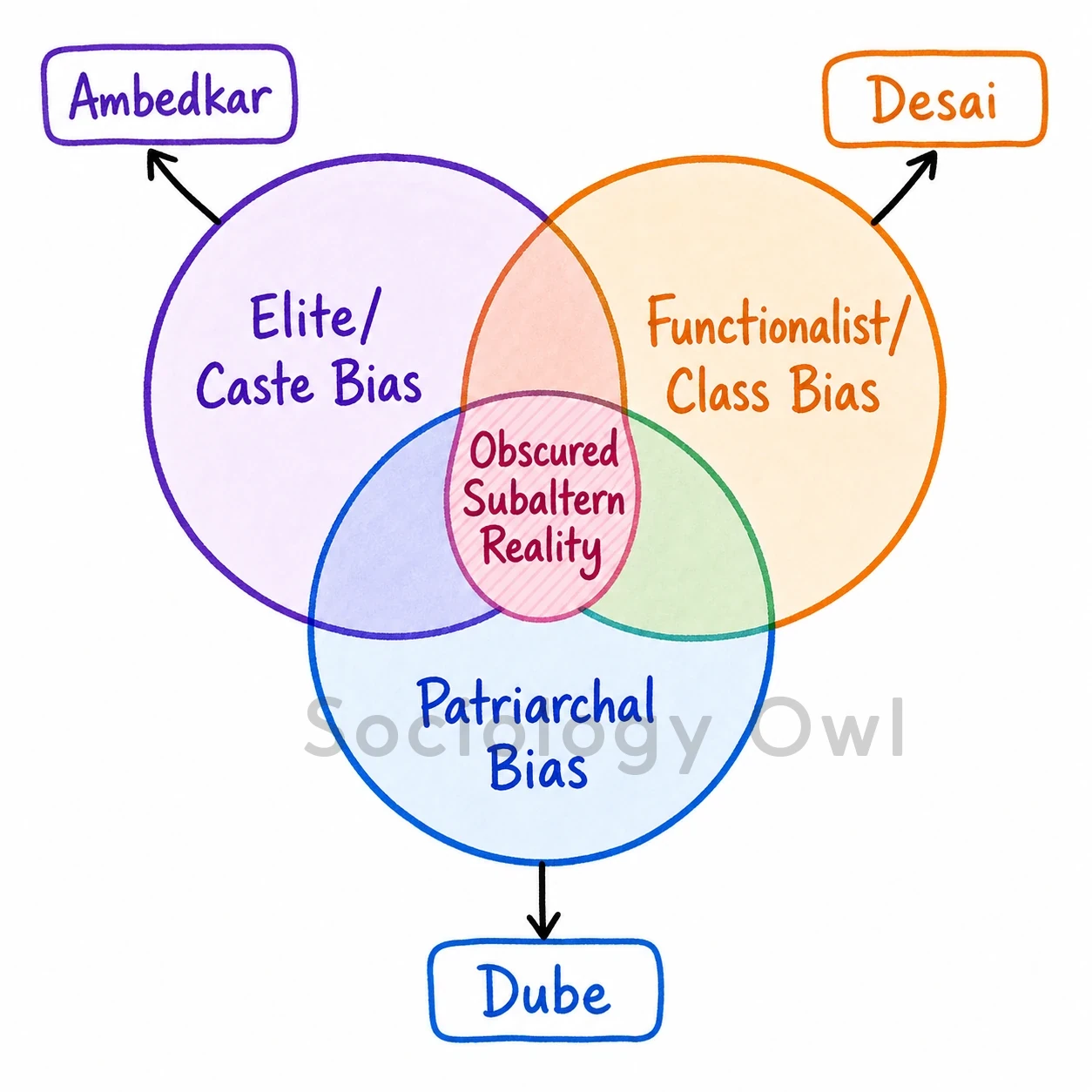
Theoretical Challenges
- Elite Bias: Researchers primarily engaged with the Dominant Caste. B.R. Ambedkar vehemently critiqued this romanticization, terming villages as “dens of ignorance.”
- Functionalist Bias: Over-focusing on ritual harmony ignored capitalist exploitation and agrarian class conflicts, prompting Marxist critiques by A.R. Desai.
- Patriarchal Bias: Early ethnographies completely ignored women’s agrarian labor. Feminist sociologists like Leela Dube highlighted this systemic gender-blindness.
Methodological Challenges
- “Native Sociologist” Dilemma: M.N. Srinivas highlighted the challenge of maintaining scientific objectivity when upper-caste, urban sociologists study their own society.
- Structural Complexity: Generalizing macro-Indian reality from micro-studies, or capturing the complex caste-class nexus (Andre Beteille, Caste, Class, and Power), proved methodologically difficult.
Today, traditional ethnographies struggle against de-agrarianization. Dipankar Gupta conceptualizes the “vanishing village,” while Jan Breman points to the modern reality of migrating “Footloose Labour”.
Conclusion
By overcoming early biases, village studies have dynamically evolved from rigid structural-functionalism into multi-sited ethnographies, remaining indispensable microcosms of a rapidly changing Indian society.