Model Answers

Q: Discuss the changing dimensions of family structure in urban India.

Question asked in UPSC Sociology 2021 Paper 2. Download our app for last 20 year question with model answers.

Model Answer:

Changing Family Structure in Urban India

Family is a universal social institution regulating reproduction, socialization and emotional support. In urban India, rapid urbanisation, industrialisation and globalisation have restructured family forms and internal relations without dissolving the institution itself.

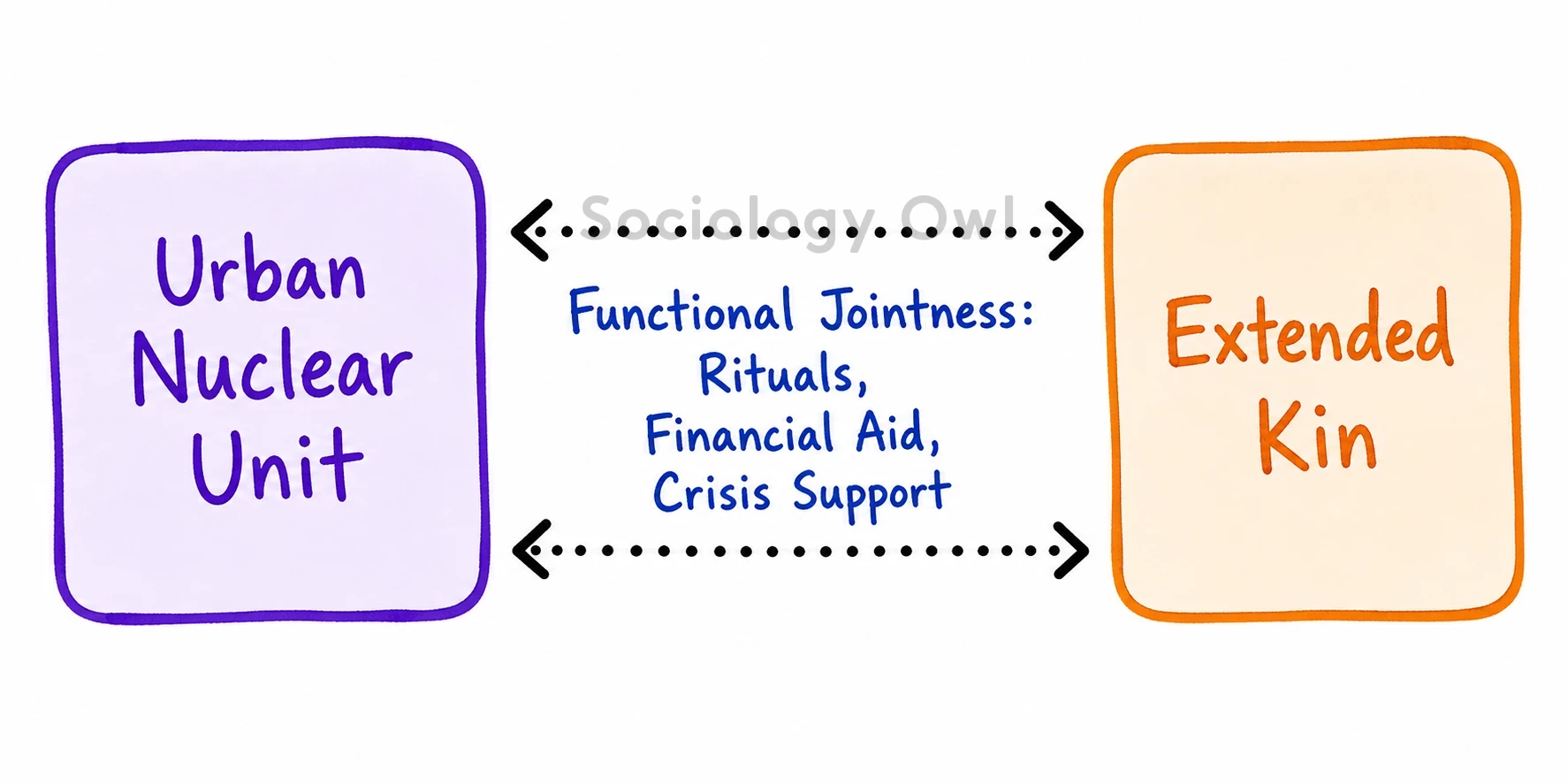
Structurally, there is a clear trend towards nuclear households. Following Parsons and Goode, the small, mobile conjugal unit fits an industrial, occupationally diverse city. Yet, as A.M. Shah’s work on the “household dimension of family” shows, the decline is of joint households, not necessarily of joint families: nuclear households often remain embedded in wider kin networks through economic support, ritual participation and decision-making. Patricia Uberoi therefore argues that the joint–nuclear dichotomy is too simplistic for contemporary India.

Changing dimensions include:

• Size and composition
– Declining fertility, housing constraints and career mobility encourage small, neolocal nuclear families in apartments and gated communities.
– New forms are emerging: single-parent families (post-divorce or widowhood), reconstituted/step families, childless by choice couples, live-in relationships, and, post-Navtej Johar judgment, more visible same-sex partnerships, though still marginal.

• Authority, gender and intimacy
– Traditional patriarchal authority is challenged by women’s education and labour-force participation; dual-earner families are common in the middle class.
– The family increasingly emphasises companionship and negotiation over obedience, aligning with Burgess and Locke’s “from institutional to companionship family,” yet unpaid care work remains heavily feminised (Leela Dube).

• Intergenerational relations and ageing
– Migration produces “left-behind” parents in small towns and solitary elderly in metros, leading to old-age homes and paid eldercare services.
– Simultaneously, parents often fund children’s higher education and housing, reflecting continuing intergenerational dependence.

• Class and space
– Among the urban poor, extended kin often co-reside in slums/chawls for risk-sharing, childcare and informal credit, resembling “functional joint families.”
– For transnational and IT-sector professionals, “commuter marriages” and digital families (Skype/WhatsApp parenting) are increasingly visible.

Despite westernisation and individualisation (M.N. Srinivas, Ulrich Beck), arranged marriage, kin endogamy and ideologies of the joint family persist, indicating adaptive, not collapsing, family structures.

In sum, urban Indian family is neither disintegrating nor static; it is selectively modernising, balancing individual aspirations with enduring kinship obligations and support.

UPSC Factory for Android
Conquer UPSC offline! 🚀 PYQs (Prelims & Mains), Test Series, Syllabus Tracker.
Give it a try, you will love it 💯
Sociology App for Android
🏆 Get everything for UPSC optional prep in one click! Top resources, 20 years mains answers, syllabus tracker. Install now! 🚀
Sociology App for Android
📚 20 years model answers, syllabus tracker, NCERT, IGNOU books, topper notes/sheets, strategies, past papers. Offline study !!💪
Sociology Optional App for Android
Get Model Answers of Last 20 Years, Syllabus Tracker, NCERT Books, IGNOU Books, Topper Notes, Answer Sheet, Strategy, Past Paper for Offline Study. Click to Download !!