Model Answer:
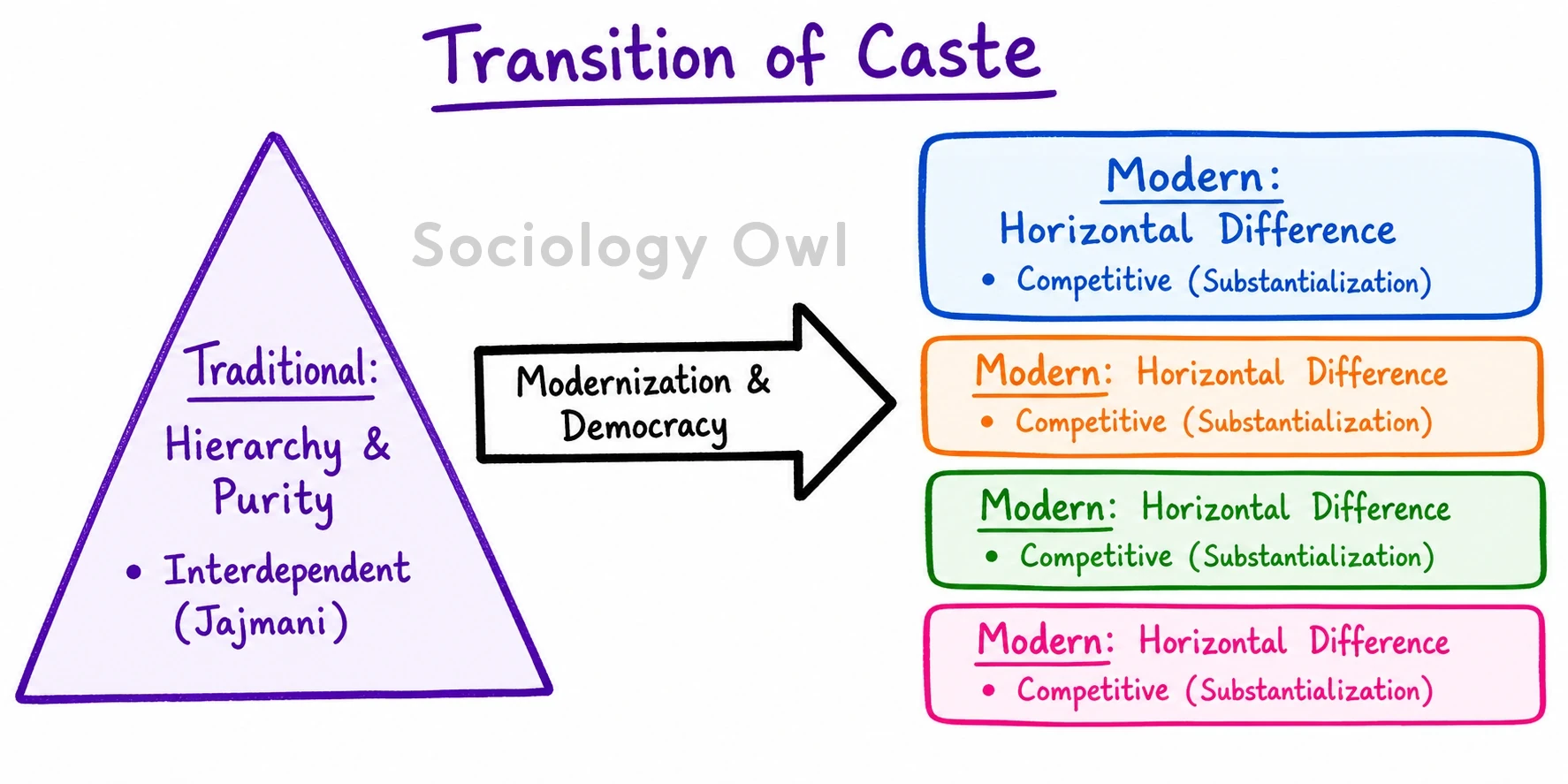
Traditional Indian caste, analyzed by Louis Dumont in Homo Hierarchicus as a system rooted in the ideology of purity and pollution, is transforming. It is shifting from a closed, ritualistic, and interdependent hierarchy to an open, secular, and competitive framework.
Structural and Political Transformations
- From Hierarchy to Difference: Dipankar Gupta argues that the traditional vertical hierarchy is being replaced by horizontal differences, where castes compete as independent identities for state resources.
- Divergence of Inequalities: Andre Beteille’s study of Sripuram highlights that the historical overlap of caste, class, and power has disaggregated, breaking traditional occupational barriers.
- Politicization of Caste: Rajni Kothari notes that caste is not disappearing but rather getting politicized through caste associations. Christophe Jaffrelot terms the resulting political assertion of lower castes the “Silent Revolution.”
- Substantialization of Caste: Popularized by C.J. Fuller, this concept highlights caste transforming into a discrete ethnic block competing for modern avenues like education and employment.
- Social Mobility: M.N. Srinivas demonstrated upward mobility through Sanskritization and the rise of the Dominant Caste due to land reforms and electoral democracy.
Debates on Continuity and Critique
- Marxist Perspective: A.R. Desai argues that structural changes are superficial; caste acts as a proxy for class, adapting to serve capitalist interests.
- Subaltern Perspective: Gail Omvedt highlights the persistence of structural violence and systemic inequality against Dalits despite legal abolitions.
- Secularization of Caste: While ritual purity and the traditional Jajmani system decline, rigid caste endogamy persists, strengthening distinct caste identities.
Sukhadeo Thorat’s empirical studies reveal severe caste discrimination against Dalits in the urban private-sector labor market. Furthermore, agrarian distress has mobilized dominant peasant groups (like Marathas and Jats) to demand backward status, illustrating caste’s modern utility as an economic pressure group.
Conclusion
As M.N. Srinivas observed, caste is a “hydra-headed monster” that continually reinvents itself. While its traditional ritual dimensions and interdependence are weakening, its political and social identities remain highly resilient, dynamically synthesizing tradition with modernity as powerful interest groups.