Model Answer:
G.S. Ghurye’s Indological Approach
G.S. Ghurye’s Indological approach relies on historical antiquity and classical Sanskrit literature to study Indian society, representing a “Book-View”. Influenced by the Diffusionist approach of W.H.R. Rivers, Ghurye utilized ancient texts to trace the civilizational continuity and evolution of Indian social institutions.
Application of Indology
Ghurye argued that Indian society’s underlying unity stems from Brahminical traditions.
- Caste System: In Caste and Race in India (1932), he utilized classical texts to outline the six structural characteristics of caste, tracing its Indo-Aryan origins and principles like gotra exogamy.
- Civilizational Unity: In Indian Sadhus, he analyzed textual depictions of asceticism as a unifying, pan-Indian civilizational force connecting diverse regions.
Sociological Critiques of the Indological Approach
- Structural-Functionalist Critique: M.N. Srinivas rejected Ghurye’s static “Book-View”, advocating for an empirical “Field-View”. Fieldwork revealed fluid hierarchies, demonstrated by dynamic realities like Sanskritization and the Dominant Caste.
- Marxist Critique: A.R. Desai argued that Indology romanticizes the past, masking the underlying economic substructure, material realities, and class conflicts prevalent in ancient India.
- Subaltern and Feminist Critiques: Scholars like B.R. Ambedkar and Uma Chakravarti noted that classical Shastras represent a hegemonic, patriarchal worldview that justifies the systemic exploitation of Dalits and women.
- Hindu Nationalist Bias: Contemporary sociologists like Sujata Patel criticized Ghurye for equating “Indian culture” almost exclusively with “Hindu culture,” marginalizing minority contributions, a bias evident in Social Tensions in India.
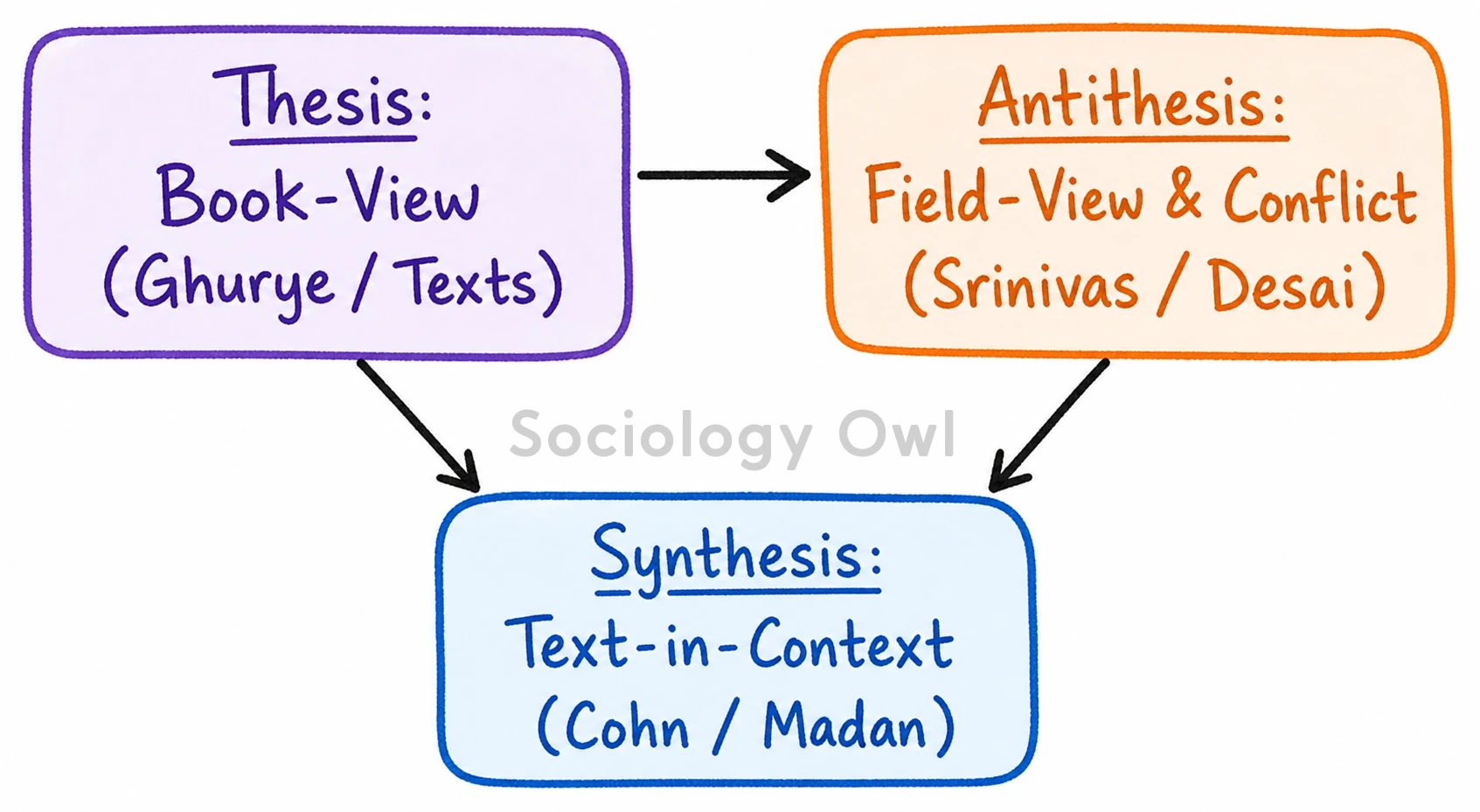
While pure Indology is largely outdated, sociologists like Bernard Cohn and T.N. Madan successfully synthesized textual knowledge with empirical fieldwork. Today, textual analysis remains vital for contextualizing the cultural roots of modern debates, such as the Uniform Civil Code and the resurgence of Ayurvedic practices.
Despite its methodological flaws, G.S. Ghurye is rightly regarded as the “Institutional Father of Indian Sociology.” His Indological approach established a distinctly indigenous sociological tradition, successfully breaking away from Western, Eurocentric models of society.