Model Answer:
Changing Nature of Kinship Relations
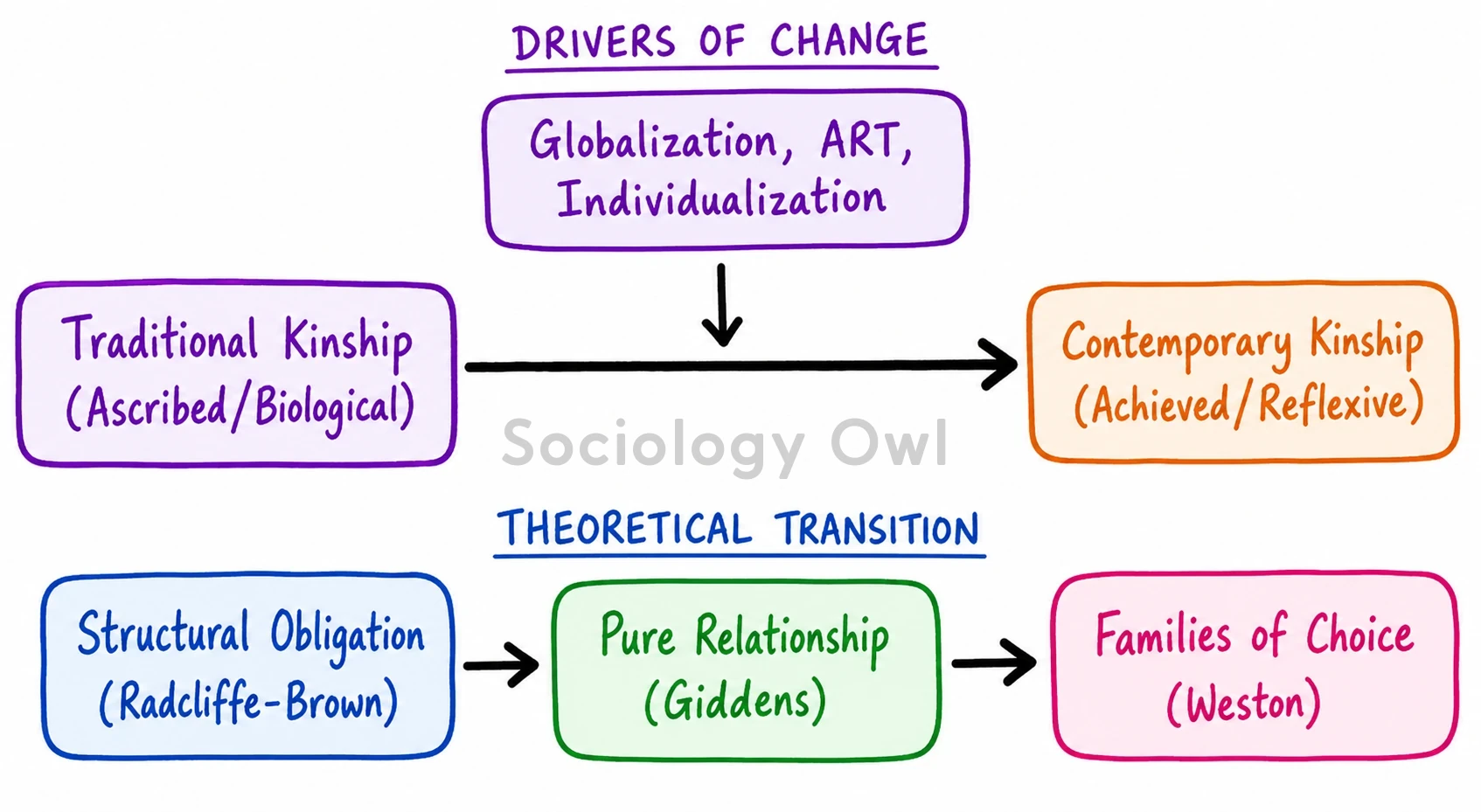
Robin Fox defines kinship as the study of what man does with the basic facts of life like mating and gestation. Traditionally viewed by A.R. Radcliffe-Brown as an ascribed system of social relations based on descent, contemporary kinship has shifted from structurally binding institutions to achieved, affective, and negotiated relationships.
Structural and Late-Modern Transformations
- Functionalist Shift: Talcott Parsons noted that industrialization necessitated the “Isolated Nuclear Family” for geographic mobility, a trend supported by William J. Goode’s thesis on global family patterns.
- Late-Modern Reflexivity: Anthony Giddens argues kinship is increasingly defined by the “Pure Relationship,” maintained for mutual satisfaction rather than structural obligation. Ulrich Beck highlights this transition from traditional fate to individual choice amidst modern individualization.
Pluralization, Technology, and Kinship Resilience
- Families of Choice: Kath Weston (Families We Choose) illustrates how LGBTQ+ communities forge kinship based on solidarity and care rather than strict biological ties.
- Fictive Kinship: Carol Stack demonstrated how the urban poor rely on non-relatives for survival, proving kinship adapts to economic constraints.
- Impact of ART: Marilyn Strathern argues that Artificial Reproductive Technologies (IVF, surrogacy) fracture traditional descent by separating biological, gestational, and social parenthood.
- Modified Extended Family: Challenging the narrative of kinship decline, Eugene Litwak posits that modern communication allows geographically dispersed kin to maintain strong, active networks of financial and emotional support.
Globalization has birthed “Transnational Care Chains” (Arlie Hochschild), where migrant women from the Global South care for families in the North while remitting resources to their own kin, fundamentally altering spatial kinship dynamics. Furthermore, transnational surrogacy commercializes sacred lineage ties into legal contracts.
Conclusion
Kinship has not disappeared; it has dynamically evolved. Moving from rigid structures dictated by blood and lineage, it remains a highly adaptable, resilient social institution, manifesting today as fluid, reflexive networks of choice, care, and technology.