Historical Context and Emergence
Emile Durkheim (1858–1917) wrote during a period of immense social upheaval in Europe, characterized by the aftermath of the French Revolution and the rapid onset of the Industrial Revolution. During this time, traditional moral authorities (like the Church) were eroding, leading to social instability. Durkheim’s methodological project, deeply influenced by Auguste Comte’s Positivism, aimed to establish sociology as a distinct, rigorous, and objective scientific discipline, entirely separate from psychology and philosophy. He sought to discover the laws of social order to cure the “pathologies” of modern industrial society.
Core Methodological Postulates
1. The Subject Matter: Social Facts
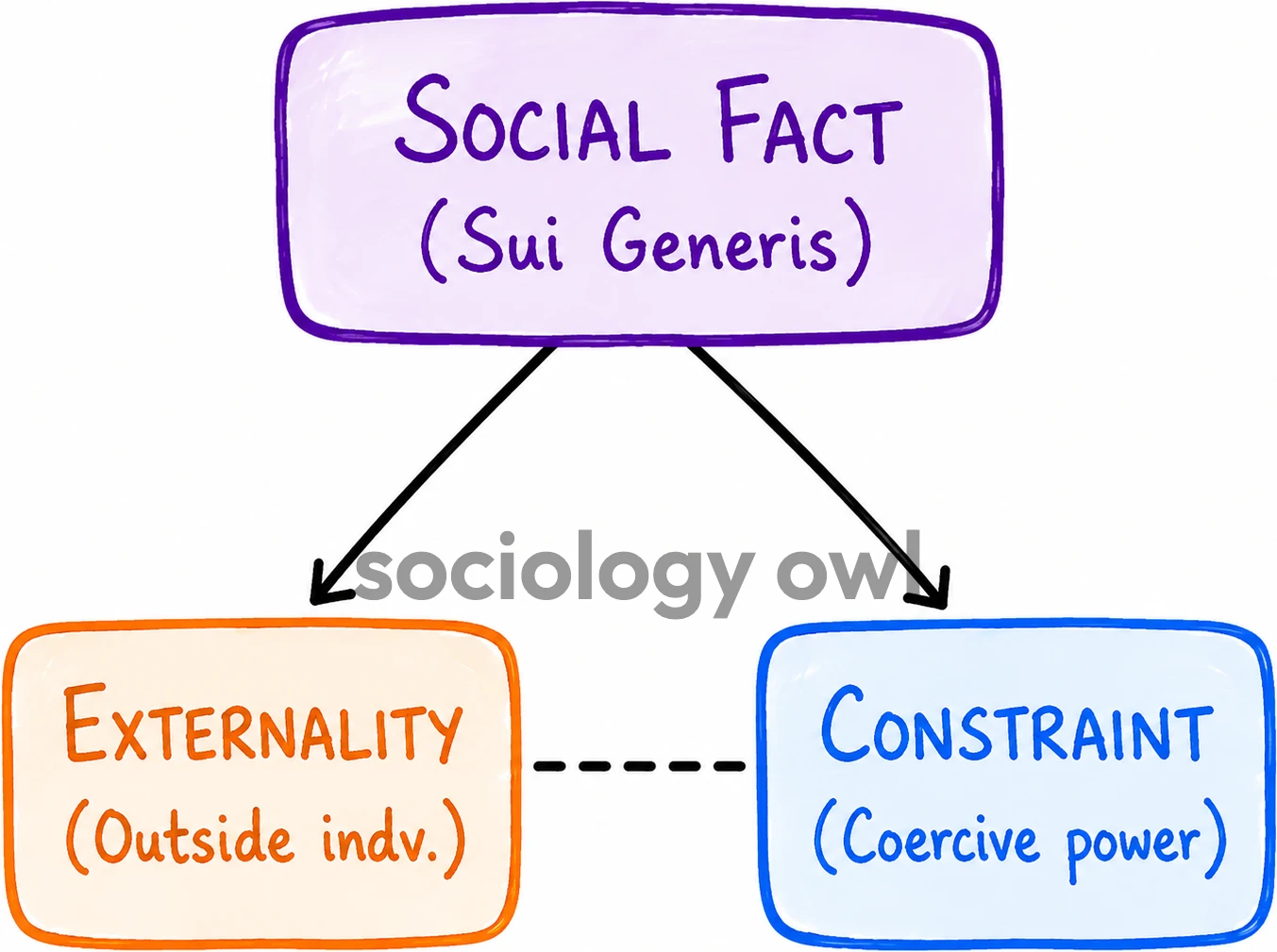
In his seminal methodological work, “The Rules of Sociological Method” (1895), Durkheim established that the true subject matter of sociology is the Social Fact. He rejected individualistic, biological, or psychological explanations (such as alcoholism or madness) for social phenomena.
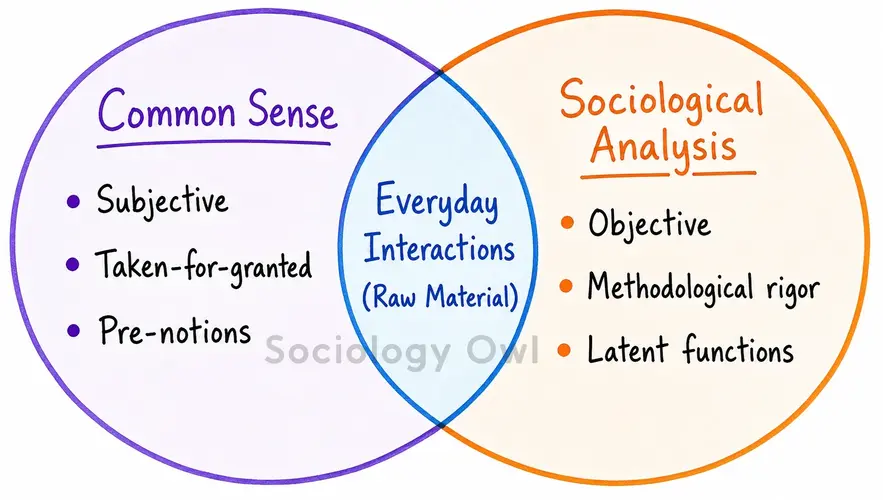
- Observation as “Things”: Durkheim argued that social facts must be treated as “things” (objective realities) that can be studied empirically, free from the researcher’s biases and preconceptions.
- Externality: Social facts exist outside the individual conscience. They are born out of collective existence (e.g., language, laws, customs).
- Constraint: Social facts exert a coercive power over individuals, shaping their behavior. For instance, in a democracy, the civic duty to vote or follow the law compels individuals to act in specific ways, backed by social sanctions.
2. The Individual and Society: Society as Sui Generis
Durkheim posited that society is Sui Generis (a reality unique unto itself). It is a self-generating entity that precedes the individual and outlives them. The whole is greater than the sum of its parts.
- Regulation of Desires: Unlike animals, human desires are insatiable. Society acts as a necessary regulatory mechanism (a moral authority) that limits these passions.
- Anomie: In his works “The Division of Labour in Society” (1893) and “Suicide” (1897), Durkheim introduced the concept of Anomie (normlessness). This occurs during rapid economic or social transitions when collective norms break down, leaving individuals without moral guidance, often leading to social disorder or Anomic Suicide.
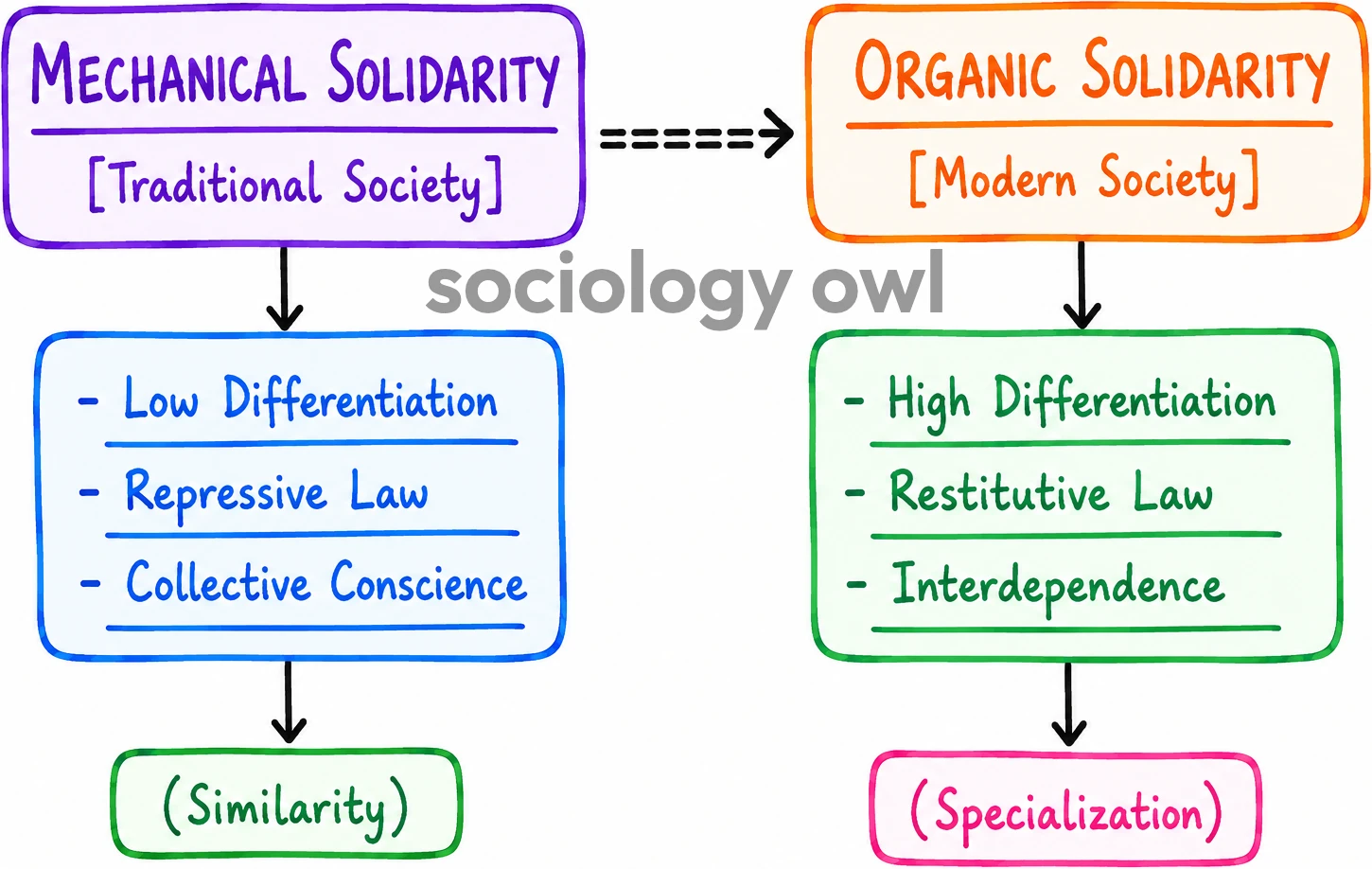
- Evolution of Solidarity: Durkheim traced the shift from Mechanical Solidarity (based on similarity, collective conscience, and repressive law in traditional societies) to Organic Solidarity (based on interdependence, high division of labor, and restitutive law in modern societies). He believed organic solidarity harmonized individualism with social cohesion.
3. Functional Analysis of Society
Drawing an analogy from biology, Durkheim viewed society as a living organism. His Structural-Functionalism required sociologists to not only find the historical cause of a social fact but also its contemporary function in maintaining social order.
- In “Elementary Forms of Religious Life” (1912), he demonstrated that the function of religious rituals is not merely spiritual, but sociological: they reaffirm social bonds and collective effervescence.
- He distinguished between Normal social facts (which contribute to social integration) and Pathological social facts (which disrupt social order, like high crime rates or sudden economic crises).
Application to the Indian Context (UPSC Paper II Linkage)
Durkheim’s methodological focus on social integration, collective conscience, and functionalism provides a profound framework for analyzing Indian society:
- M.N. Srinivas and Structural-Functionalism: Indian sociologist M.N. Srinivas heavily utilized Durkheimian and Radcliffe-Brownian functionalism. In his book “Religion and Society Among the Coorgs of South India”, Srinivas showed how local rituals and the concept of purity/pollution functioned to maintain caste solidarity, directly mirroring Durkheim’s study of religion.
- Agrarian Crisis and Anomic Suicide: Durkheim’s concept of Anomic Suicide is highly relevant in understanding farmer suicides in contemporary India. The breakdown of traditional village safety nets (the Jajmani system) combined with exposure to volatile global market forces creates a state of normlessness and extreme distress for marginalized farmers.
- Caste and Division of Labour: S.C. Dube in “Indian Village” highlighted the functional interdependence of castes. While traditional India exhibited elements of Mechanical Solidarity through rigid caste endogamy, the interdependence of occupational castes (Jajmani) also showed early forms of Organic Solidarity.
- G.S. Ghurye and Integration: G.S. Ghurye’s Indological focus on shared religious texts and cultural unity across the Indian subcontinent echoes Durkheim’s emphasis on a strong Collective Conscience binding a diverse society together.
Comparative Analysis: Methodological Perspectives
To fully grasp Durkheim’s methodology, it must be juxtaposed with the other founding fathers of sociology:
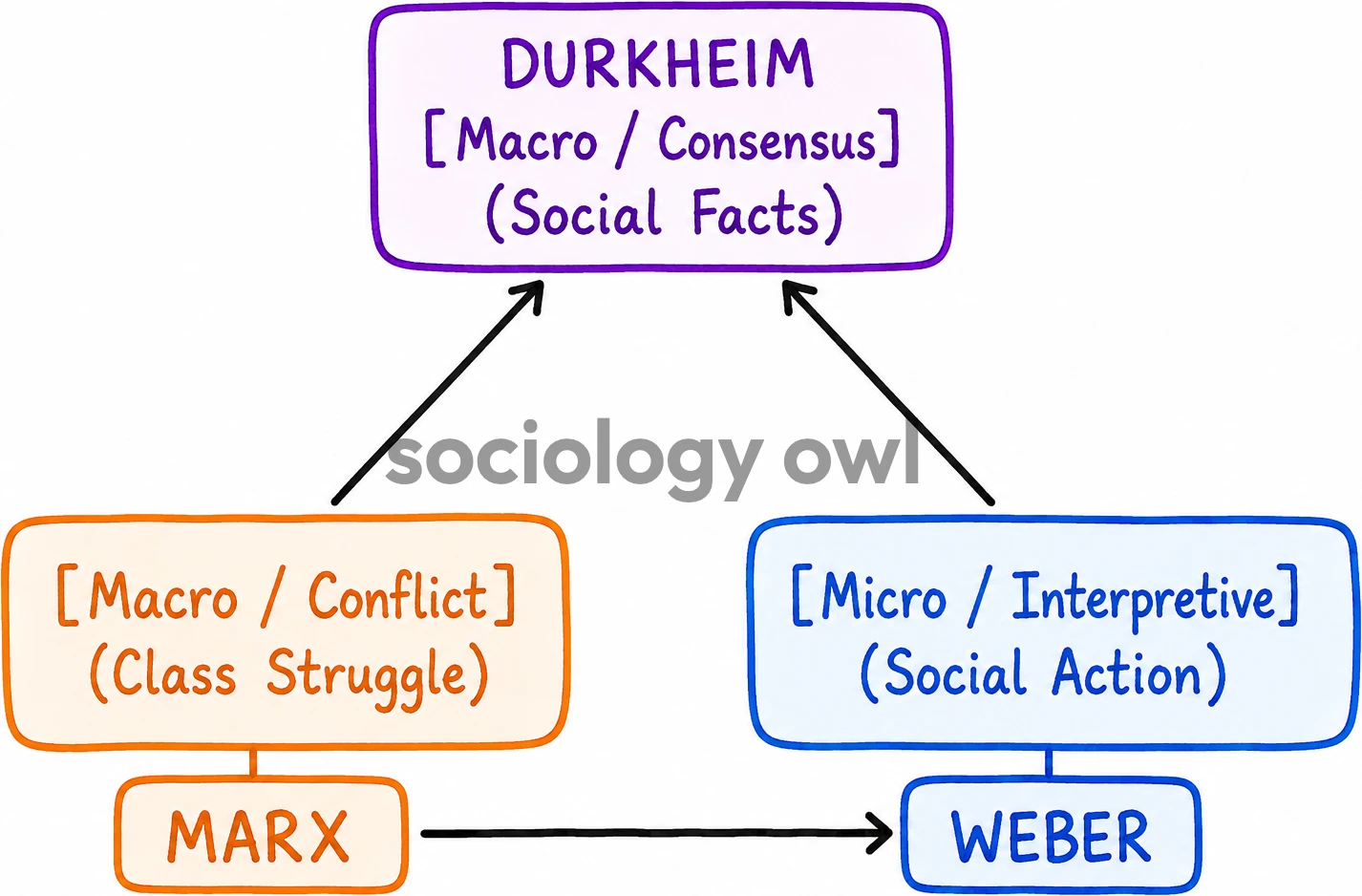
| Parameter | Emile Durkheim (Functionalism) | Karl Marx (Conflict Theory) | Max Weber (Interpretive Sociology) |
|---|---|---|---|
| Primary Focus | Social Order, Harmony, and Consensus. | Class Struggle, Inequality, and Conflict. | Individual Social Action and Meanings. |
| View on Conflict | Views conflict as Pathological or abnormal; a symptom of social sickness. | Views conflict as the engine of history and a catalyst for necessary social change. | Views conflict as arising from disparities in Class, Status, and Party. |
| Subject Matter | Macro-level Social Facts (Structural Realism). | Macro-level Economic Structures (Historical Materialism). | Micro-level Social Action (Methodological Individualism). |
| Methodology | Positivism / Quantitative / External Observation. | Dialectical Materialism. | Verstehen (Empathetic understanding) / Qualitative. |
Contemporary Relevance
In the 21st century, Durkheim’s methodology remains highly applicable to the globalized world:
- Social Media and Collective Conscience: Platforms like Twitter and Instagram generate new forms of “collective effervescence” (e.g., global social movements like #MeToo or environmental protests).
- Modern Anomie: The gig economy, remote work, and rapid technological disruption (Artificial Intelligence) are breaking down traditional workplace solidarity. This hyper-individualism often leads to a modern sense of isolation, anxiety, and Anomie.
- Global Pandemics: The COVID-19 pandemic perfectly illustrated Durkheim’s organic solidarity. When one part of the global social organism failed (public health), it immediately disrupted interconnected institutions (economy, education, travel), proving the intricate interdependence of modern society.
Conclusion
Emile Durkheim successfully laid the methodological bedrock for sociology by defining its unique subject matter and championing empirical, objective analysis. By focusing on the structural forces that bind individuals together, he provided an enduring lens to study human association. As Durkheim himself famously stated, “Society is not a mere sum of individuals. Rather, the system formed by their association represents a specific reality which has its own characteristics.” His transition of sociology from a speculative philosophy to a rigorous science, as noted by thinker Raymond Aron, secures his legacy as the true architect of modern sociological methodology.