Model Answer:
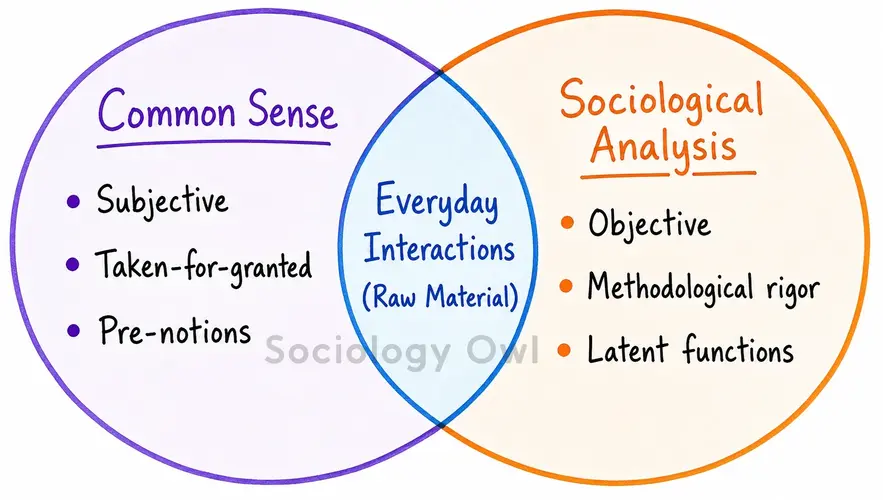
While Positivism (Emile Durkheim) treats society as a set of measurable “social facts,” Phenomenology and Ethnomethodology emerged as radical micro-sociological critiques, arguing that social reality is an inherently subjective construct.
Critiques of Positivism
Phenomenological Critique:
- Subjective Meaning: Alfred Schutz argued that individuals construct reality using shared “typifications” (mental categories) and “intersubjectivity.”
- Rejection of Objectivity: Positivism fails by ignoring the subjective “lifeworld,” falsely reducing human consciousness to mere quantifiable variables rather than understanding meanings.
Ethnomethodological Critique:
- Order as an Accomplishment: Harold Garfinkel challenged positivism’s search for external, universal laws. Using “breaching experiments,” he proved social order is an ongoing, everyday accomplishment.
- Contextual Reality: Concepts like “indexicality” (meaning depends on context) and “reflexivity” render positivist attempts at creating generalized, objective social laws impossible.
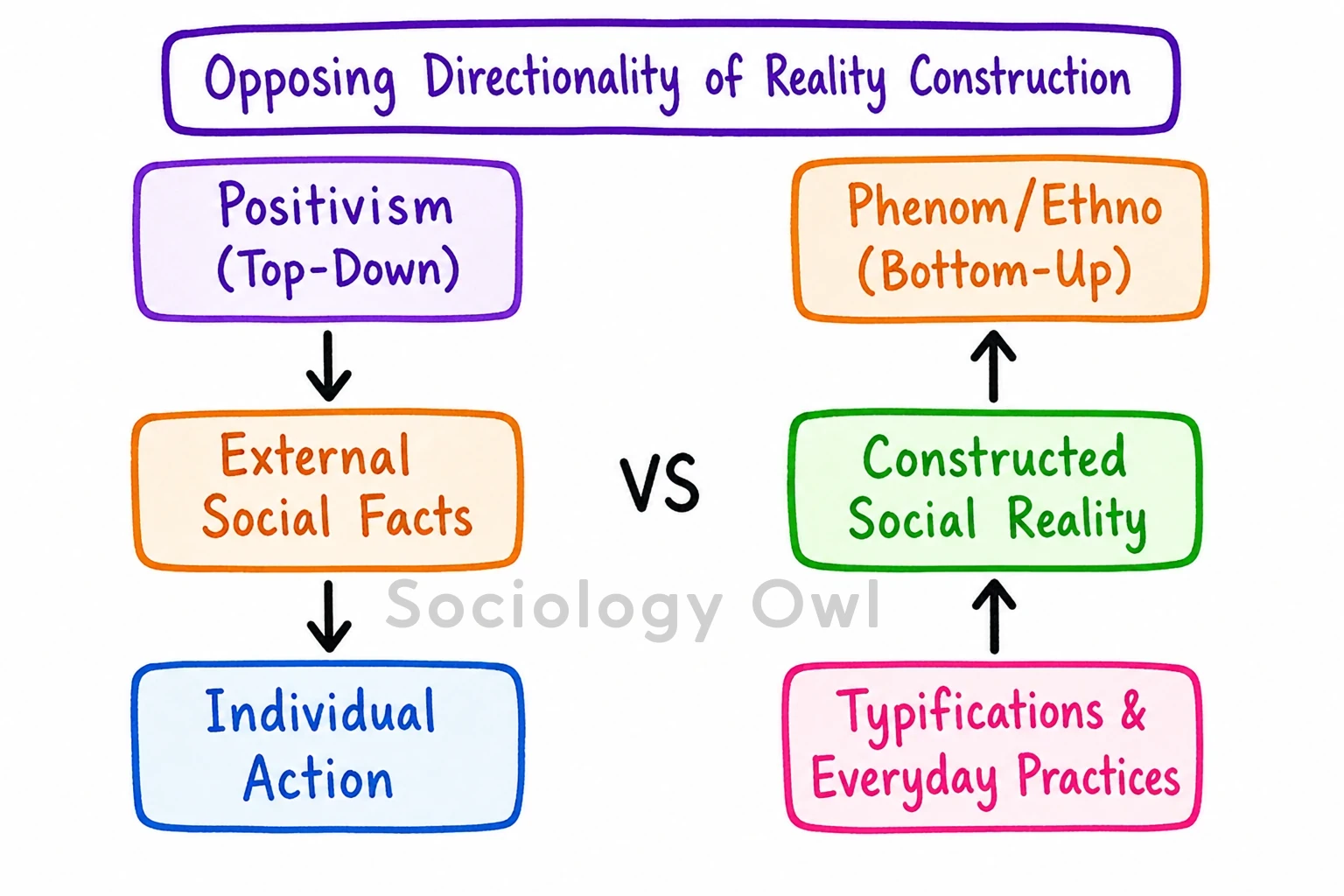
- Application: Aaron Cicourel’s study on juvenile justice demonstrates that positivist crime statistics are not objective facts, but subjective constructs resulting from police typifications.
- Counter-Critique: Marxists and Structuralists argue these micro-perspectives overcompensate, ignoring macro-objective realities like class inequality and institutional power dynamics.
Conclusion
While these perspectives successfully expose the limits of pure positivism, modern sociology demands a synthesis. Anthony Giddens’ Structuration Theory achieves this by effectively reconciling objective macro-structures with subjective micro-agency.