Model Answer:
Research design is a sociological study’s blueprint, reflecting the epistemological divide between Interpretivism and Positivism.
Comparative Analysis of Research Designs
- Objective: Exploratory design generates new hypotheses regarding undefined phenomena via an Inductive approach. Explanatory design tests existing theories to establish cause-and-effect relationships via a Deductive approach.
- Epistemology: Exploratory aligns with Interpretivism and micro-sociology, seeking Verstehen (empathic understanding). Explanatory relies on Positivism and macro-sociology to discover objective universal laws.
- Methodology: Exploratory uses unstructured qualitative methods (e.g., ethnography); Explanatory uses structured quantitative tools (e.g., statistical surveys).
- Sociological Examples: William Foote Whyte’s Street Corner Society explored hidden slum structures using participant observation. Conversely, Emile Durkheim’s Suicide used explanatory concomitant variation to causally link social integration and suicide.
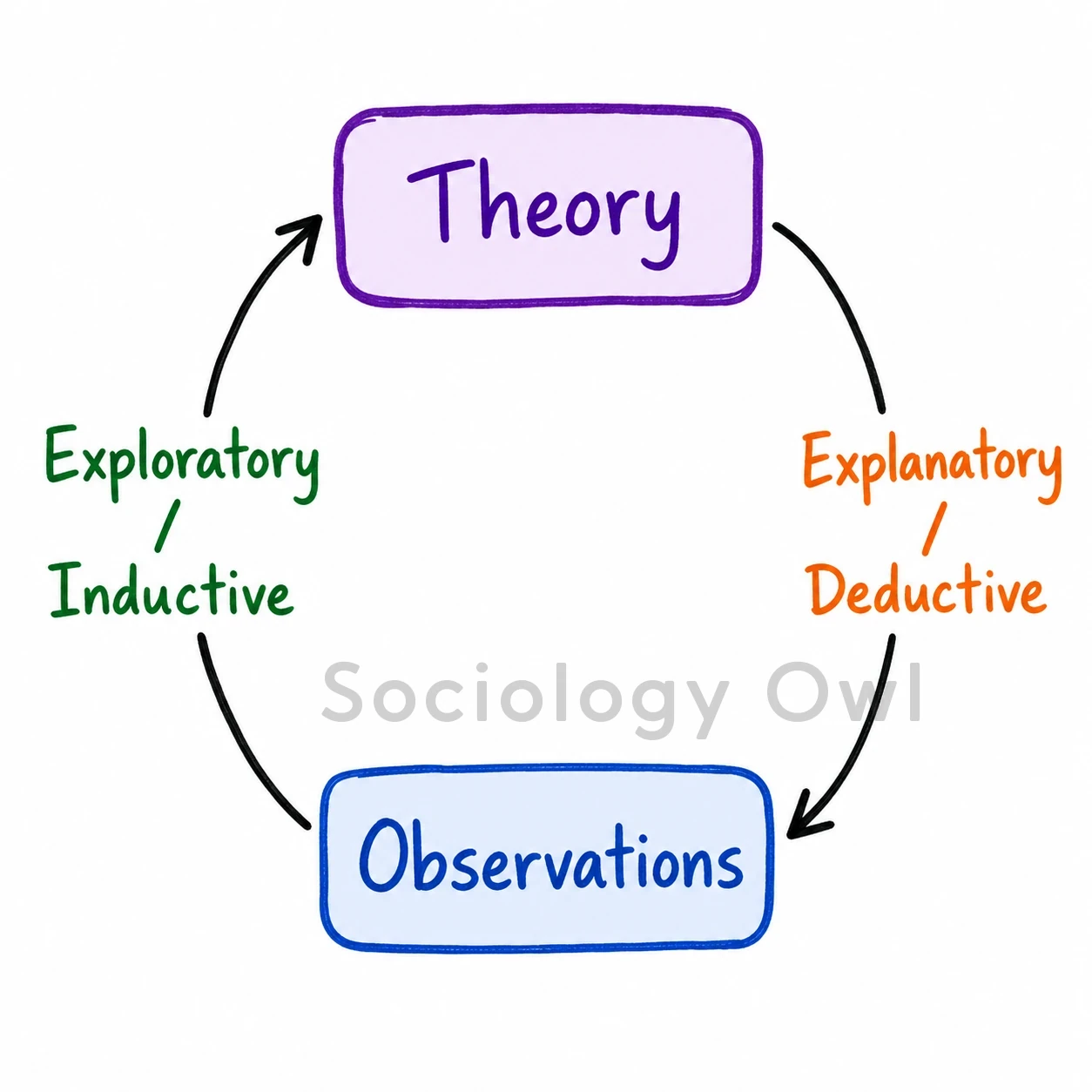
Studying artificial intelligence’s impact on gig workers requires exploratory interviews to grasp new subjective nuances, followed by explanatory surveys to map structural employment trends.
Conclusion
Modern sociology rejects strict methodological binaries. By embracing Methodological Pluralism and Triangulation (Norman Denzin), researchers successfully combine exploratory depth with explanatory breadth to achieve holistic insights.