Model Answer:
Durkheim’s Suicide Theory and Arguments
In Le Suicide (1897), Emile Durkheim sought to establish sociology as a positivist science by proving that a highly individualistic act is caused by “Social Facts” (suicidogenic currents). He defined suicide sociologically as death resulting from a direct or indirect act of the victim, knowing the outcome. Using “Concomitant Variation” on European data, he demonstrated the supremacy of society over the individual.
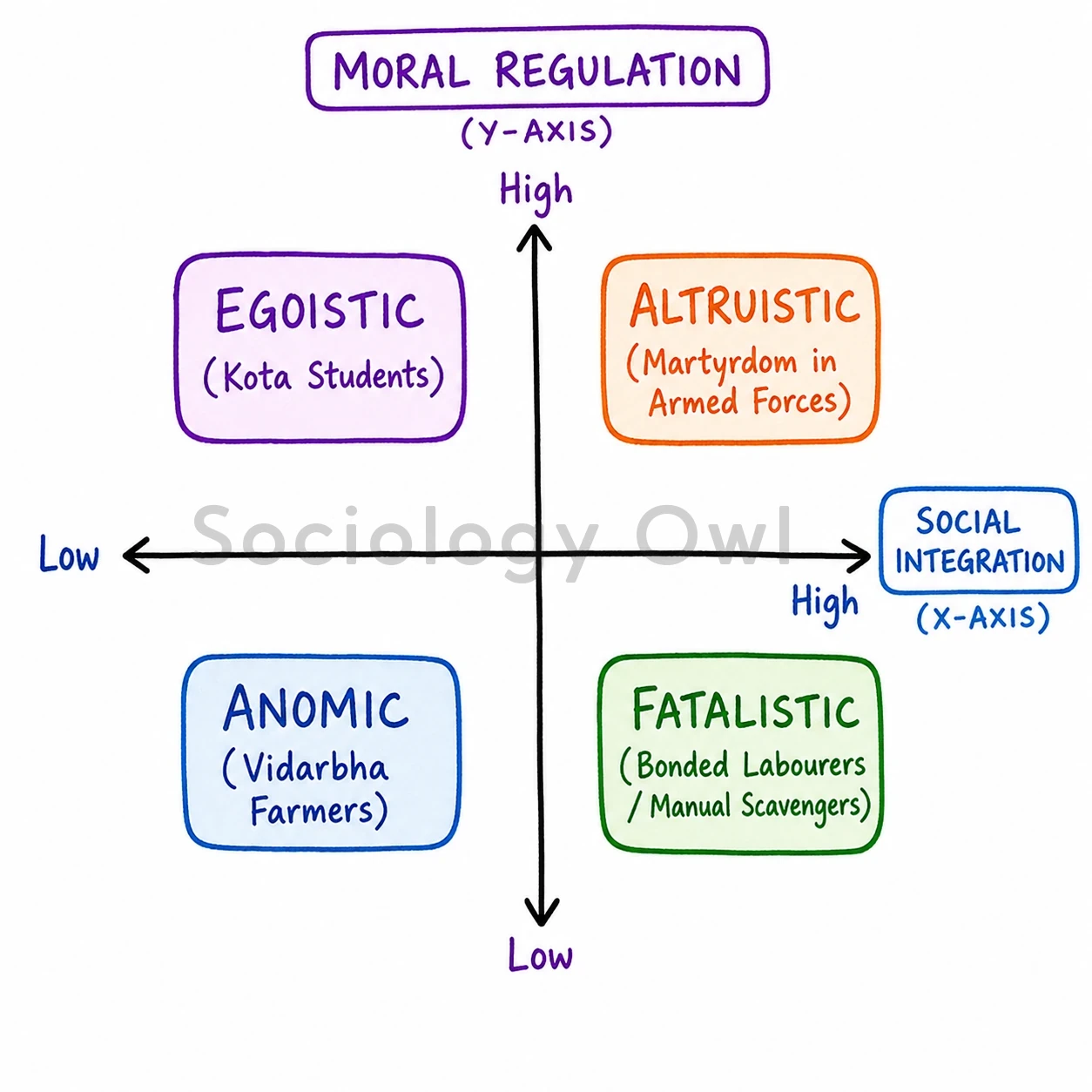
Durkheim argued suicide rates depend on two macro-sociological forces:
Social Integration
Egoistic: Low integration (detachment, isolation).
Altruistic: High integration (over-identification with group norms).
Moral Regulation
Anomic: Low regulation (normlessness, sudden economic shocks).
Fatalistic: High regulation (oppressive discipline, hopelessness).
Analyzing Contemporary Indian Society
Durkheim’s framework powerfully decodes India’s high suicide rates, reflecting NCRB data trends:
Egoistic Suicide
Hyper-individualism and the breakdown of traditional family support lead to extreme isolation, visible in the tragic Kota student suicides.
Altruistic Suicide
Over-integration into rigid family or sectarian beliefs, tragically exemplified by the Burari mass suicide or fasts-unto-death by political zealots.
Anomic Suicide
Globalization and market-driven agriculture create sudden economic shocks and normlessness, driving Farmer Suicides in regions like Vidarbha.
Fatalistic Suicide
Inescapable structural oppression, such as caste-based marginalization (e.g., the Rohith Vemula case) or women trapped in patriarchal domestic abuse.
Critics reject Durkheim’s macro-positivism. Phenomenologist J.D. Douglas argues official statistics are mere social constructions by coroners, while Ethnomethodologist J.M. Atkinson emphasizes the subjective “meaning” of the act. Globally, Indian youth suicides mirror suicidogenic currents in hyper-competitive societies like South Korea or Japan (Hikikomori).
Conclusion
While modern psychiatry favors a biopsychosocial model, Durkheim’s structural perspective remains indispensable. As India navigates the turbulent transition from mechanical to organic solidarity, viewing suicide through the lens of integration and regulation is vital for formulating systemic public policies, rather than merely treating it as individual psychiatric failure.