Model Answer:
AGIL Model of Talcott Parsons
In The Social System, Talcott Parsons designed the AGIL framework to explain how societies maintain a “Moving Equilibrium”. To analyze key societal problems, this lens must shift to diagnose systemic strains, institutional maladjustments, and failures in Social Control Mechanisms.
Diagnosing Societal Crises via AGIL Deficits
Parsons argued that problems emerge when interdependent subsystems fail their functional prerequisites:
- Adaptation (A – Economy): Deficits in resource mobilization cause unemployment and inflation. Robert Merton applied his concept of Dysfunctions here, showing how economic growth latently produces extreme inequality.
- Goal Attainment (G – Polity): Governance deficits, corruption, and policy paralysis reflect a systemic inability to prioritize and execute collective goals.
- Integration (I – Law/Community): The breakdown of Value Consensus breeds polarization and violence. This directly mirrors Emile Durkheim’s concept of Anomie, where rapid change dissolves normative regulation.
- Latency (L – Family/Education): Failures in Socialization erode civic values. Jørgen Habermas’s “Legitimation Crisis” and Louis Althusser’s Ideological State Apparatus illustrate how institutional commodification destroys normative commitments.
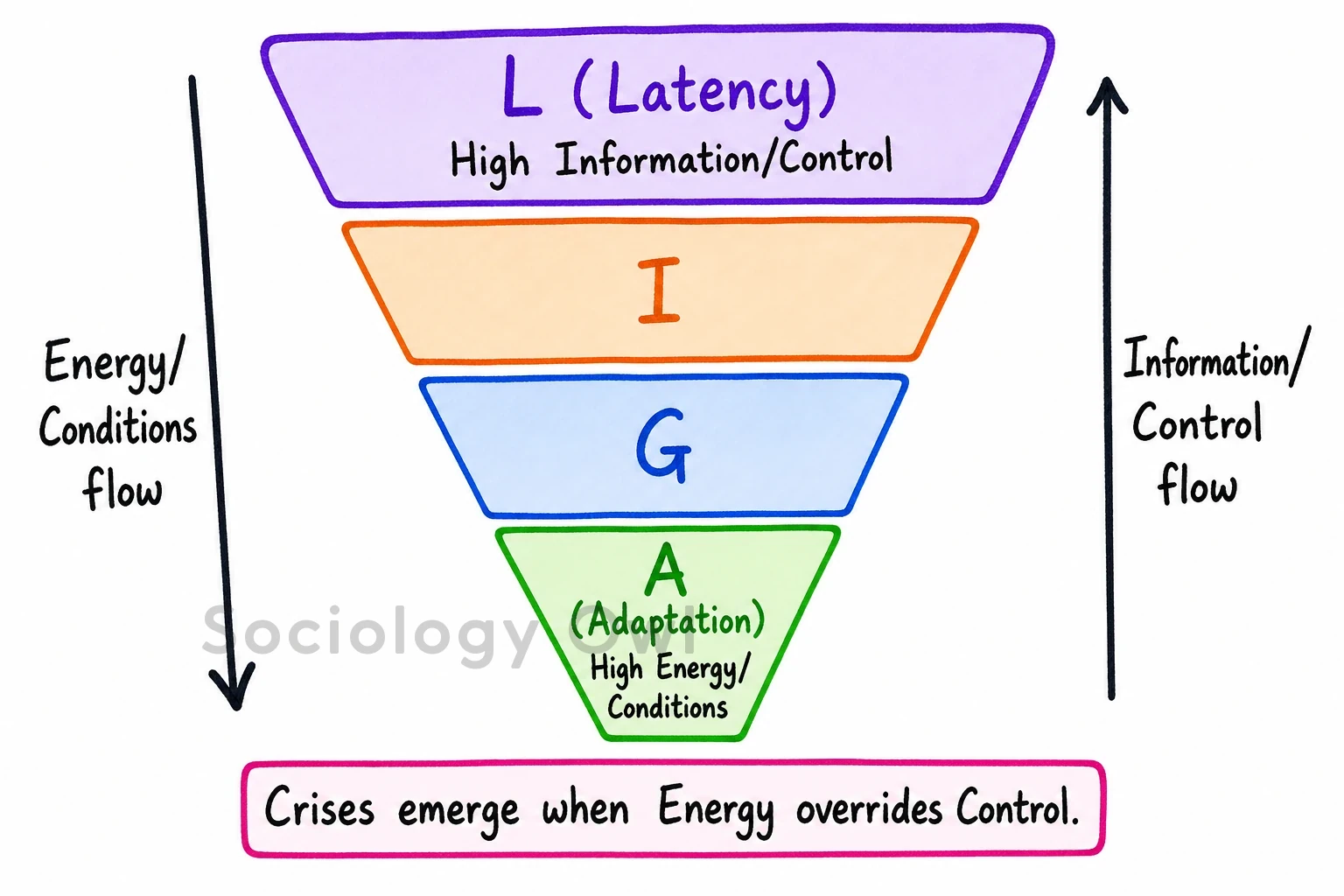
Furthermore, Parsons’ Cybernetic Hierarchy of Control explains that crises occur when high-energy subsystems (Adaptation/Economy) overwhelm high-information subsystems (Latency/Culture), leading to issues like hyper-consumerism overriding ethical values.
Critique of the Parsonian Approach
- C. Wright Mills criticized AGIL as overly abstract “Grand Theory”, unable to capture visceral realities like poverty.
- Ralf Dahrendorf argued its consensus-bias blinds it to how problems often stem from the coercive power of the state over the masses.
The COVID-19 pandemic highlights AGIL’s systemic interdependence. An Adaptive (A) shock (economic collapse) forced strict Goal Attainment (G) responses (state lockdowns), which triggered Integrative (I) crises (migrant distress and social isolation) and ultimately strained Latency (L) (mental health and education disruptions).
Conclusion
While conflict theorists expose its blind spots regarding power and coercion, Neo-Functionalists like Jeffrey Alexander have revived AGIL. It remains a highly sophisticated diagnostic grid, proving that mapping structural interdependencies is crucial for policymakers tackling multidimensional global crises.