1. Historical and Theoretical Context
The sociological analysis of power and authority was fundamentally shaped by Max Weber in his magnum opus, Economy and Society (1922). Emerging during the rapid industrialization and bureaucratization of late 19th-century Europe, Weber sought to understand the changing nature of human domination. Unlike Karl Marx, who viewed power as a unidimensional concept rooted exclusively in the ownership of the means of production (economic determinism), Weber proposed a pluralistic model. He argued that power operates across multiple dimensions—Class (economic), Status (social), and Party (political)—and is a pervasive feature of all social relationships.
2. The Concept of Power (Macht)
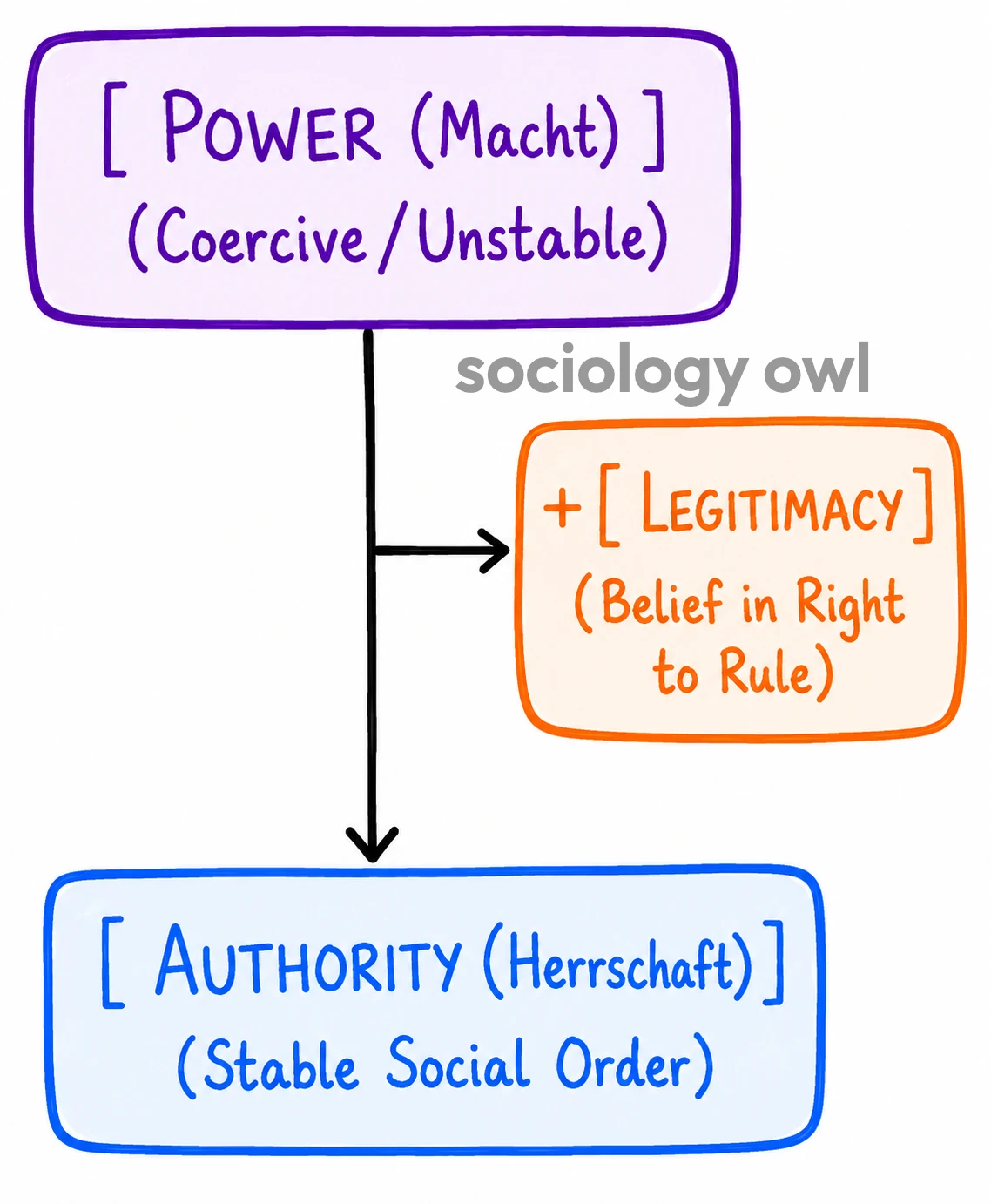
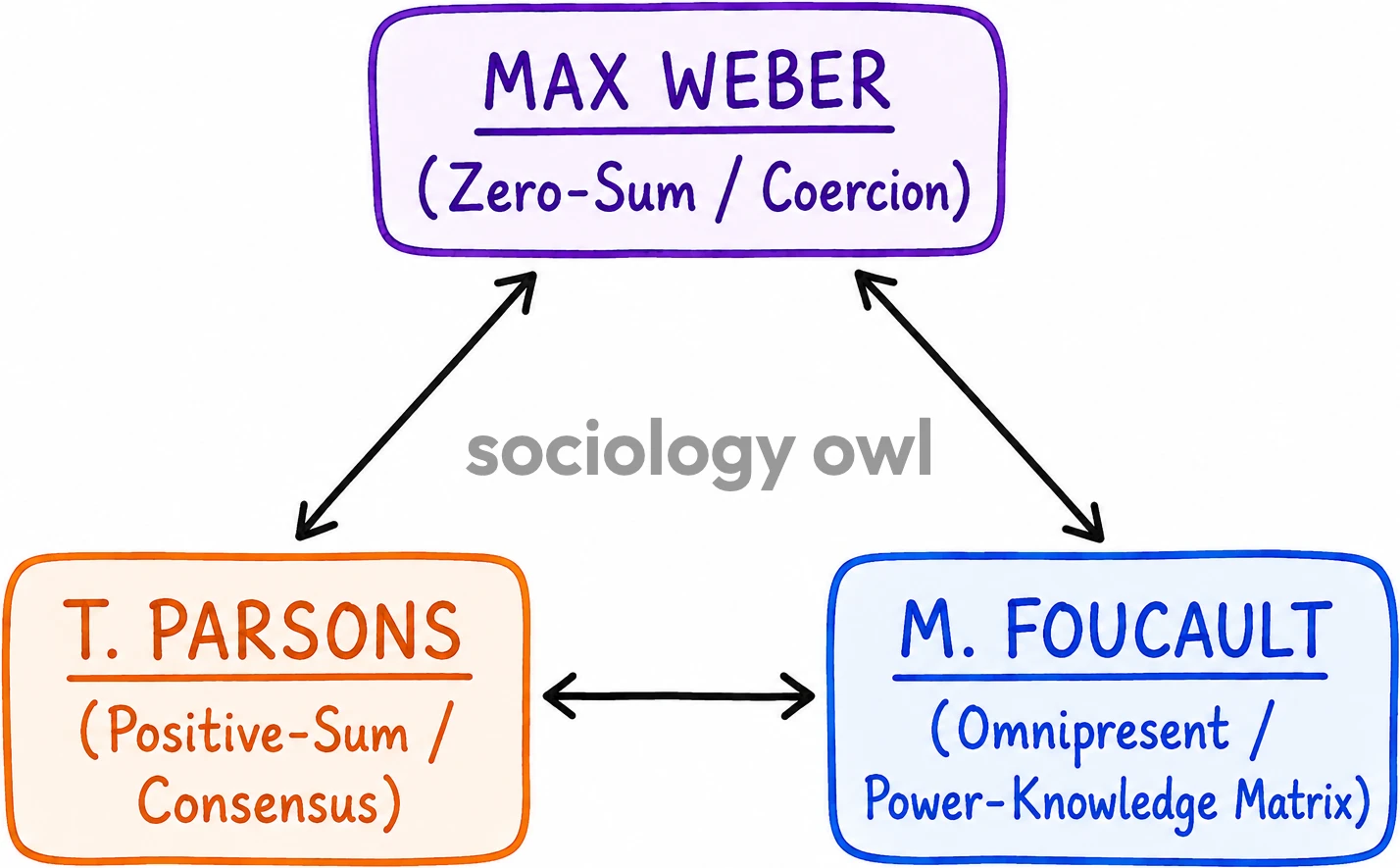
Weber defined power (Macht) as the chance of a man or a number of men to realize their own will in a social action even against the resistance of others. For Weber, power is a zero-sum game (if one has more, the other has less) and is tied to individual agency and coercion.
- Power Derived from a Constellation of Interests: Emerges from a group’s ability to control resources in a free market (e.g., monopolistic cartels).
- Power Established within a System: Rooted in an established social structure that allocates the right to command.
3. Authority (Herrschaft) and Legitimacy
Because pure power based on coercion is unstable, rulers seek to legitimize their dominance. Weber used the German term Herrschaft (often translated as authority or domination) to describe legitimate power. Authority exists when subordinates accept the ruler’s right to issue commands and internalize a duty to obey. Thus, Power + Legitimacy = Authority.
Legitimacy is the crucial variable that transforms mere coercion into stable social order. Jurgen Habermas later expanded on this, noting that modern states face a Legitimation Crisis when they can no longer maintain mass loyalty.
4. Weber’s Tripartite Classification of Authority
Weber directly linked his typology of authority to his four types of Social Action. He identified three ideal types of authority:
Traditional Authority
Legitimacy is claimed on the basis of age-old customs and the sanctity of historical traditions. It corresponds to Traditional Action. Examples include patriarchy, gerontocracy, and monarchies. Followers obey out of personal loyalty to the traditional chief.
Charismatic Authority
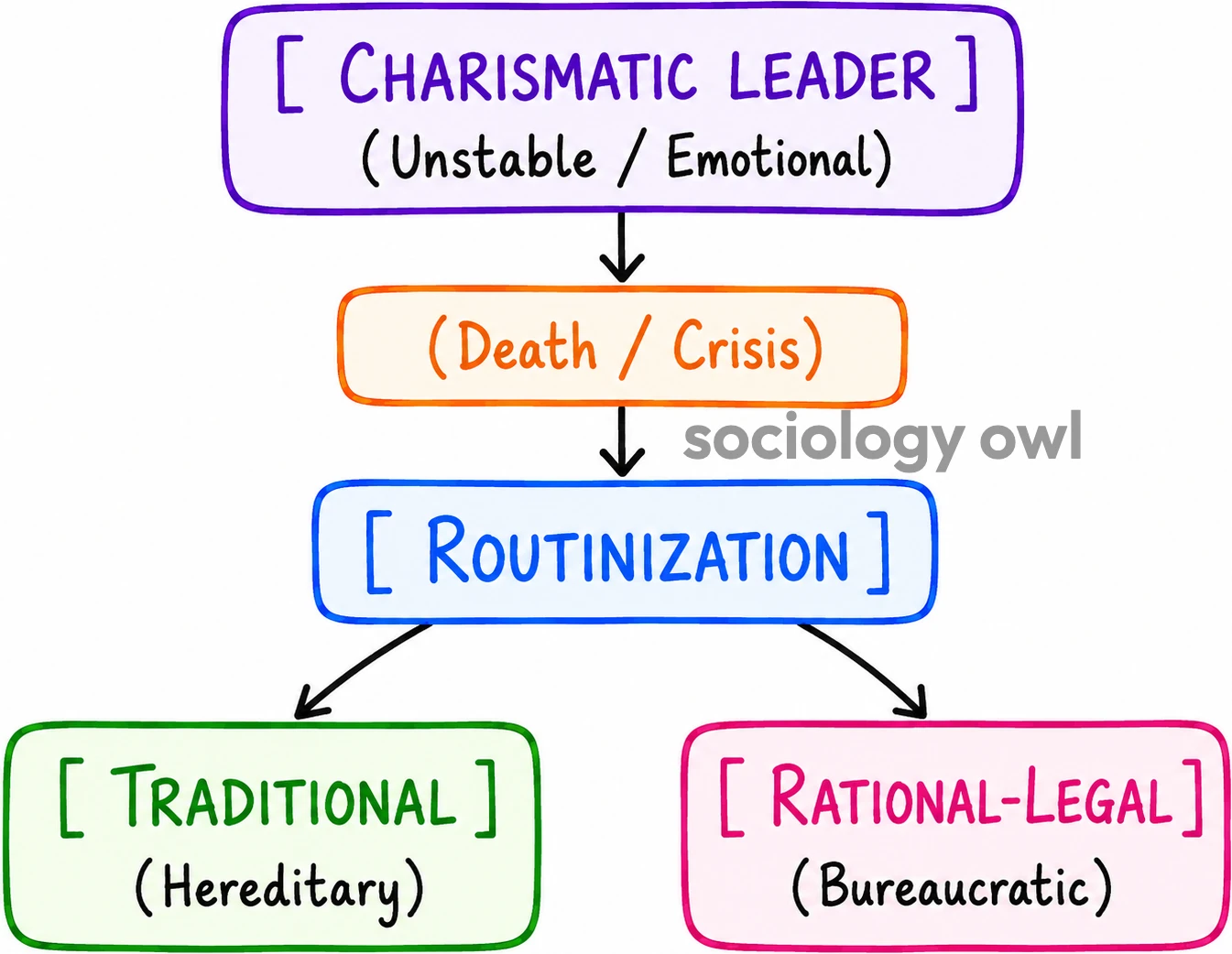
Rooted in the exceptional, supernatural, or heroic qualities of an individual leader. It corresponds to Affective Action (emotional bond) and sometimes Wertrational Action (value-rational). Because charismatic authority is tied to a single mortal individual, it is inherently unstable. To survive the leader’s death, it must undergo the Routinization of Charisma, transforming into either traditional or rational-legal authority.
Rational-Legal Authority
Legitimacy is derived from a system of consciously made rational rules, laws, and procedures. It corresponds to Zweckrational Action (goal-oriented rationality). Obedience is owed to the legally established impersonal order, not to an individual. This is the hallmark of modern bureaucratic states.
Comparative Analysis of Authority Types
| Feature | Traditional Authority | Charismatic Authority | Rational-Legal Authority |
|---|---|---|---|
| Basis of Legitimacy | Customs and traditions | Heroic or supernatural traits | Codified laws and rules |
| Type of Social Action | Traditional | Affective / Wertrational | Zweckrational |
| Administrative Machinery | Relatives, retainers | Devoted disciples | Bureaucracy |
| Stability | Highly stable | Highly unstable (needs routinization) | Stable and predictable |
5. Bureaucracy: The Iron Cage of Rationality
Bureaucracy is the purely technical, most efficient administrative machinery of Rational-Legal Authority. Weber described its ideal-type features as including a clear hierarchy, written rules, strict specialization, impersonal relationships, and merit-based recruitment.
However, Weber warned of the dark side of this rationalization, predicting that humanity would become trapped in an Iron Cage of Rationality, suffering from disenchantment (Entzauberung) and dehumanization.
6. Application in the Indian Context (Paper 2 Integration)
Weber’s framework is highly instrumental in analyzing the structural transformations in Indian society:
- Traditional Authority in India: Sociologist M.N. Srinivas observed traditional authority functioning through the Dominant Caste and the Jajmani system, where power was legitimized by ritual status and agrarian landholding. Louis Dumont in Homo Hierarchicus emphasized how the ideology of purity and pollution legitimized Brahminical authority.
- Charismatic Authority in Indian Politics: Scholars like Lloyd and Susanne Rudolph have analyzed how traditional elements were mobilized through charismatic authority in India. Mahatma Gandhi’s leadership is a classic example of merging traditional asceticism with political charisma. Similarly, Dipankar Gupta notes the prevalence of charismatic and patronage-based leadership in regional politics (e.g., N.T. Rama Rao, Mayawati).
- Rational-Legal Authority and Development: The British introduced a rational-legal colonial bureaucracy (the “Steel Frame”). Post-independence, sociologists like S.C. Dube analyzed how this bureaucracy struggled to act as an agent of rural development because officials remained trapped in a colonial, authoritarian mindset. Andre Beteille, in his study of Sripuram, documented the shift of power from traditional caste structures to rational-legal institutions like Panchayats and political parties.
7. Critiques and Alternative Perspectives
For high-scoring answers, Weber’s concepts must be contrasted with other prominent sociological paradigms:
- Talcott Parsons (Functionalist View): Criticized Weber’s zero-sum view of power. Parsons argued that power is a positive-sum game—a systemic resource generated by society to achieve collective goals.
- Michel Foucault (Post-Structuralist View): Argued that power is not just held by the state or individuals; it is ubiquitous, capillary, and deeply intertwined with knowledge (Power/Knowledge matrix). Power flows through all social relations and discourses.
- Robert Merton (Critique of Bureaucracy): Highlighted the dysfunctions of bureaucracy, noting that strict adherence to rules leads to Bureaucratic Ritualism and Trained Incapacity (where rules become ends in themselves).
- Steven Lukes: Proposed the Radical View of Power (Three Faces of Power), arguing that Weber only saw decision-making power, ignoring non-decision making (agenda-setting) and ideological conditioning (manipulating desires).
8. Contemporary Relevance
Weber’s concepts remain highly applicable in the 21st century. The rise of global populism highlights a resurgence of Neo-Charismatic Authority, where leaders bypass rational-legal institutions to appeal directly to the masses via social media. Simultaneously, traditional bureaucracy is being transformed by e-governance and artificial intelligence into a Digital Bureaucracy, which increases efficiency but exacerbates the “iron cage” through mass surveillance and algorithmic control.
9. Conclusion
Max Weber’s analysis of power and authority provided sociology with an indispensable vocabulary for understanding political sociology and organizational behavior. By demonstrating how raw power is domesticated into legitimate authority, Weber mapped the trajectory of human modernization. As modern societies continue to grapple with the tension between the efficiency of rational-legal bureaucracies and the emotional appeal of charismatic leaders, Weber’s insight remains profoundly prophetic. In the words of sociologist Raymond Aron, Weber’s sociology of domination perfectly captures the tragic paradox of modernity: “The machinery of rational administration, built to serve humanity, ultimately threatens to enslave it.”