Model Answer:
Development, Tribal Identity, and Environmental Resistance
The interplay between environmental movements, development, and tribal identity constitutes the central fault line of India’s post-colonial political economy. It highlights the structural contradictions between capitalist growth, ecological sustainability, and indigenous survival.
Development versus Tribal Identity
- A.R. Desai argues that India’s capitalist path of development structurally necessitates the expropriation of tribal resources through “primitive accumulation.”
- Walter Fernandes highlights this disproportionate burden: tribals constitute ~8% of the population but over 40% of those displaced by development projects.
- Virginius Xaxa notes that this alienation from land and forests paradoxically crystallized a pan-tribal political identity, often leading to Retribalization as communities assert distinct roots to resist marginalization.
Regarding tribal identity and environmental resistance, Madhav Gadgil and Ramachandra Guha, in Ecology and Equity, conceptualize this conflict as one between urban-industrial “Omnivores” and tribal “Ecosystem People.” Extractive development turns tribals into “ecological refugees,” sparking an “environmentalism of the poor.” Amita Baviskar, in In the Belly of the River, demonstrates how Bhilala tribals during the Narmada Bachao Andolan mobilized their indigenous identity to fight the dam, proving that grassroots environmentalism is fundamentally about cultural survival and identity defense.
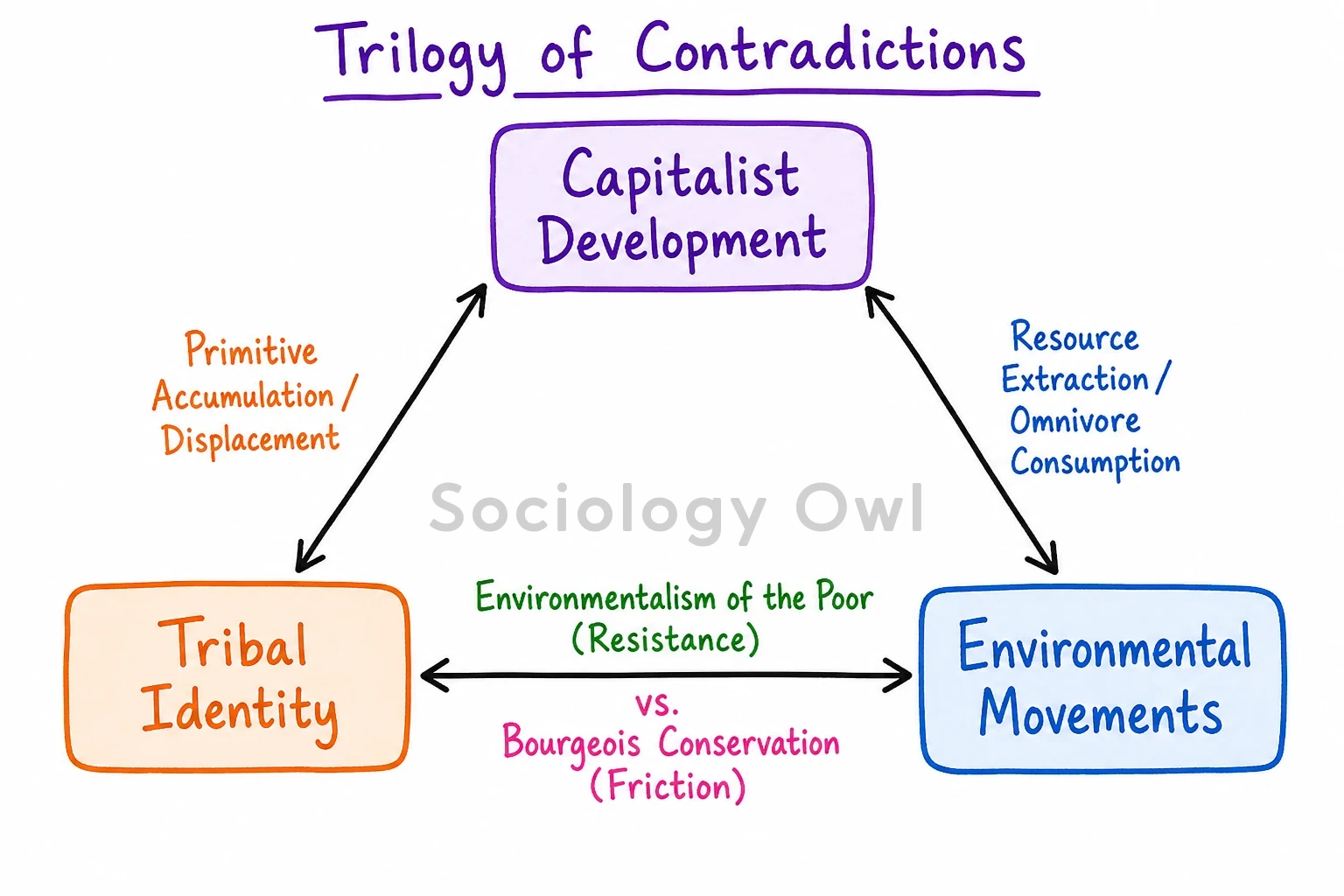
The friction between conservation and tribes shows that the trilogy is not always harmonious. Amita Baviskar critiques “Bourgeois Environmentalism,” where urban-centric conservation (e.g., Tiger Reserves) views tribals as encroachers. This “authoritarian conservation” leads to “green displacement,” attacking tribal identity just as brutally as industrial development.
The Dongria Kondh’s resistance against Vedanta’s bauxite mining in the Niyamgiri Hills perfectly encapsulates this trilogy: corporate development versus ecological degradation versus tribal spiritual identity. Institutional interventions like the Forest Rights Act (FRA), 2006 and PESA, 1996 attempt to reconcile these tensions by legally recognizing tribes as custodians of the environment.
Conclusion
Resolving this trilogy requires moving beyond extractive state capitalism. As B.K. Roy Burman observes, tribes possess a symbiotic relationship with their land. Tribal identity must therefore be embraced not as an obstacle to development, but as an epistemological guide to achieving true ecological and social balance.