Model Answer:
Gender Stratification and Classical Sociology
Early stratification theories suffered from “Malestream Sociology”, treating male experiences as the universal norm and ignoring gender as an independent axis of inequality.
- Marxist Approach: Friedrich Engels reduced women’s subordination merely to a byproduct of capitalism and private property.
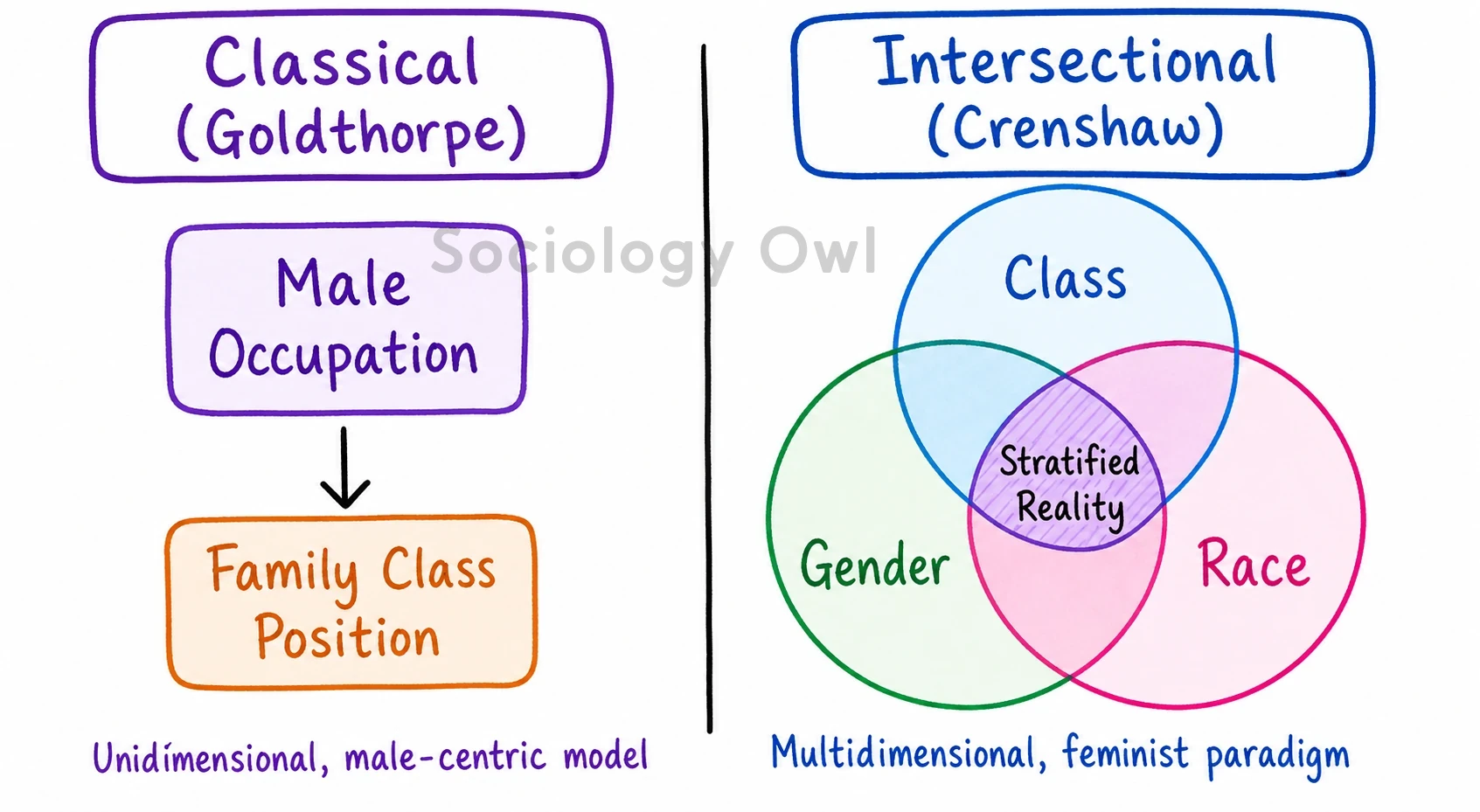
- John Goldthorpe: Derived a family’s class solely from the male household head, sparking fierce critiques from feminists like Michelle Stanworth.
- Talcott Parsons: Naturalized inequality by functionally justifying the division between male “instrumental” and female “expressive” roles.
Feminist Reconceptualization
- Unpaid Labor: Ann Oakley (The Sociology of Housework) exposed domestic exploitation, and Arlie Hochschild highlighted women’s “second shift”.
- Intersectionality: Kimberl0e9 Crenshaw proved that gender stratification is not monolithic but intricately overlaps with race and class.
Stratification remains visibly gendered today, evidenced by the global “Motherhood Penalty” and inherently gendered organizational structures (Joan Acker).
Conclusion
While classical sociology was inherently gender-blind, contemporary paradigms are not. Feminist and intersectional frameworks have successfully established gender as a fundamental, cross-cutting dimension of global social stratification.