Model Answer:
Positivism, rooted in Enlightenment rationality and pioneered by Auguste Comte, asserts that sociology must adopt natural science methods to discover universal laws of human behavior. Emile Durkheim operationalized this by advocating treating “social facts as things” in The Rules of Sociological Method, establishing an objective, empirical basis for sociology.
Critiques of Positivism
Ontological and Epistemological Critiques:
- Neglect of Subjective Meaning: Max Weber argued humans possess consciousness and agency. His interpretivist approach emphasizes Verstehen (empathetic understanding) to grasp internal motivations, contrasting with natural matter that merely reacts.
- Reflexivity: Anthony Giddens formulated the Double Hermeneutic. Unlike natural objects, humans interpret sociological theories and alter their behavior accordingly, rendering law-like prediction impossible.
- Scientific Fallibility: Karl Popper rejected positivist verification in favor of Falsification. Furthermore, Thomas Kuhn demonstrated through Paradigm Shifts that science itself is a socially constructed, subjective enterprise rather than purely objective.
Axiological and Structural Critiques:
- Myth of Value-Neutrality: Alvin Gouldner argued complete objectivity is impossible. During the Positivist Dispute, the Frankfurt School (Jurgen Habermas) argued that positivism legitimizes the oppressive status quo by masking structural inequalities as “value-neutral” facts.
- Reductionism: Phenomenologists like Alfred Schutz argue positivism reduces inter-subjective social realities into mechanical variables. Interpretivists argue this necessitates Clifford Geertz’s “Thick Description” to capture cultural depth.
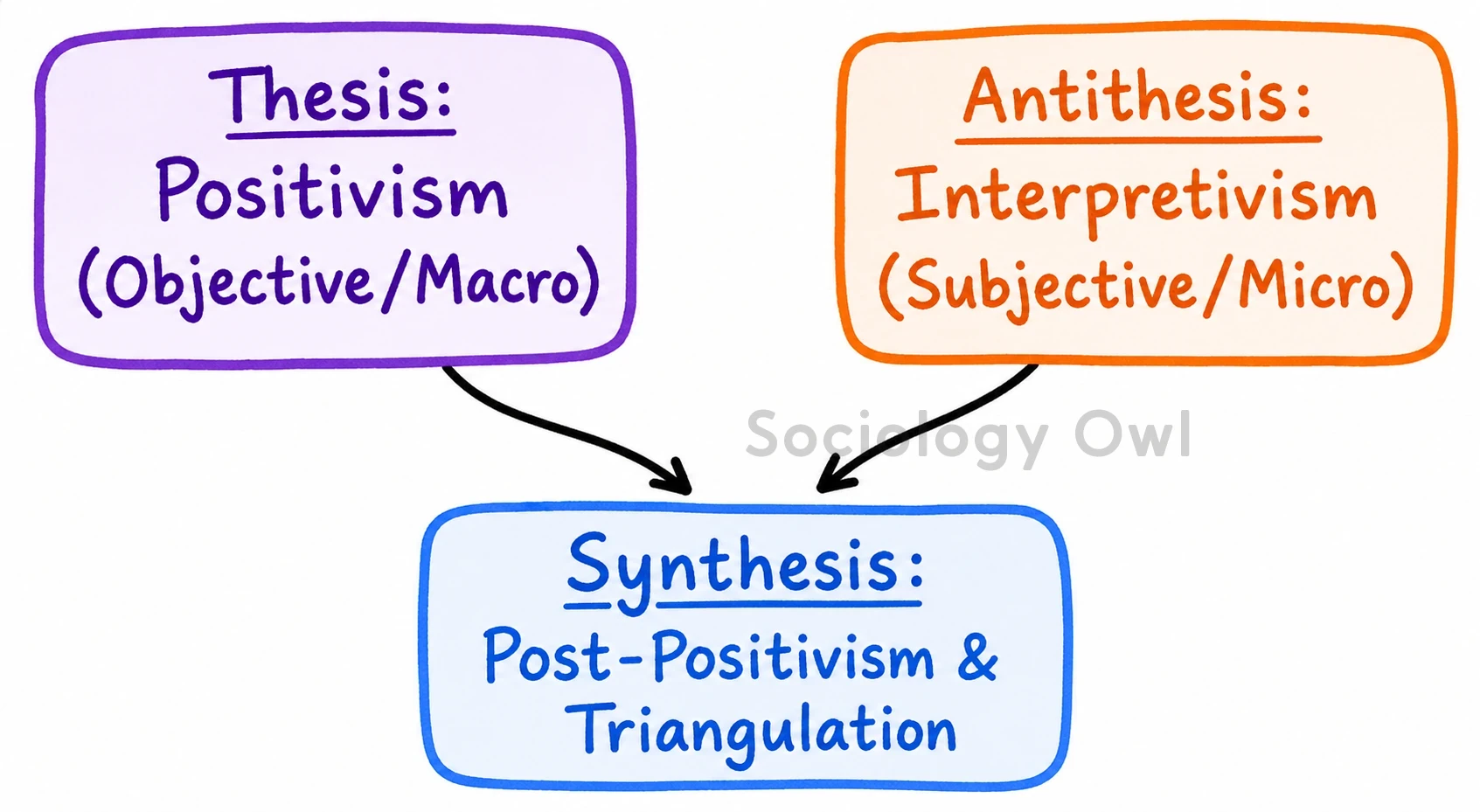
Critical Evaluation of the Anti-Positivist Critiques: Extreme anti-positivism or postmodernism risks radical relativism—if no objective truth exists, sociological policy-making becomes impossible. Consequently, sociology has shifted toward Post-Positivism (e.g., Roy Bhaskar’s Critical Realism), which accepts that while absolute objectivity is unattainable, rigorous empirical observation remains vital when conducted with reflexivity.
Contemporary Relevance: Today’s reliance on Big Data and algorithmic governance represents modern hyper-positivism. However, predictive AI in criminal justice often reproduces structural biases (racism, classism). This proves that quantitative data lacking contextual Verstehen fails to capture complex human realities.
Conclusion
The historical hostility between positivism and its critics has matured into methodological pluralism. Modern sociologists embrace Alan Bryman’s concept of Triangulation, synergizing quantitative and qualitative methods to comprehensively capture both macro-structural patterns and micro-level human experiences.