Model Answer:
Historical Materialism, the cornerstone of Karl Marx’s sociological thought, posits that material and economic conditions are the primary drivers of societal evolution. Marx constructed this methodology by inverting Georg Hegel’s dialectics (replacing idealism with materialism) and integrating Ludwig Feuerbach’s materialism.
Main Features of Historical Materialism
- Base-Superstructure Model: The economic base, comprising the Forces of Production (FOP) and Relations of Production (ROP), determines the ideological superstructure (politics, law, religion). As Marx wrote in A Contribution to the Critique of Political Economy, “social existence determines consciousness.”
- Dialectical Contradiction: Historical change occurs when dynamic FOP (technology, labor methods) outgrow static ROP (property and class laws). This structural contradiction generates class struggle, culminating in revolutionary transformation.
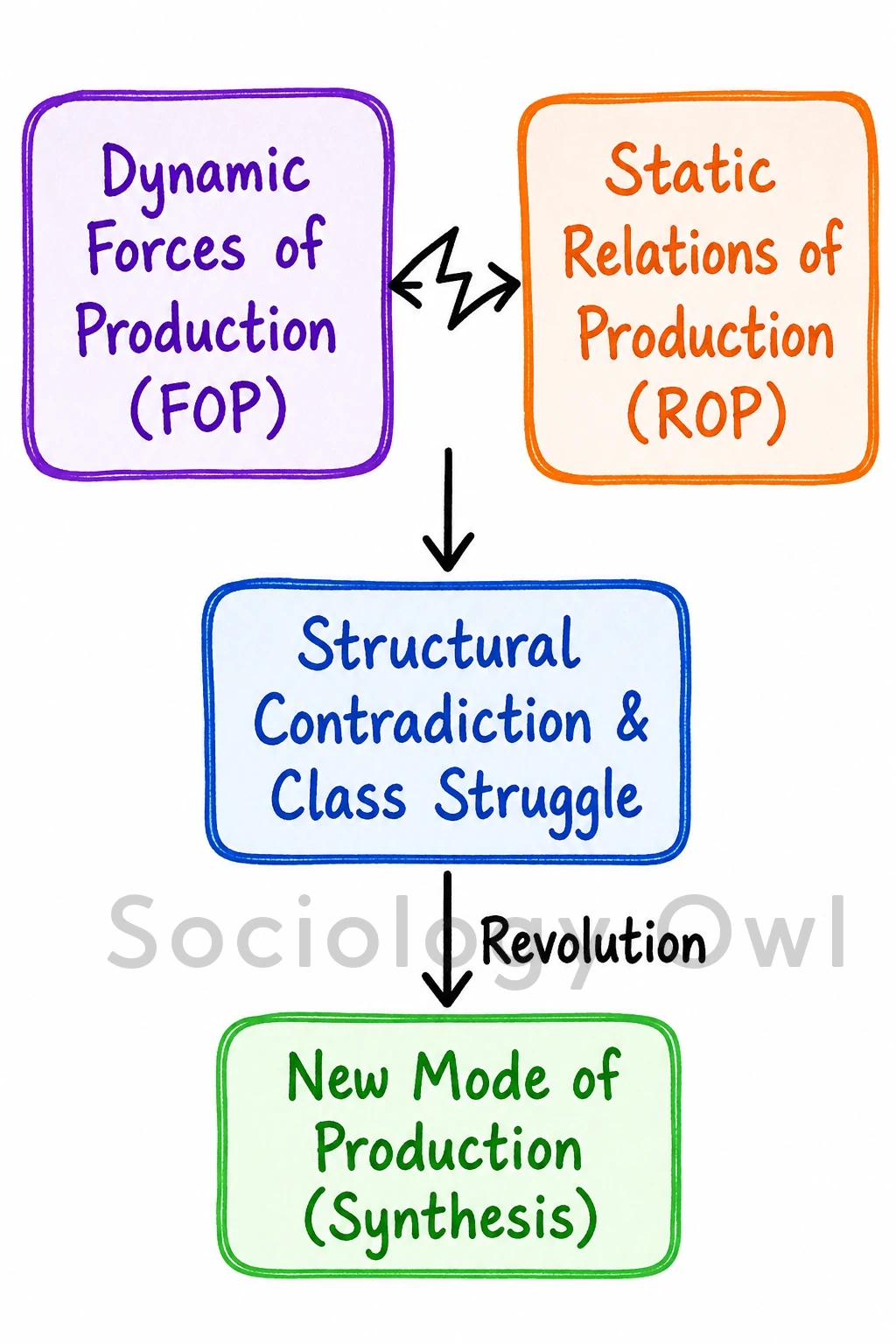
- Evolutionary Stages: History progresses through distinct modes of production driven by class antagonism: Primitive Communism → Ancient Mode (Slavery) → Feudalism → Capitalism → Socialism/Communism.
Contemporary Relevance
- Global Capitalism: Immanuel Wallerstein’s World Systems Theory validates Marx globally, explaining neocolonial exploitation where Core nations extract surplus from the Periphery. Contemporary Oxfam reports on wealth concentration echo Marx’s capital accumulation thesis.
- Ideological Control: Antonio Gramsci’s Cultural Hegemony and Louis Althusser’s Ideological State Apparatus explain how modern capitalism survives not just by economic force, but by manufacturing consent through media and algorithms.
- Worker Alienation: Gig economy precarity highlights ongoing worker commodification and Alienation.
- Limitations and Critiques: Herbert Marcuse (Frankfurt School) noted that capitalism pacified the working class by creating “false needs” through consumerism. Ralf Dahrendorf criticized Marx for missing the “decomposition of capital”—the rise of a salaried middle class and institutionalized union conflict. Furthermore, feminists like Heidi Hartmann argue the theory is “sex-blind,” ignoring patriarchy’s independent structural force.
Conclusion
While strict Economic Determinism is challenged today, Historical Materialism remains an indispensable analytical tool. Adapted by Neo-Marxists, it continues to anchor critical sociology and environmental sociology, notably utilizing concepts like the “Metabolic Rift” to critique capitalist-driven ecological crises.