Model Answer:
Urbanization in India is not merely a demographic shift but a complex structural and cultural transformation. Ashish Bose characterizes India’s unique demographic trajectory as “Pseudo-urbanization,” where urban growth occurs without commensurate economic development, while M.S.A. Rao views it as a profound shift in the traditional social matrix.
Trends of Urbanization in India
- Subaltern Urbanization: Coined by Eric Denis and Partha Mukhopadhyay, the emergence of thousands of new census towns reflects autonomous growth driven by local capital and informal networks, independent of state industrial planning.
- Exclusionary Urbanization: Amitabh Kundu argues that top-heavy metropolitan growth pushes the urban poor to the peripheries while gentrifying core city spaces.
- Rural-Urban Continuum: Disputing a strict rural-urban dichotomy, G.S. Ghurye and Dipankar Gupta highlight a continuum where mixed migration blurs spatial and cultural boundaries.
Industrialization: Not the Sole Precondition
While the Western paradigm links urbanization directly to the Industrial Revolution, India’s trajectory is multi-causal:
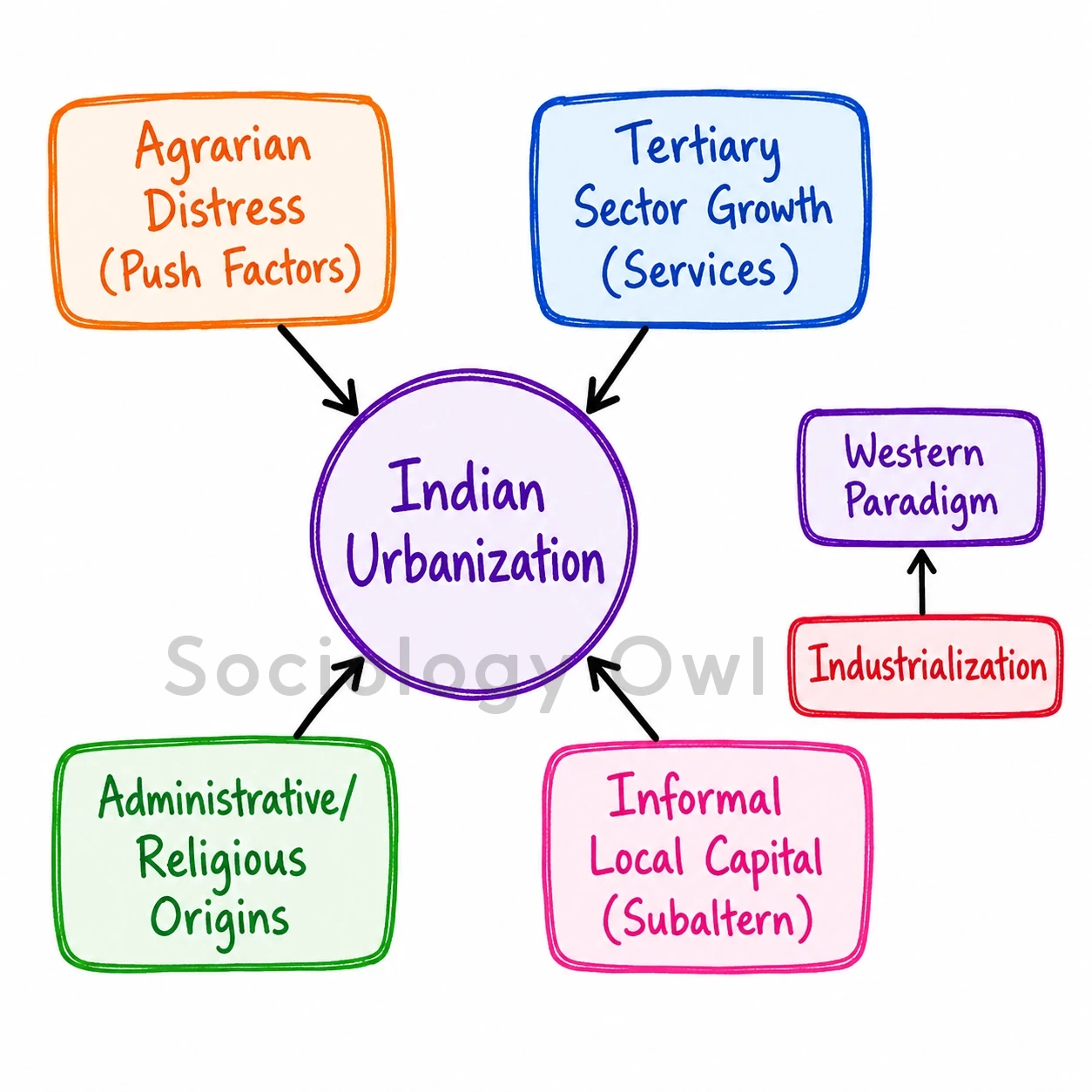
- Over-urbanization: Bert F. Hoselitz notes that Indian cities grow demographically without proportionate industrial expansion, heavily driven instead by the tertiary service sector.
- Typology of Cities: M.S.A. Rao explicitly identified non-industrial origins for urban centers, including religious (Varanasi), administrative (Chandigarh), and commercial towns.
- Agrarian Distress and Informalization: Jan Breman highlights how rural unviability pushes footloose labor into cities. Furthermore, Kalyan Sanyal argues that post-1991 economic reforms bypassed traditional manufacturing, creating vast informal sectors rather than an industrial proletariat.
Policy and Crisis Integration: The government’s Shyama Prasad Mukherji Rurban Mission actively addresses non-industrial rural-urban clusters by providing urban amenities. Additionally, the COVID-19 reverse migration ruthlessly exposed how Indian urbanization heavily relies on an informal, non-industrial workforce, validating Breman’s thesis.
Conclusion
India’s urbanization represents a distinct, multi-causal synthesis of modern economic shifts and traditional structures, proving industrialization is not the sole precondition. Moving forward, urban policy must embrace David Harvey’s framework of the “Right to the City,” shifting from exclusionary enclaves toward inclusive spaces for informal and rural migrant populations.