Model Answer:
Sampling in Social Research
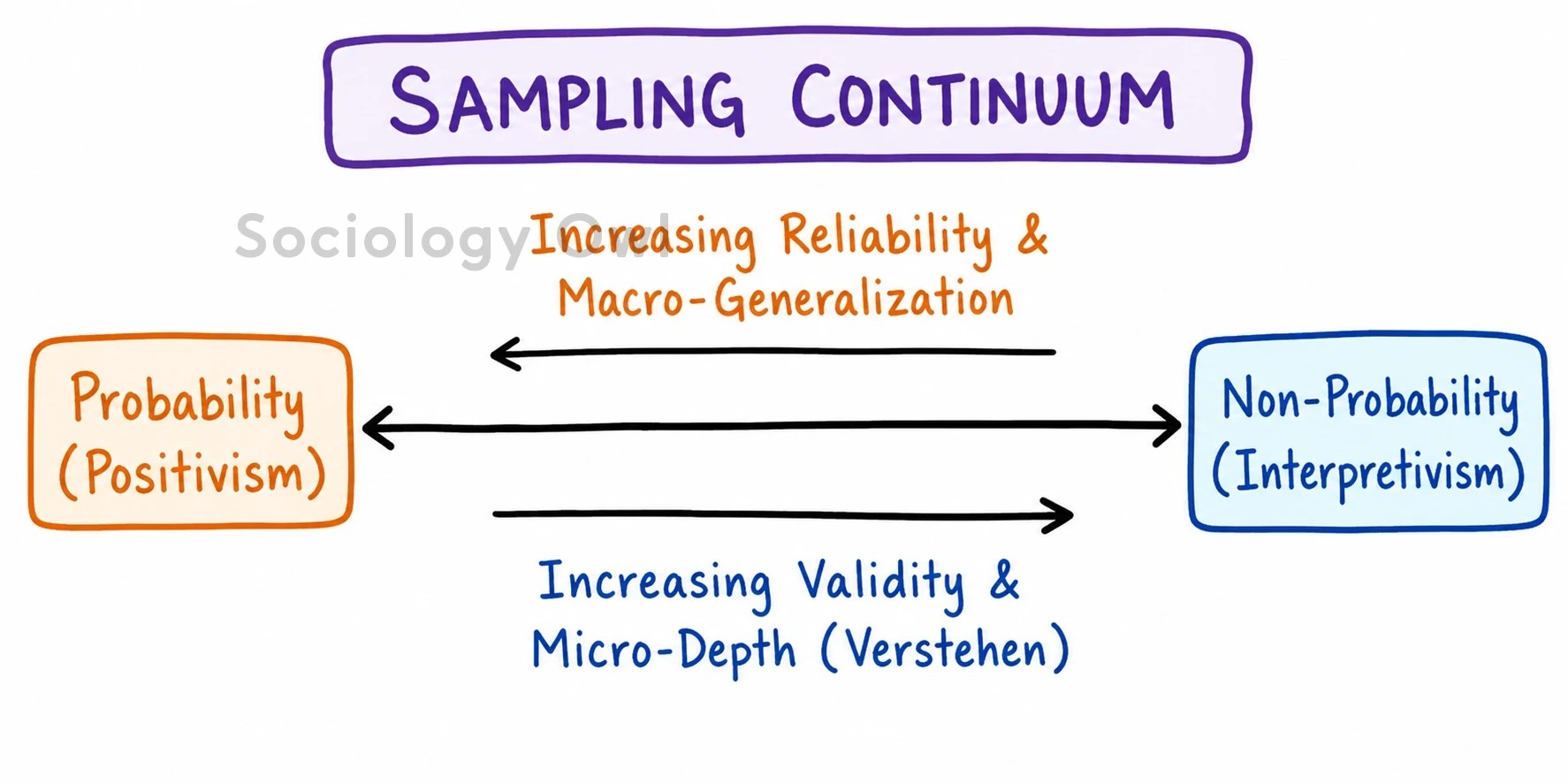
Sampling is the methodological process of selecting a subset from a population to make empirical inferences. Sociologically, the choice of sampling depends on epistemological stances: Positivists seek large, representative samples for macro-generalizations and reliability, while Interpretivists prefer smaller, non-representative samples to achieve subjective depth (Verstehen).
Probability Sampling
Every unit has a known, non-zero chance of selection, ensuring statistical rigor.
- Simple Random & Systematic Sampling: Guarantees equal selection chance. Advantage: Highly representative and free from researcher bias. Disadvantage: Requires a flawless Sampling Frame, which is often politically contested or unavailable. Peter Townsend utilized complex random sampling in Poverty in the UK to generalize poverty rates.
- Stratified & Cluster Sampling: Divides populations into distinct strata (e.g., class) or geographical clusters. Advantage: Guarantees representation of marginalized subgroups. Disadvantage: High implementation complexity. John Goldthorpe employed stratified sampling in the Oxford Social Mobility Study to ensure all occupational classes were adequately represented.
Non-Probability Sampling
Selection relies on researcher judgment, prioritizing contextual depth (Validity) over statistical representativeness.
- Purposive Sampling: Deliberate selection of information-rich cases. Advantage: Yields deep theoretical insights. Disadvantage: High susceptibility to researcher bias. Paul Willis used this in Learning to Labour, purposively selecting working-class boys to study cultural reproduction.
- Snowball Sampling: Initial participants refer others. Advantage: Crucial for accessing hidden or stigmatized populations. Disadvantage: Severe network bias. Howard Becker effectively used snowballing in Outsiders to study underground marijuana subcultures.
In Digital Sociology, researchers utilize Big Data to scrape social media platforms as massive convenience sampling (e.g., analyzing #BlackLivesMatter). However, this introduces “Algorithmic Bias”, reinforcing Postmodernist critiques that modern, fragmented societies cannot be captured by one universal, representative sample.
Conclusion
Strict probability sampling faces Feminist critiques; Ann Oakley argues it reduces individuals to mere data points, stripping away power dynamics. To overcome individual sampling flaws, modern sociologists embrace Methodological Pluralism and Triangulation (Alan Bryman), combining probability and non-probability methods to achieve both macro-level reliability and micro-level validity.