Model Answer:
Marriage is a socially sanctioned sexual and economic union. K.M. Kapadia defined traditional Hindu marriage as a sacred sacrament emphasizing Dharma (duty), Praja (progeny), and Rati (pleasure). Today, modernization and globalization are profoundly reshaping its contours.
Recent Trends in Indian Marriage
- Hybrid Modernities: Patricia Uberoi observes a shift toward ‘love-cum-arranged’ unions. Matrimonial algorithms expand partner pools while blending individual choice with family consent.
- Individualization: Applying Ulrich Beck, youth navigate marriage as personal choice, seeking companionship and “Confluent Love” (Anthony Giddens) over institutional obligation.
- Commodification: Patricia Uberoi notes globalization has catalyzed conspicuous consumption, transforming marriages into status-displaying “Big Fat Indian Weddings.”
- Kinship Linkages: A.M. Shah highlights that while households fragment, functional “jointness” persists through parental funding in marriages.
- Alternative Unions: Live-in relationships and legal debates on same-sex marriage reflect expanding normative boundaries.
Departure from Traditional Practices
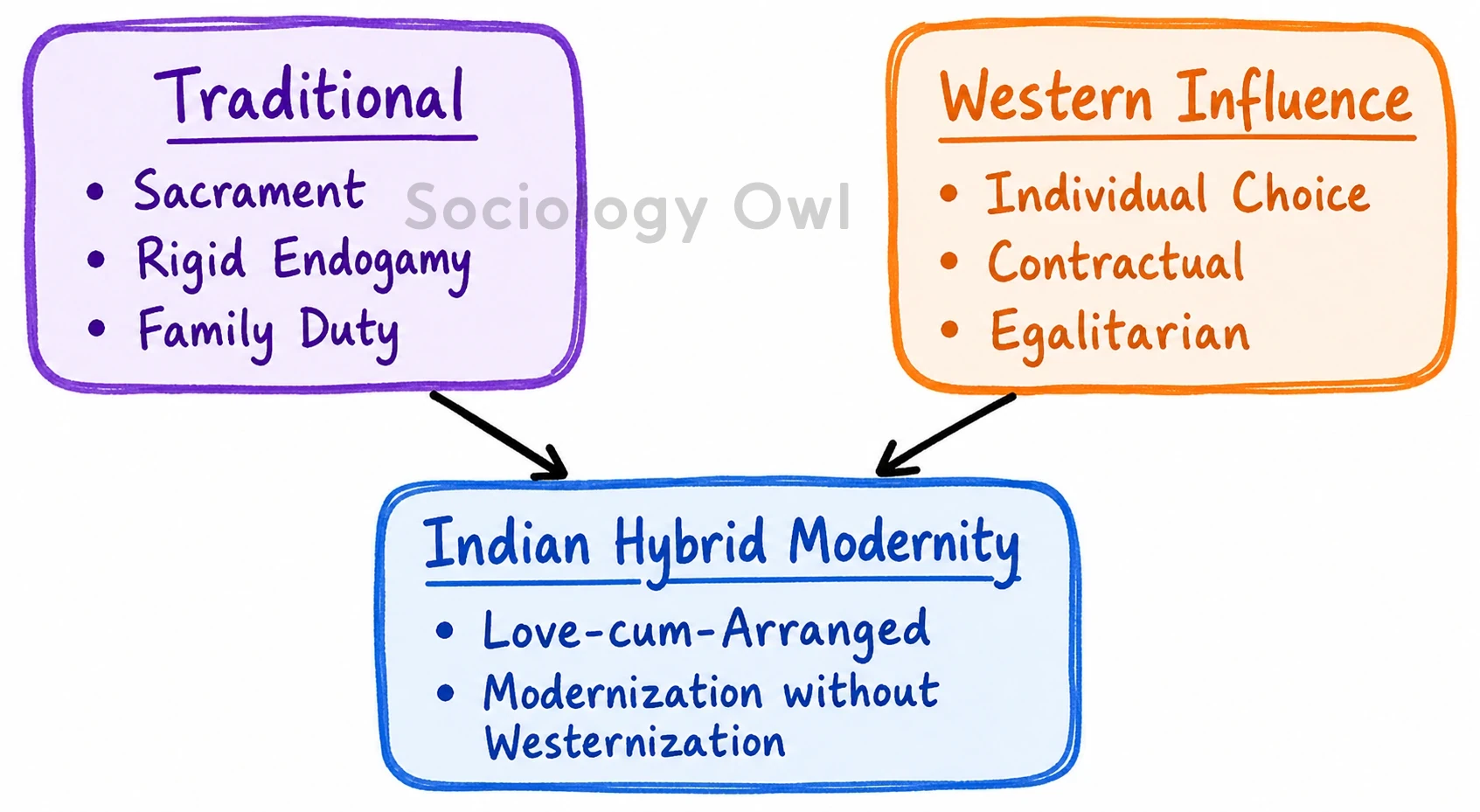
- Nature of the Bond: Shifting from an indissoluble sacrament to a legalistic Social Contract, evidenced by rising mutual-consent divorces.
- Mate Selection: Rigid endogamy prescribed by Dharmashastras is weakening. However, a paradox exists; via Sanskritization (M.N. Srinivas), dowry has spread to subaltern groups historically practicing bride-price.
- Power Dynamics: Patriarchal authority faces egalitarian aspirations. Yet, feminists argue modern marriages create a “Second Shift” (Arlie Hochschild) for working women, driving delayed marriages.
- Subaltern Critique: The “homogeneous traditional marriage” reflects upper-caste bias. Historically, Dalit and Tribal traditions were secular, permitting divorce and remarriage.
Unlike Japan’s celibacy syndrome, Indian marriage remains near-universal, demonstrating structural resilience (Talcott Parsons) despite functional transformations in a globalized era.
Conclusion
Indian marriage exemplifies “Modernization without Westernization” (Yogendra Singh). Transitioning from a rigid institution to a relationship, the persistent structural scaffolding of caste ensures it remains a uniquely Indian hybrid, balancing modern individual agency with collective tradition.