Model Answer:
Same-Sex Marriages and Population Dynamics in India
While legally unrecognized (Supriyo v. Union of India, 2023), same-sex marriage impacts India’s social demography normatively rather than statistically, challenging traditional, procreation-centric population models.
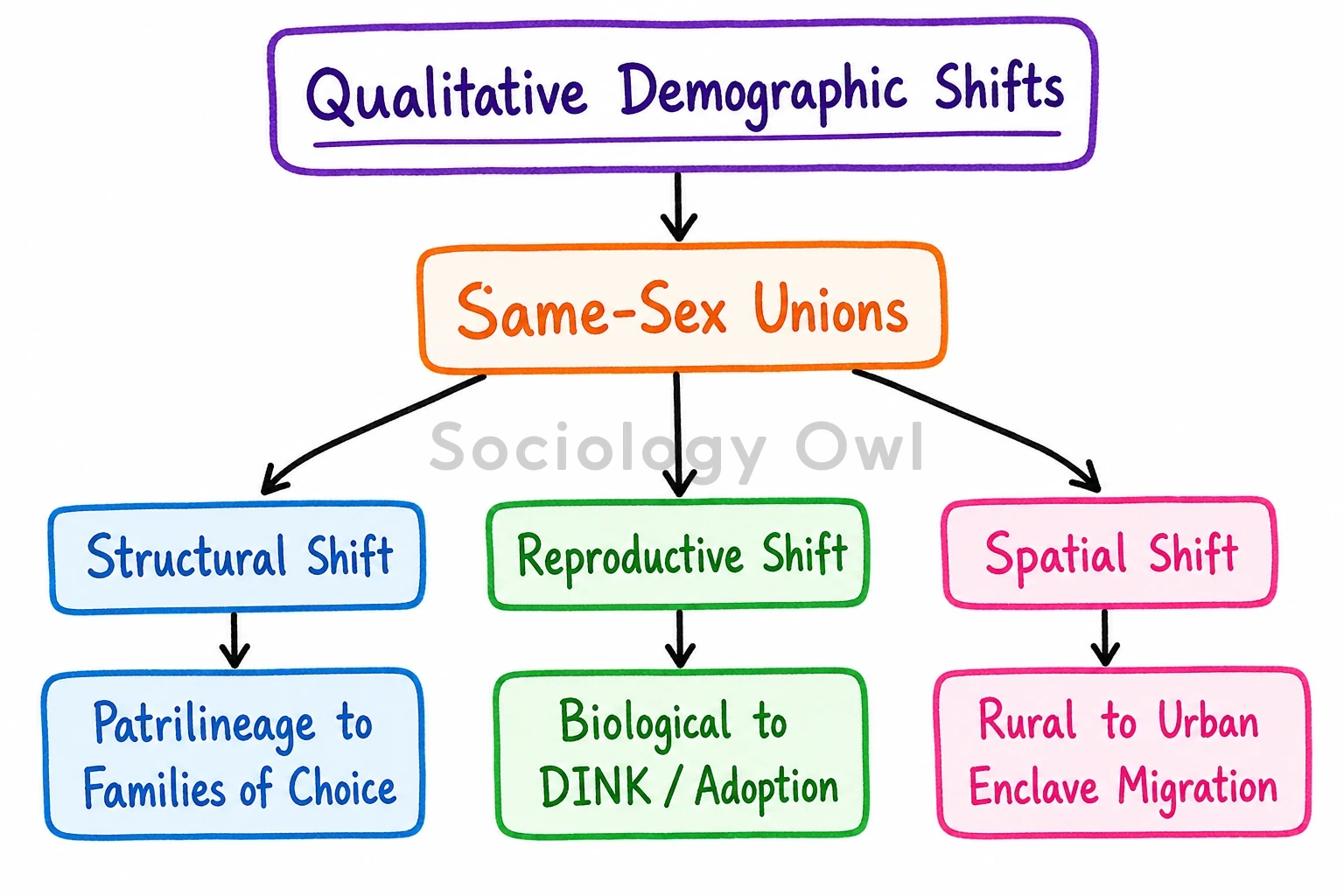
Disruption of Traditional Kinship
- K.M. Kapadia identifies Praja (progeny) as a core mandate of Hindu marriage. Same-sex unions fundamentally decouple marriage from biological reproduction.
- They challenge Leela Dube’s “Seed and Earth” metaphor, disrupting patrilineal reproduction (Vansh) and shifting focus from collective lineage to emotional companionship.
Alternative Parenthood and Policy
- The demographic expansion of queer “families of choice” is actively curtailed by the Surrogacy (Regulation) Act, 2021 and CARA guidelines.
- This fosters DINK (Double Income, No Kids) households, potentially altering future elderly dependency ratios by increasing reliance on institutional care rather than filial support.
Same-sex dynamics drive rural-to-urban demographic migration. Queer individuals frequently relocate to metropolitan cities seeking progressive spaces and anonymity, shaping distinct urban enclaves.
Conclusion
While macro-factors drive India’s fertility decline, same-sex unions mark a qualitative demographic shift. As Patricia Uberoi notes, they reflect modern India’s negotiation between traditional kinship obligations and the emergence of individual constitutional morality.