Model Answer:
Nation-building is the conscious process of integrating diverse populations into a cohesive political community. In India, as Sunil Khilnani notes in The Idea of India, this involved transforming a civilizational entity into a modern “state-nation.” It requires navigating the complex tension between “Civic Nationalism” (constitutional secularism) and “Cultural Nationalism” (shared religious heritage).
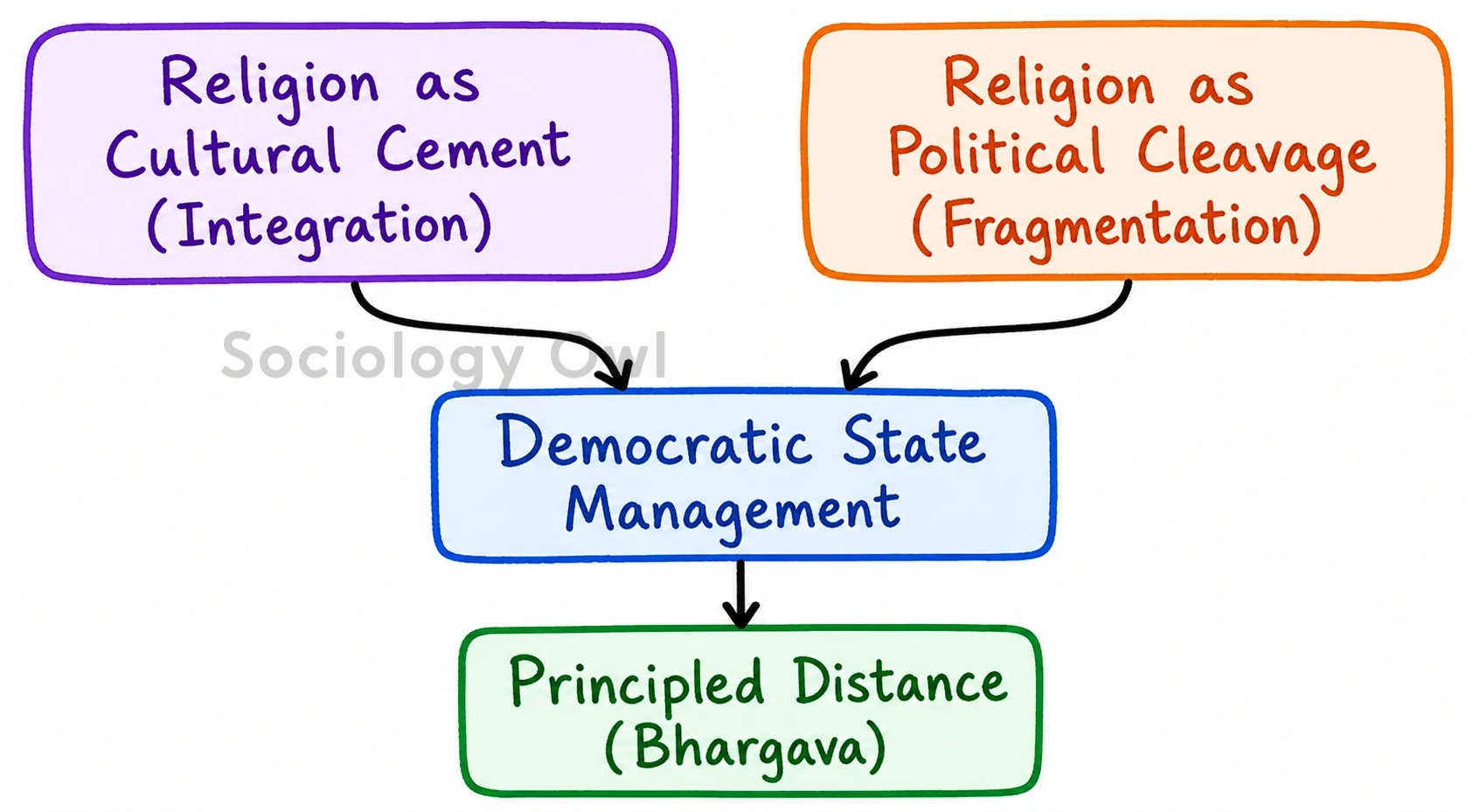
Religion as an Integrative Force
Religion provides shared moral frameworks crucial for collective social solidarity.
- Civilizational Unity: Indologist G.S. Ghurye argued that India’s foundational national unity is deeply rooted in its shared Hindu traditions and texts.
- Cultural Integration: M.N. Srinivas demonstrated how Sanskritization creates a pan-Indian cultural idiom, facilitating integration and mobility across diverse caste hierarchies.
- Mass Mobilization: Gandhi’s strategic synthesis of religious idioms (Ram Rajya, Sarva Dharma Sambhava) united diverse masses against colonialism, creating a “spiritual domain” of nationalism (Partha Chatterjee).
Religion as a Fragmenting Force
Conversely, the politicization of religion poses severe challenges to democratic consolidation.
- Subaltern Critique: B.R. Ambedkar and Kancha Ilaiah argue that nation-building based on upper-caste Hindu religious idioms alienates Dalits and religious minorities, fracturing rather than unifying the nation.
- Class Fragmentation: Marxist sociologist A.R. Desai posited that the capitalist ruling class intentionally uses religious communalism to fragment working-class solidarity, hindering equitable nation-building.
- Ideological Weaponization: Dipankar Gupta distinguishes between religion as faith (fostering harmony) and ideology (creating rigid “us vs. them” boundaries). This manipulation sustains what Paul Brass terms “institutionalized riot systems.”
Recent policy debates highlight religion’s ongoing friction with Indian nation-building. The Citizenship Amendment Act (CAA) sparked intense debates over defining citizenship along religious lines versus constitutional secularism. Similarly, the Uniform Civil Code (UCC) discourse reflects the tension between national legal integration and minority religious rights.
Conclusion
Religion’s role in Indian nation-building is profoundly paradoxical. Resolving this requires embracing Rajeev Bhargava’s model of “Principled Distance”—where the state maintains equal respect and contextual intervention—harmonizing India’s deeply religious society with its secular, democratic aspirations.