Model Answer:
Countering Charles Metcalfe’s colonial myth of static “little republics,” the 1950s saw a boom in sociological village studies driven by post-independence nation-building. M.N. Srinivas is widely regarded as the pioneer of the “Field View” via participant observation, though S.C. Dube published the first full-length sociological study, Indian Village (1955).
Contributions to Village Studies
- M.N. Srinivas: In The Remembered Village (Rampura study), he employed a structural-functionalist lens. He introduced concepts like Sanskritization and Dominant Caste, emphasizing “Village Solidarity” wherein the village acted cohesively despite internal caste hierarchies.
- A.R. Desai: In Rural Sociology in India, Desai utilized a Marxist historical-dialectical approach. He rejected the harmonious village notion, analyzing it as a site of class conflict, land alienation, and peasant pauperization under colonial capitalism.
- Andre Beteille: Using a Weberian framework in his Sripuram study, he mapped the shift from a closed to an open stratification system, noting how the traditional overlap between Caste, Class, and Power had fractured.
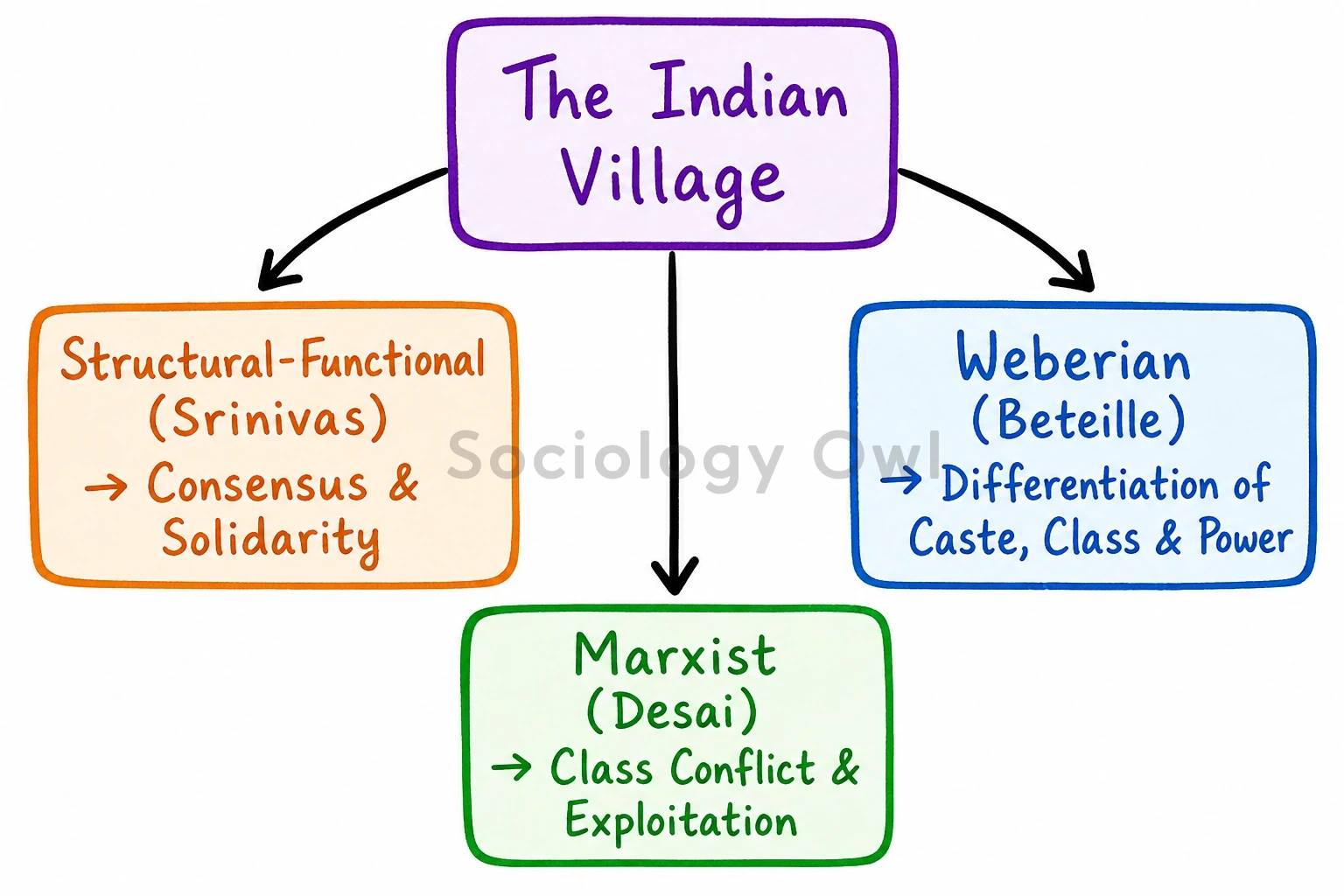
| Sociologist | Theoretical Framework | Method & View of Change |
|---|---|---|
| M.N. Srinivas | Structural-Functionalism | Participant observation; cultural mobility and integration. |
| A.R. Desai | Marxist / Historical-Materialism | Macro-historical analysis; class struggle and capitalist exploitation. |
| Andre Beteille | Weberian (Trinitarian Model) | Empirical observation; differentiation of status, wealth, and power. |
Critiques of Village Studies
- B.R. Ambedkar: Fiercely critiqued the sociological romanticization of the village, terming it a “den of ignorance, narrow-mindedness, and communalism” that perpetuated Dalit oppression.
- Louis Dumont: Argued that the village is merely an architectural and demographic reality; the true ideological reality of India is Caste.
Today, globalization and migration have fundamentally altered rural realities. Sociologists like Dipankar Gupta conceptualize the “Vanishing Village”, while Surinder S. Jodhka explores how early structural frameworks help decode ongoing agrarian distress and shifting dominant caste politics (e.g., Maratha/Jat reservation demands).
Conclusion
While pioneers like M.N. Srinivas provided the foundational anatomy of the Indian village, their empirical methodologies laid the essential groundwork for contemporary sociologists to study the dynamic, highly political, and globally integrated rural landscapes of 21st-century India.