Model Answer:
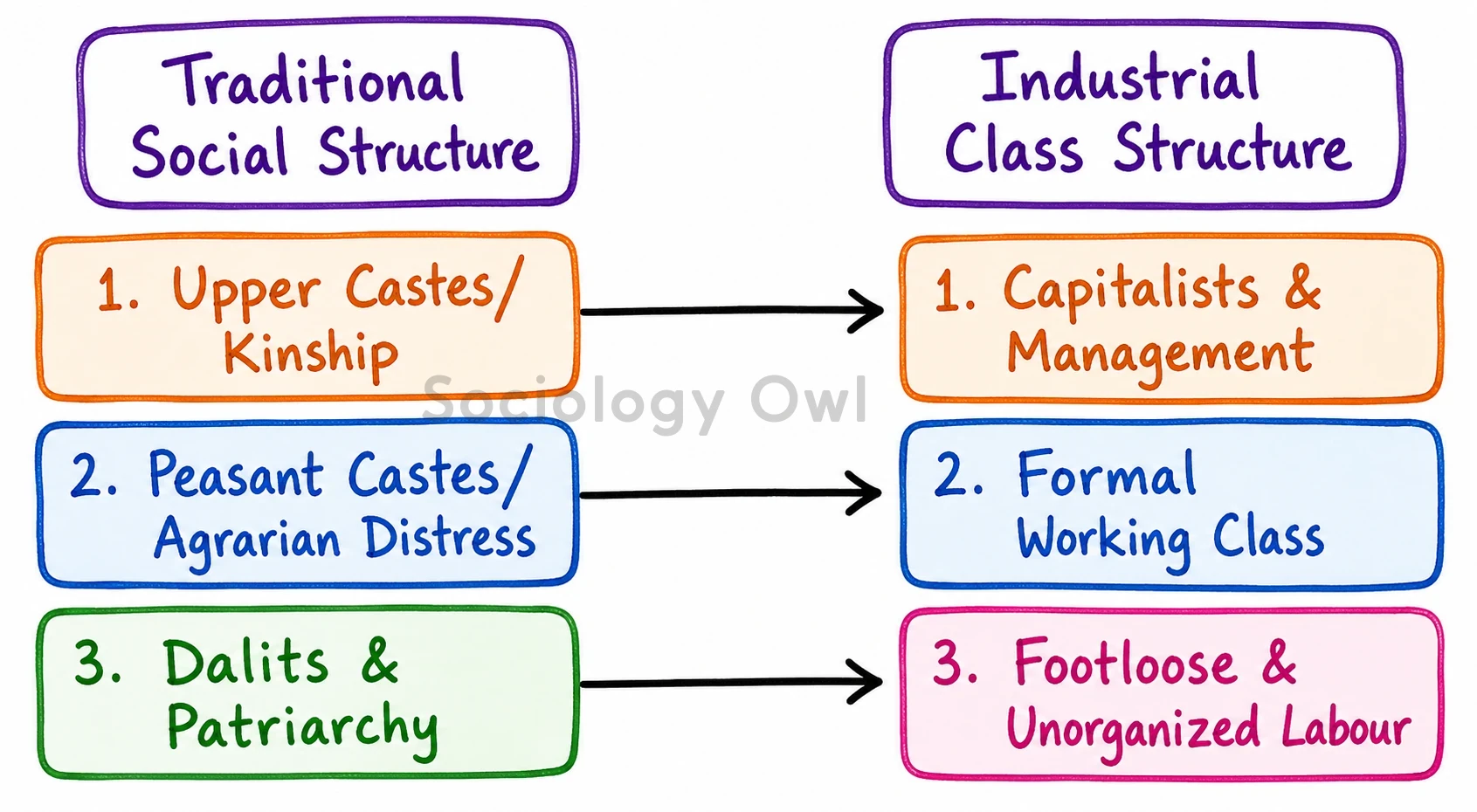
India’s transition to an industrial economy did not obliterate its traditional social structure—comprising caste, kinship, agrarian relations, and patriarchy—but adapted it. As A.R. Desai noted, the emerging capitalist class utilized traditional institutions to consolidate wealth, resulting in a superimposition of modern class lines upon traditional social hierarchies.
Traditional Structures Shaping Industrial Classes
- Capital and Kinship: Harish Damodaran in India’s New Capitalists illustrates how traditional mercantile castes monopolized early industrial capital via kinship networks, while upper castes dominated managerial roles through inherited educational capital.
- The Division of Labourers: B.R. Ambedkar famously critiqued that caste is not merely a division of labour, but a “division of labourers.” Consequently, Shudras and Dalits disproportionately occupy the unorganized manual workforce.
- Agrarian-Industrial Nexus: Jan Breman highlights how agrarian distress within rural structures pushes marginalized castes into the urban industrial reserve army as precarious “footloose labour.”
- Patriarchy and Class: Feminist scholars like Neetha N. demonstrate how patriarchal structures funnel women into the most exploitative, low-paid industrial tiers, such as garment manufacturing.
Transformations and Counter-Trends
- Secularization of Work: Analyzing counter-trends, G.S. Ghurye observed that industrialization promotes occupational freedom. Richard Lambert, in his classic study of Poona factories, found that the internal shop-floor fostered a secular hierarchy, even if external social relations remained caste-bound.
- Dalit Capitalism: Chandra Bhan Prasad highlights the rise of the Dalit Indian Chamber of Commerce and Industry (DICCI), demonstrating how modern capitalism and state support can fracture traditional caste-class monopolies.
In the modern IT sector, Carol Upadhya reveals that subtle caste networking still influences career progression. Furthermore, today’s gig economy often preys on a workforce made vulnerable by traditional agrarian and caste marginality. Acknowledging these structural impediments, state policies like Stand-Up India actively target SC/ST and women entrepreneurs to democratize industrial capital.
Conclusion
India’s industrial class structure remains a dynamic synthesis of modernization and tradition. While democratic capitalism, secular workspaces, and affirmative action challenge historical monopolies, the traditional structures of caste, agrarian ties, and patriarchy fundamentally continue to condition access to capital and labor markets.