Model Answer:
According to Gabriel Almond and Bingham Powell, pressure groups act as “aggregators of interests,” striving to influence public policy without seeking political office. Their role in democracies is paradoxical, oscillating between facilitating civic engagement and enabling elite capture.
Pressure Groups as a Democratic Necessity
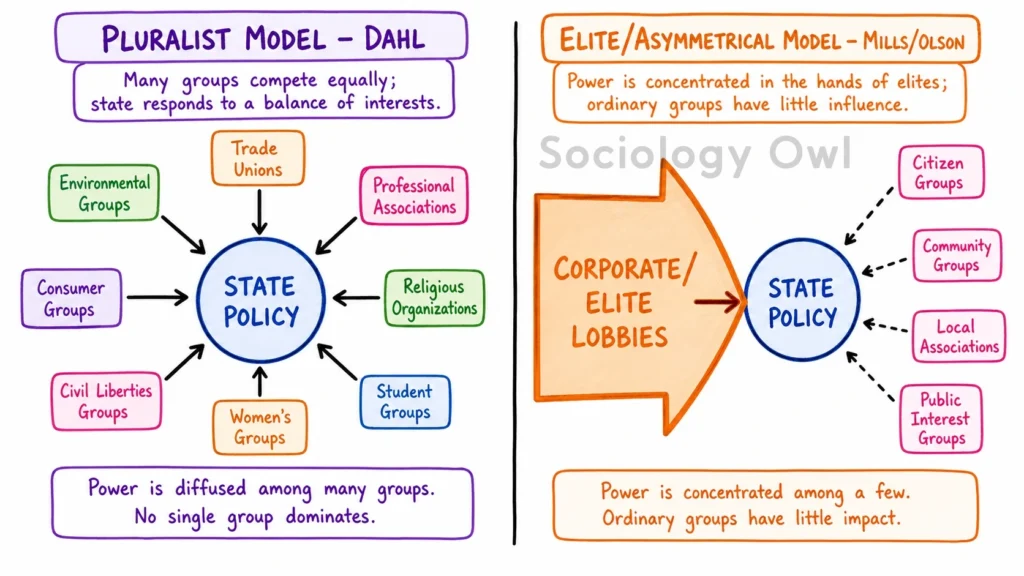
Robert Dahl’s pluralist theory posits that pressure groups are vital for articulating diverse socio-economic interests, acting as the lifeblood of plural representation.
- Buffer Against State Power: Alexis de Tocqueville, in Democracy in America, argued that civic associations act as a crucial buffer between the individual and the centralized state, preventing the “tyranny of the majority.”
- Global Watchdogs: Specialized groups provide technical input and hold governments accountable. For instance, global groups like Greenpeace articulate marginalized environmental interests, fostering robust grassroots participation outside traditional party structures.
Pressure Groups as a Democratic Threat
Conversely, critical theorists warn that pressure groups can distort democratic equality.
- Capitalist Hegemony: Building on C. Wright Mills’ elite theory, Neo-Marxist Ralph Miliband argued that wealthy business lobbies serve as instruments to maintain capitalist dominance, subverting true political equality.
- Asymmetrical Influence: Mancur Olson’s “Logic of Collective Action” explains that small, well-funded corporate lobbies are highly organized, while larger citizen groups suffer from the “free-rider problem.” Consequently, groups like the National Rifle Association (NRA) in the USA can hijack public policy against majoritarian will.
- Internal Oligarchy: Applying Robert Michels’ “Iron Law of Oligarchy”, even pressure groups fighting for democratic rights inevitably bureaucratize, becoming ruled by an unaccountable elite leadership detached from grassroots members.
In the digital age, Manuel Castells observes the rise of “Network Societies”. Decentralized, internet-mediated movements (like #MeToo or global climate strikes) act as democratized pressure mechanisms, challenging and bypassing traditional, opaque lobbying structures.
Conclusion
Pressure groups remain an indispensable yet volatile element of democracy. To prevent elite capture and ensure true pluralism, modern societies must realize Jrgen Habermas’ ideal of a “Public Sphere” and “Deliberative Democracy”, where policies are shaped by transparent public discourse rather than the financial muscle of oligarchic lobbies.