Model Answer:
Chronic poverty, extending persistently across generations, transcends classical income-subsistence models like those of Seebohm Rowntree. It is fundamentally a structural trap of powerlessness. Robert Chambers’ “Deprivation Trap” illustrates how isolation, physical vulnerability, and poverty intersect. To understand this multidimensionality, sociology employs capability and social capital deprivation frameworks.
Capability Deprivation Approach
- Core Concepts: Advanced by Amartya Sen (Development as Freedom) and Martha Nussbaum, poverty is defined as the lack of substantive freedoms or “Capabilities” to achieve valuable “Functionings” (e.g., nourishment, education).
- “Conversion Factors”: Sen argues that even if resources are provided, marginalized individuals may lack the personal or social conversion factors necessary to translate resources into actual well-being.
- Critique: Marxist scholars criticize this approach as overly individualistic, arguing it focuses excessively on personal agency while underplaying the macro-structural forces of capitalism that intentionally maintain an impoverished reserve army of labor.
Social Capital Deprivation Approach
- Conflict Perspective: Pierre Bourdieu argues that elites use social capital to maintain class boundaries. Chronic poverty is thus the reproduction of inequality, as the poor are systematically excluded from resource-rich elite networks.
- Functionalist Perspective: Robert Putnam emphasizes the lack of “Bridging” capital (inter-group linkages), which isolates impoverished communities from broader economic opportunities.
- Critique: Alejandro Portes highlights the “dark side” of social capital. In chronic poverty (e.g., slums), strong intra-group “Bonding” capital can create isolation and dependency traps, echoing Oscar Lewis’s “Culture of Poverty”.
- Unit of Analysis: Sen focuses on individual agency (capabilities as the ends), whereas Bourdieu and Putnam emphasize structural networks (social capital as the means).
- Interdependence: Social capital acts as a structural “Conversion Factor”. Without social networks, an individual’s capability to achieve mobility remains fundamentally stunted.
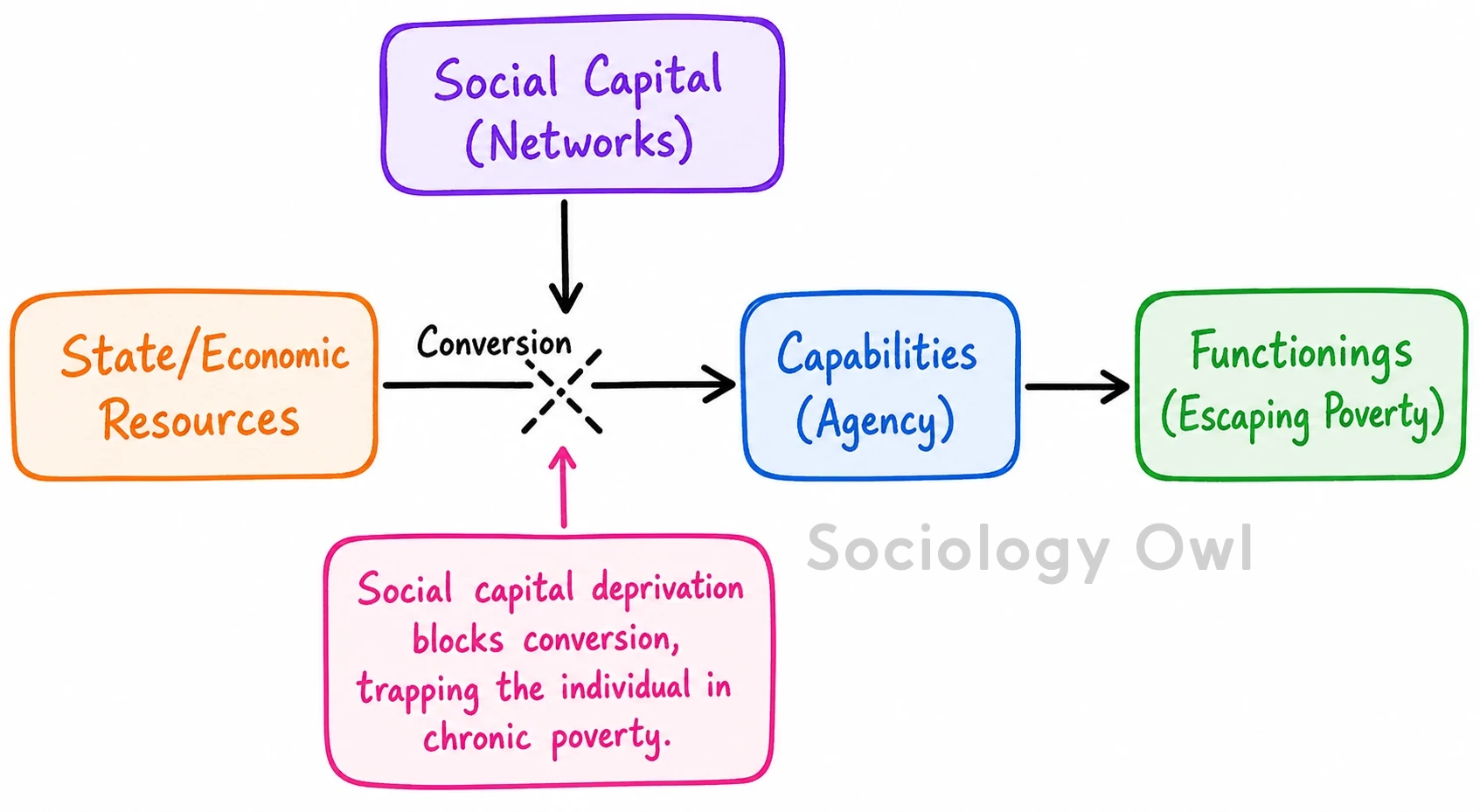
Globally, the UNDP’s Multidimensional Poverty Index (MPI) operationalizes capability deprivations. In India, the intersectionality of caste and class demonstrates this nexus: Dalits historically excluded from Savarna-dominated social networks suffer severe social capital deprivation, directly resulting in capability deprivations like poor health and educational outcomes.
Conclusion
Eradicating chronic poverty requires moving beyond economic alleviation towards structural empowerment. It necessitates a holistic policy approach that synthesizes Sen’s focus on expanding human agency with Bourdieu’s structural critique of dismantling exclusionary social networks.