Model Answer:
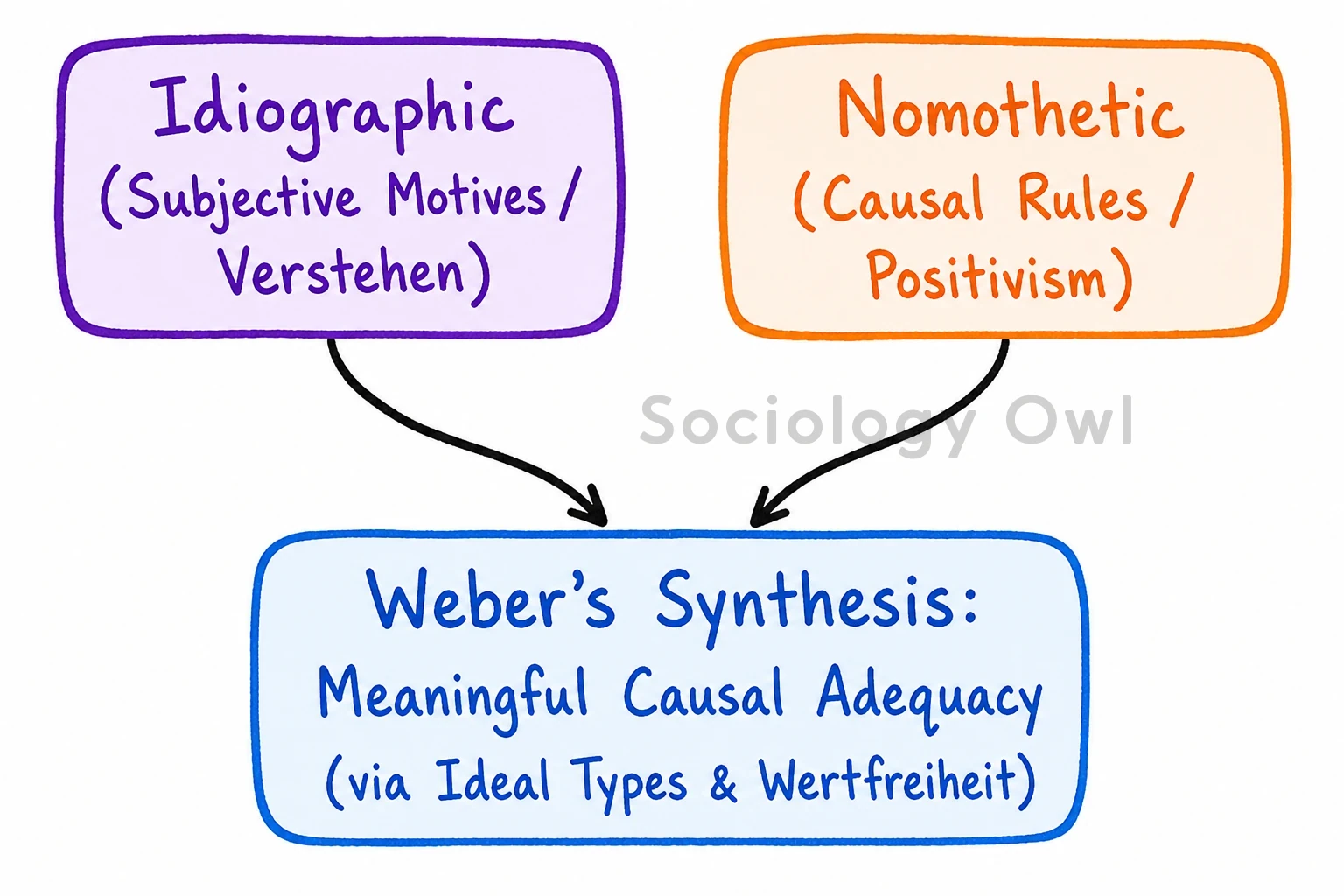
Max Weber’s Verstehen (interpretive understanding) emerged during the German Methodenstreit, bridging the methodological debate by synthesizing positivist (objective/nomothetic) and Wilhelm Dilthey’s interpretivist (subjective/idiographic) traditions.
The Subjectivity-Objectivity Synthesis
- Embracing Subjectivity: Weber analyzes Social Action through Erkl¤rendes Verstehen (motivational understanding) to empathetically grasp the subjective internal motives driving human behavior.
- Ensuring Objectivity: These subjective insights are systematically structured into Erkl¤ren (causal explanation). Scientific objectivity is rigorously safeguarded using analytical constructs like Ideal Types and by maintaining Wertfreiheit (value-neutrality).
Critical Perspectives
- Positivist Critique: Ernest Nagel argued that Verstehen is merely a heuristic device that lacks strict empirical verifiability.
- Phenomenological Critique: Alfred Schutz contended that Weber relied too heavily on objective structural typologies, neglecting the continuous construction of everyday intersubjectivity.
Regarding COVID-19 vaccine hesitancy, positivists objectively count the unvaccinated. Verstehen uniquely decodes the subjective institutional mistrust driving this behavior, enabling holistic sociological explanations.
Conclusion
Max Weber masterfully rescued sociology from cold positivism without abandoning scientific rigor, laying the essential methodological groundwork for modern interpretative traditions like symbolic interactionism.