Model Answer:
Introduction
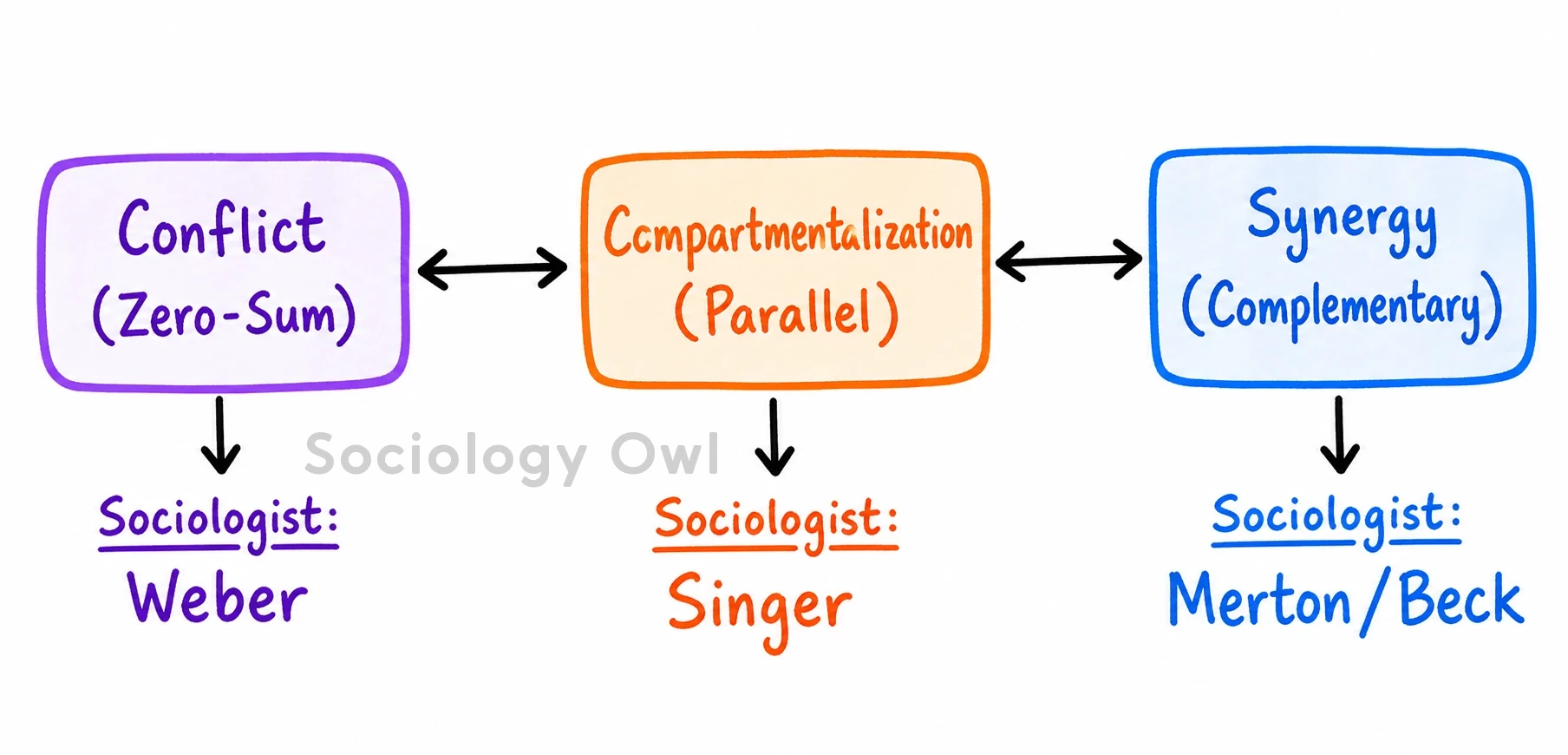
Science (Karl Popper’s focus on empiricism) and religion (Emile Durkheim’s focus on the sacred) interact not as a zero-sum game, but through a complex modern spectrum.
Conflict and Coexistence
Disenchantment: Max Weber argued scientific rationality would inevitably replace faith, causing a “disenchantment of the world.”
Conflict: This friction remains visible in evolution-creationism debates and bioethical disputes (e.g., stem-cell research).
Dual Needs: Bronislaw Malinowski noted that humans inherently require both practical science and religious comfort.
Compartmentalization: Milton Singer explains how modern individuals separate cognitive domains. For instance, ISRO scientists seamlessly perform traditional religious rituals before deploying advanced space technology.
Synergy and Risk: Robert Merton noted historical synergies (Puritan Ethos). Today, Ulrich Beck argues that science-induced crises (“Risk Society”) trigger religious revivalism as people seek secure anchors.
Global Example: Pope Francis’s encyclical Laudato Si successfully integrates climate science with theological moral stewardship.
Conclusion
Science and religion remain complementary frameworks in modern society. While science explains the empirical ‘how’ of the universe, religion continues to provide the existential ‘why’ and fundamental moral anchoring.