Model Answer:
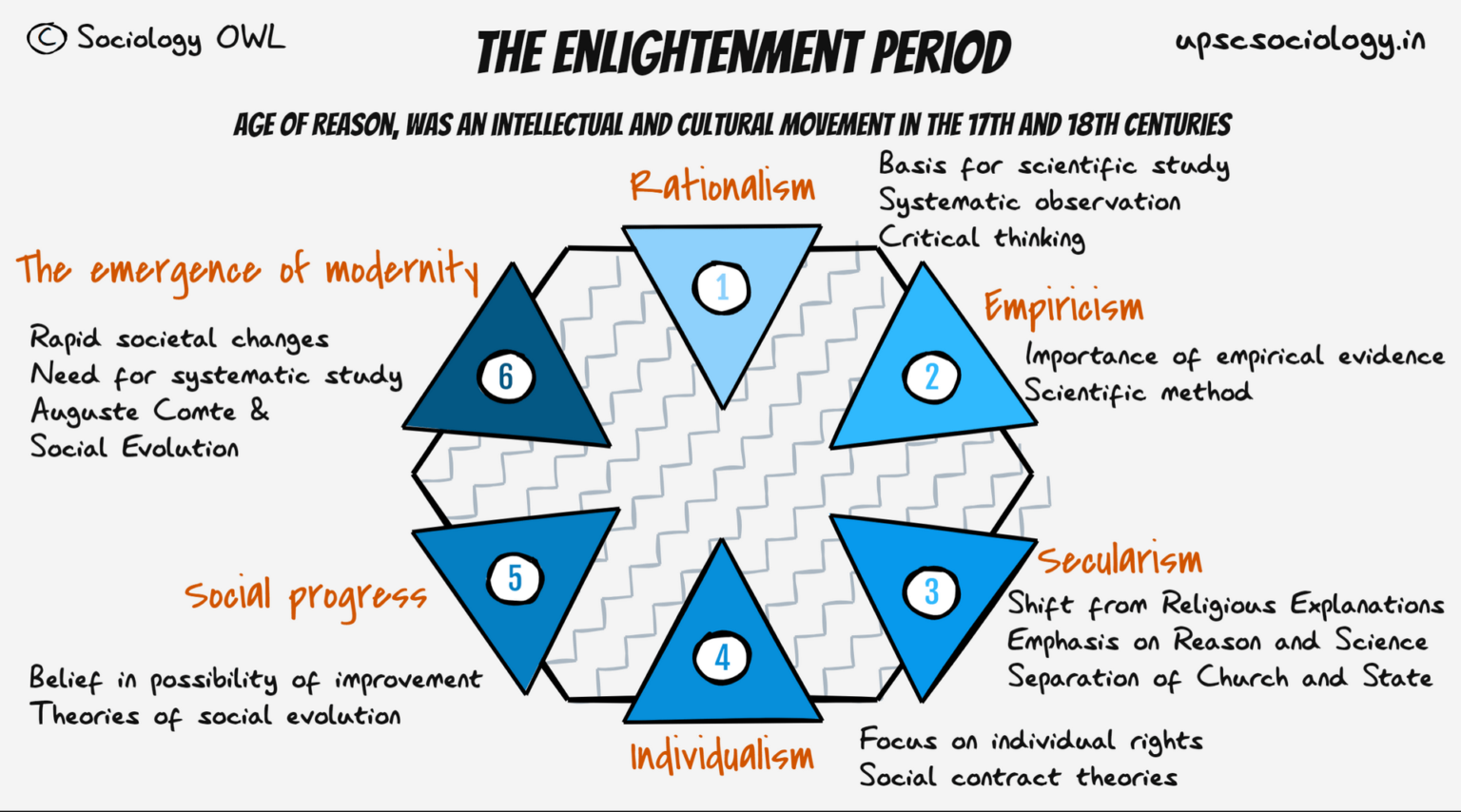
The Enlightenment (18th century) marked a radical shift from a theocentric (God-centered) medieval worldview to an anthropocentric (human-centered) “Age of Reason.” Alongside the material chaos of the French and Industrial Revolutions (the “Dual Revolution”), this intellectual awakening created the epistemological foundation for sociology.
Direct Contributions of the Enlightenment
- Rationalism and the Comparative Method: Thinkers rejected religious dogma in favor of empirical observation. Montesquieu, in The Spirit of the Laws, acted as a proto-sociologist by empirically comparing different societal structures.
- Secularization of Thought: Society was reconceptualized as a human construct rather than divine will. This framework allowed later sociologists like Emile Durkheim to study religion purely as an observable Social Fact.
- Discovery of “Civil Society”: Jean-Jacques Rousseau distinguished between the formal “State” and “Civil Society,” providing sociologists with a distinct structural realm to study independent of political science.
- Teleological View of Progress: The optimistic belief in human perfectibility inspired the systematic study of society for social reform.
Conservative Reaction and Sociological Synthesis
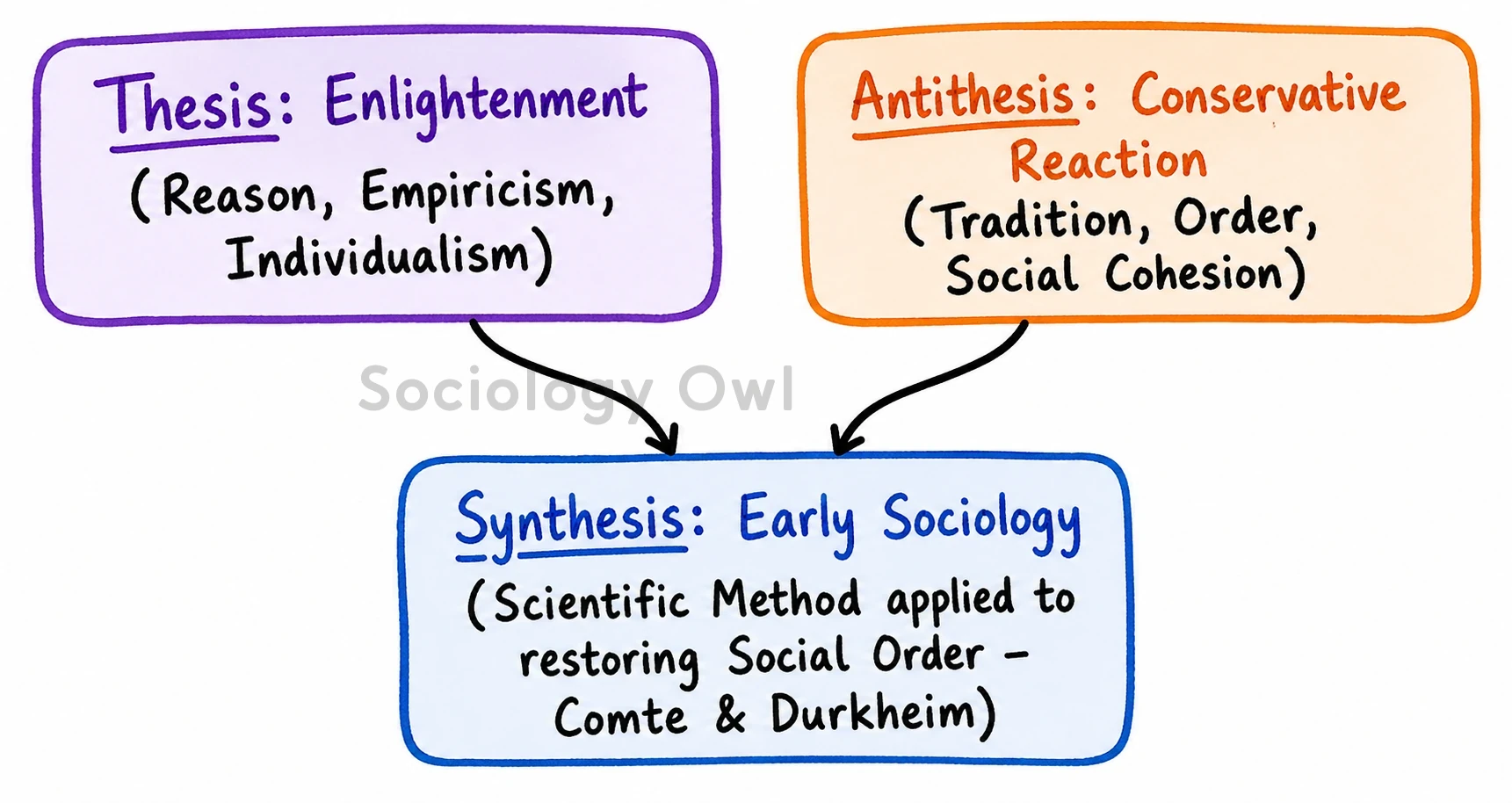
Sociology emerged not just from a linear progression of Enlightenment ideals, but dialectically through a Conservative Reaction.
- Thinkers like Louis de Bonald and Joseph de Maistre fiercely criticized the Enlightenment for promoting extreme individualism and destroying traditional social cohesion.
- Irving Zeitlin famously asserted that “early sociology developed as a reaction to the Enlightenment.”
- Early sociology was a synthesis: Auguste Comte and Emile Durkheim borrowed the scientific method from the Enlightenment but applied it to the Conservative goal of restoring social order. Comte’s motto, “Order and Progress,” perfectly encapsulates this synthesis.
Critical Perspective: The Dark Side of Enlightenment
The Frankfurt School sociologists Theodor Adorno and Max Horkheimer, in Dialectic of Enlightenment, critiqued extreme instrumental rationality, arguing that it ultimately led to modern alienation and hyper-bureaucratized oppression, such as the Holocaust.
Today, sociology uses rational inquiry to study the limits of Enlightenment rationality, evident in the critical analysis of technologically driven algorithmic biases and the global ecological crises born from unchecked scientific “progress.”
Conclusion
Ultimately, sociology emerged as an intellectual response to the structural chaos of modernity. It was born from a unique dialectical synthesis—merging the Enlightenment’s empirical and rational methods with the Conservative desire for social solidarity and structural equilibrium.