Model Answer:
Building on Ernst Troeltsch’s typology, Howard Becker defines a Cult as a loosely organized, transient, and individualistic religious group. Unlike sects, cults introduce entirely new traditions centered on the Charismatic Authority (Max Weber) of a leader.
Factors Driving the Growth of Cults
- Pathologies of Modernity: Capitalism breeds Alienation (Karl Marx) and Anomie (Emile Durkheim). Cults offer a “surrogate family” to overcome isolation in fragmented urban societies.
- Relative Deprivation: Charles Glock argues cults attract individuals facing psychic or social deprivation, rather than mere economic poverty.
- World-Affirming Appeal: Roy Wallis notes that modern “world-affirming” cults promise practical success and self-realization in hyper-competitive capitalist societies.
- Spiritual Marketplace: Secularization (Peter Berger) weakens institutional religions, creating an open market for alternative spiritualities amplified by global media.
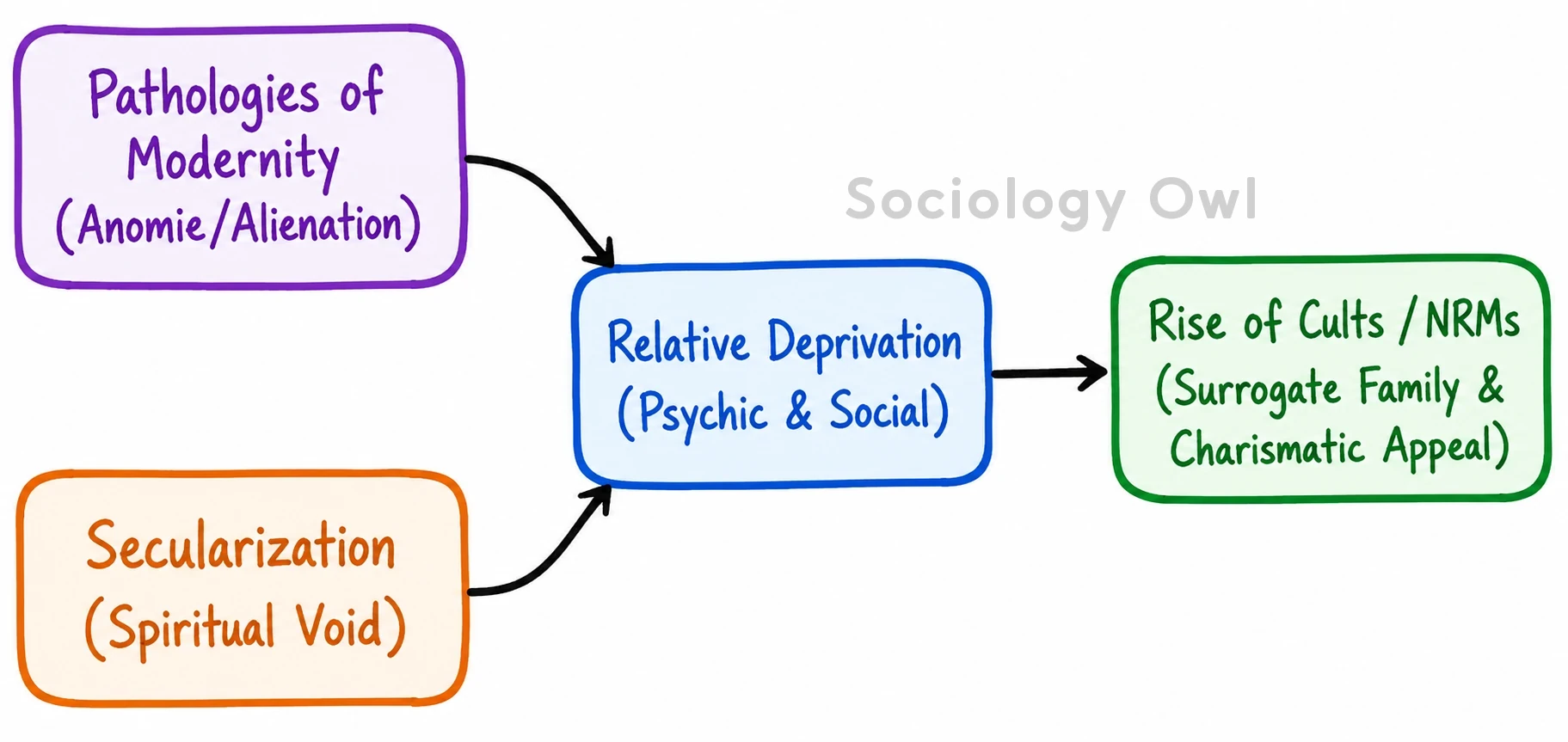
Digital networks have globalized groups like NXIVM and Dera Sacha Sauda, illustrating how charismatic leadership exploits modern psychological vulnerabilities on a transnational scale.
Conclusion
Due to heavy media stigmatization, contemporary sociologists like Eileen Barker advocate replacing the term “cult” with the neutral framework of New Religious Movements (NRMs) to ensure objective sociological inquiry.