Model Answer:
Strain Theory – Conformity and Deviance
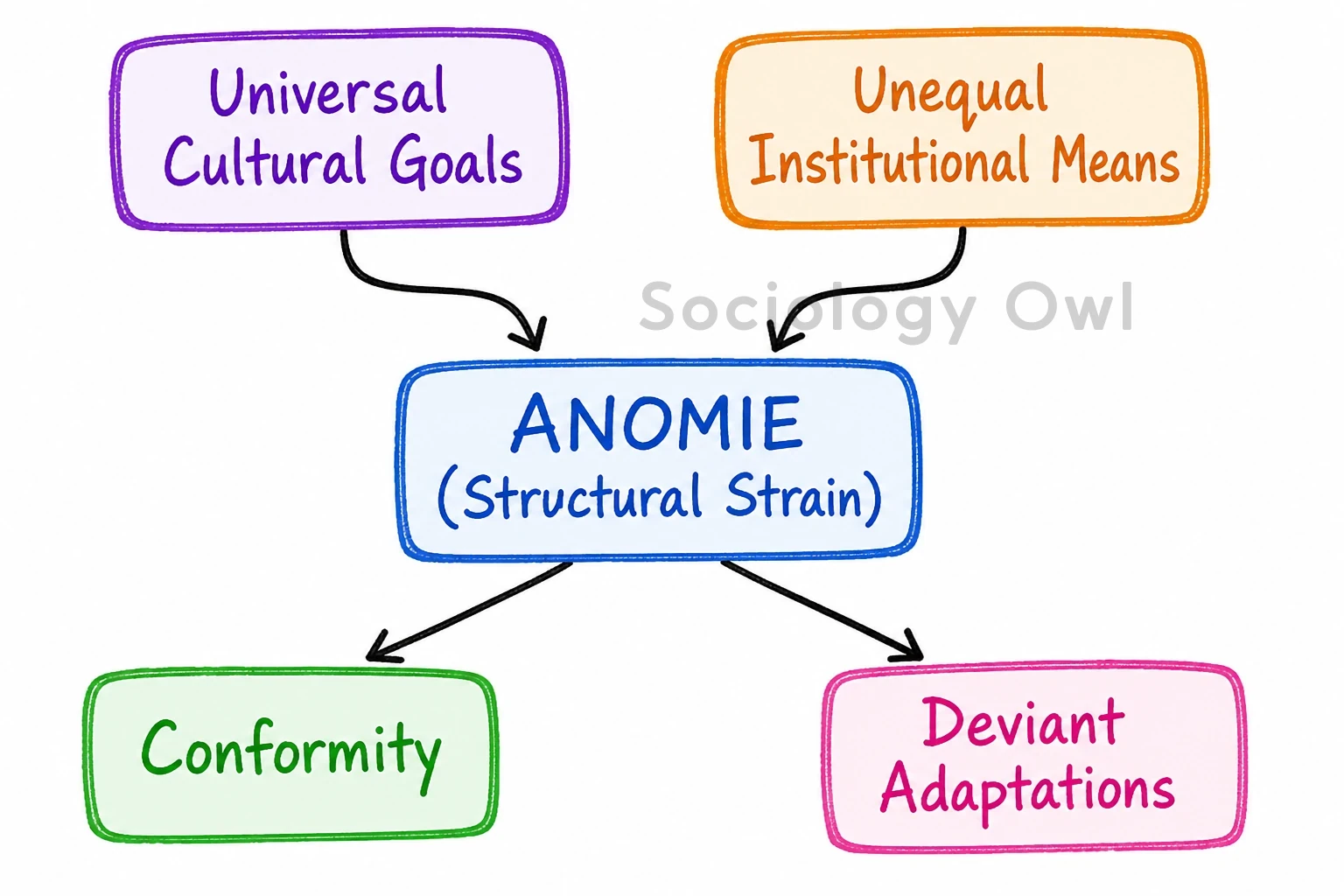
In Social Structure and Anomie, Robert K. Merton shifted deviance from biological pathology to a Structural-Functionalist view. Conformity and deviance coexist not as opposites, but as continuum points adapting to the exact same social structure.
Coexistence occurs because society promotes universal Cultural Goals (e.g., wealth) but unevenly distributes legitimate Institutional Means across classes. This mismatch creates Anomie (strain), generating varied adaptations:
Adaptation Types
- Conformity (+Goals, +Means): Pursuing legitimate careers.
- Innovation (+Goals, -Means): Achieving wealth illegally (e.g., Jamtara cyber-crimes).
- Ritualism (-Goals, +Means): Goal Displacement (e.g., bureaucratic red-tapism).
- Retreatism (-Goals, -Means): Escapism (e.g., youth drug epidemics).
- Rebellion (±Goals, ±Means): Seeking structural overhaul (e.g., Naxalism).
- Critique: Cloward & Ohlin add that Merton ignores that deviants also face unequal access to Illegitimate Opportunity Structures.
In modern aspirational societies, hyper-consumerism amid unemployment continuously breeds both conforming tech-entrepreneurs and “innovative” deviants (e.g., the Vyapam scam) side-by-side.
Conclusion
Merton established that deviance is not a breakdown of society but an integral reflection of its structural inequalities. Reducing deviance therefore requires equitable structural opportunities, not merely punitive laws.