Model Answer:
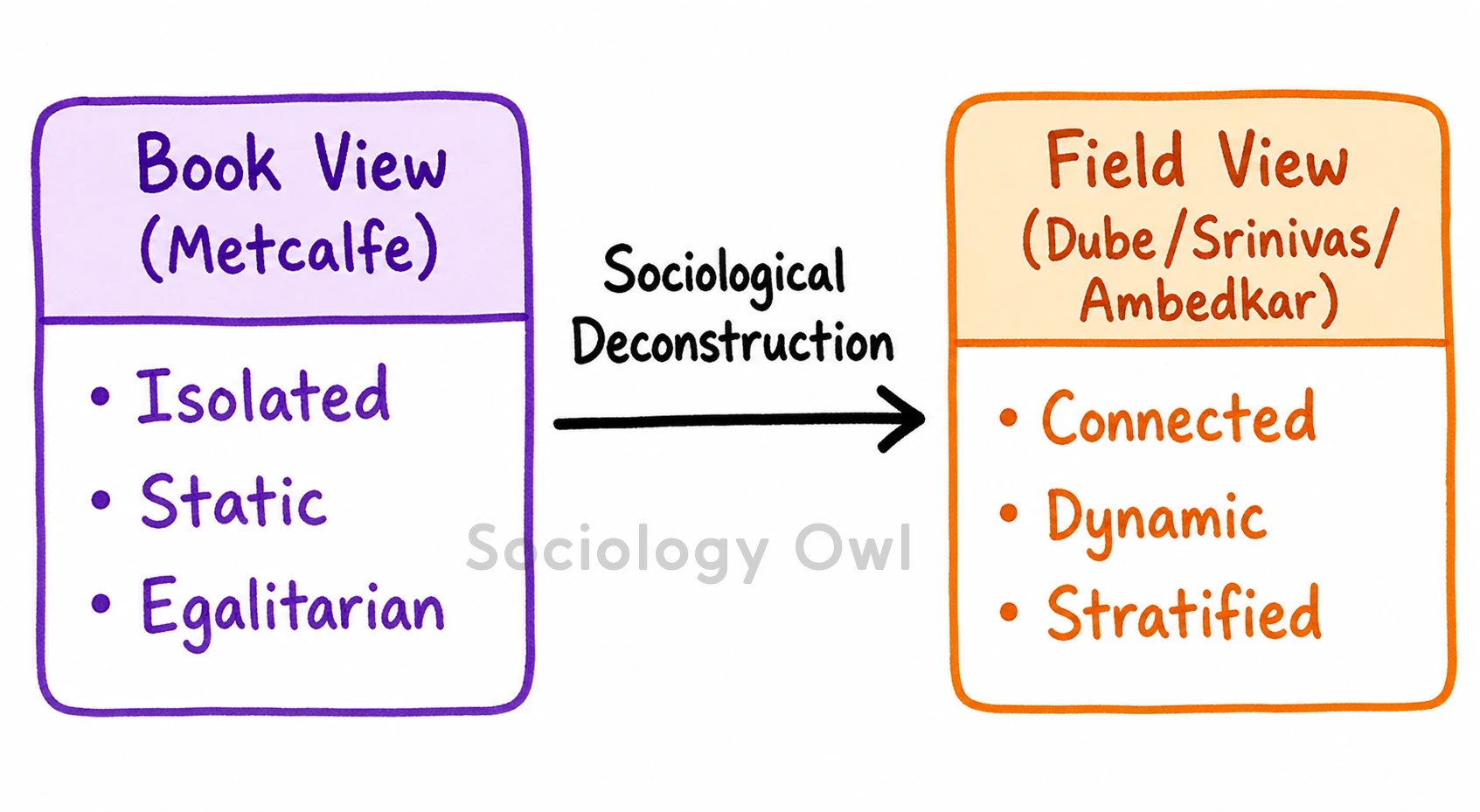
The phrase “Little Republics” was coined by colonial administrator Sir Charles Metcalfe (1832), portraying Indian villages as self-sufficient, egalitarian, and unchanging. While Mahatma Gandhi romanticized this “Book View”, post-independence sociological “Field View” studies decisively debunked it as a colonial myth.
Sociological Critique of the Myth
- Myth of Isolation: In Indian Village, S.C. Dube showed that villages were never isolated entities; they were externally connected through marriage exogamy and the inter-village Jajmani system.
- The Subaltern Critique: B.R. Ambedkar fiercely rejected this romanticization, calling the village a “sink of localism, a den of ignorance, narrow-mindedness, and communalism” characterized by structural violence against Dalits.
- Myth of Egalitarianism: M.N. Srinivas (Dominant Caste) and Andre Beteille (Sripuram study) exposed deep caste-class stratification, disproving the notion of harmonious self-governance.
The 73rd Constitutional Amendment Act attempted to construct actual democratic republics via Panchayati Raj. However, local governance remains challenged by elite capture and gender proxies like the Sarpanch Pati phenomenon.
Conclusion
Today, globalization, agrarian capitalism, and Rurbanization have firmly integrated villages into the macro-economy. The static image of the “Little Republic” is sociologically obsolete, replaced by deeply connected, stratified, and dynamic rural realities.