Model Answer:
Social Mobility: Open and Closed System
P.A. Sorokin (Social and Cultural Mobility) defines social mobility as the movement across social strata, dictated by whether stratification is open (achievement-based) or closed (ascription-based).
Dynamics of Open and Closed Systems
- Open Systems: The Davis-Moore thesis posits that open systems utilize merit-based mobility to allocate talent functionally. Max Weber notes that economic resources dynamically enhance individual “life chances” for upward mobility.
- Closed Systems: Status is strictly birth-ascribed. Louis Dumont (Homo Hierarchicus) illustrates how ritual purity in the caste system prevents individual mobility, permitting only collective movement via Sanskritization.
The Critical Intersection
Pure open systems are a sociological myth. Pierre Bourdieu argues elites leverage Cultural Capital for Social Reproduction, restricting lower-class mobility. Similarly, Frank Parkin highlights “Social Closure”, where privileged groups monopolize resources (e.g., elite degrees) to mimic closed-system dynamics.
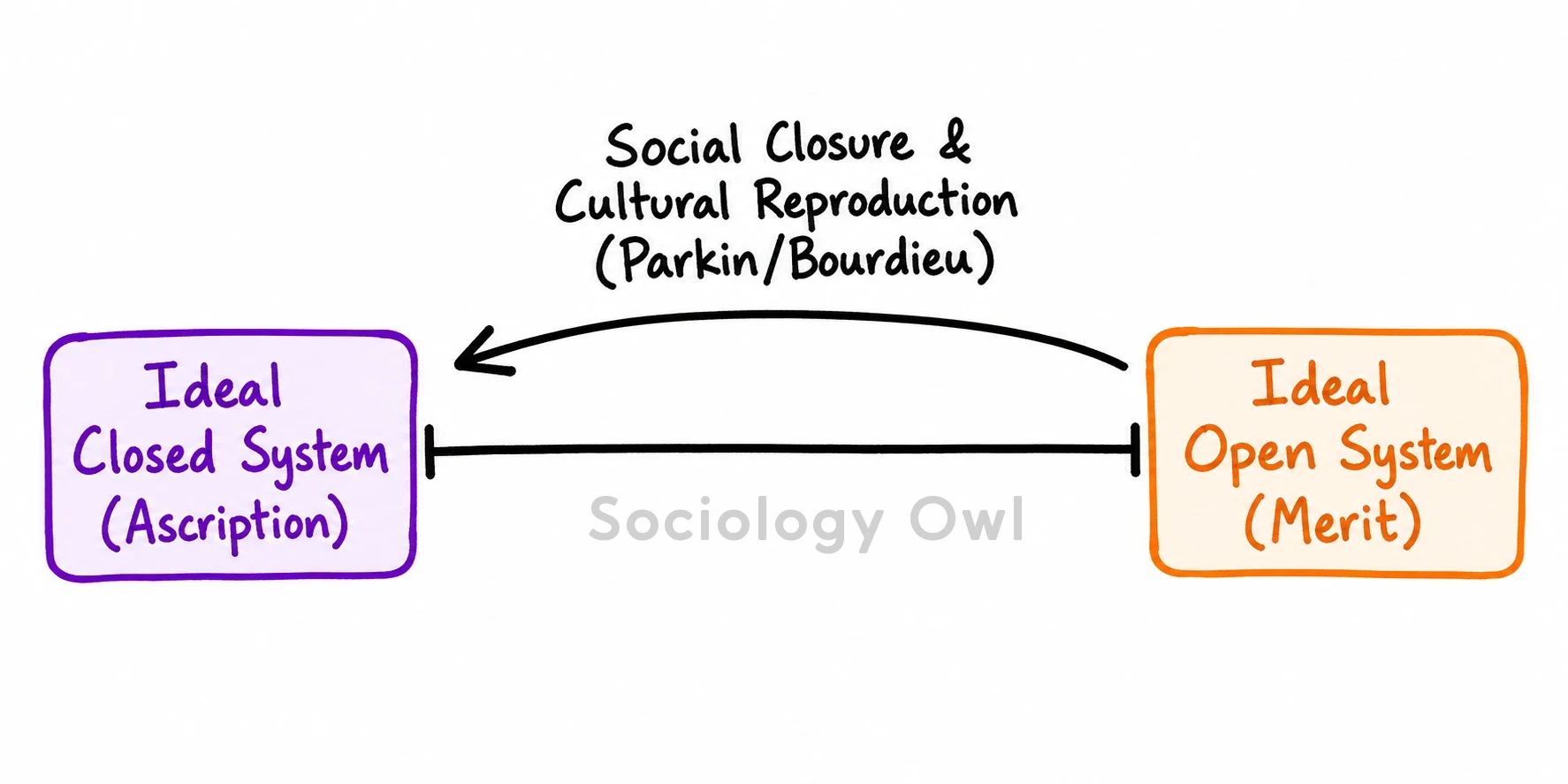
The Great Gatsby Curve highlights declining intergenerational mobility in highly unequal capitalist nations (like the USA), demonstrating closed tendencies within modern open economies.
Conclusion
While contemporary democracies champion open mobility, structural inequalities persist. Achieving genuine social mobility requires dismantling exclusionary closures through robust affirmative action and welfare policies.