Model Answers
Q: Write short note on Manifest and latent functions.
Question asked in UPSC Sociology 2001 Paper 1. Download our app for last 20 year question with model answers.
Model Answer:
Manifest and Latent Functions
Robert K. Merton introduced the concepts of Manifest and Latent functions in his seminal work, Social Theory and Social Structure (1949), to refine the early structural-functionalist approach. Merton argued that early functionalists (like Malinowski) wrongly assumed that all social institutions have universally positive and intended purposes. To correct this, he proposed separating the subjective dispositions (motives) of individuals from the objective consequences (functions) of their actions.
1. Manifest Functions:
- Definition: These are the objective consequences of a social action or institution that are intended and recognized by the participants in the system.
- Nature: They are consciously deliberately planned to achieve a specific goal and are easily observable.
- Classic Example: In the Hopi tribe’s Rain Dance, the manifest function is the conscious intent to appease the gods and bring rain for their crops.
2. Latent Functions:
- Definition: These are the objective consequences of a social action that are unintended and unrecognized by the participants.
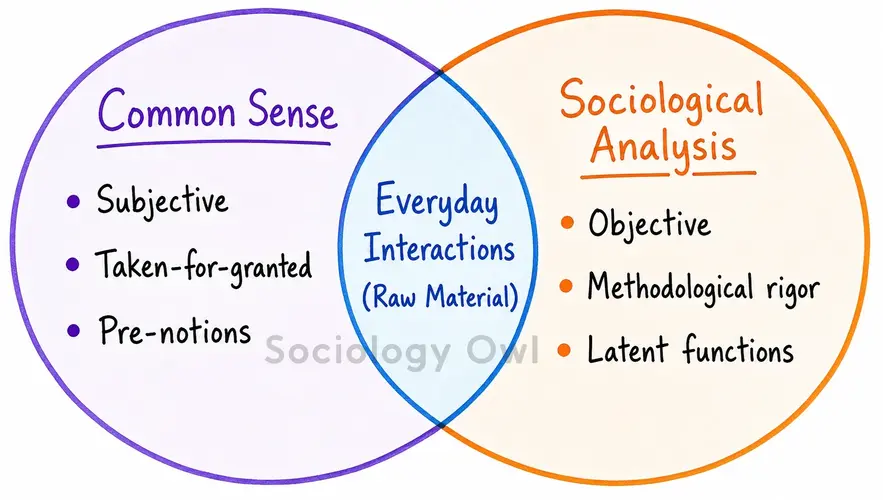
- Nature: They are by-products of social activities. Merton argued that discovering latent functions is the true task of the sociologist, as it goes beyond mere “common sense.”
- Classic Example: In the Hopi Rain Dance, the latent function is the reinforcement of group solidarity and social cohesion during times of ecological crisis, even if it doesn’t actually rain.
Significance in Sociological Analysis:
- Explains “Irrational” Practices: It helps explain why seemingly irrational or harmful practices survive. For example, Merton showed how corrupt “political machines” in the US survived because their latent function was providing immediate welfare to destitute immigrants, which formal government agencies failed to do.
- Overcomes Naïve Functionalism: It forces sociologists to look beneath the surface-level goals of institutions (e.g., the latent function of a prison might be acting as a “school for crime” rather than its manifest goal of rehabilitation).
- Value-Neutrality: It prevents sociologists from making moral judgments, focusing instead on objective sociological realities.
Conclusion
Merton’s dichotomy, along with his introduction of Manifest and Latent Dysfunctions (negative consequences), transformed functionalism from a rigid, conservative ideology into a flexible, dynamic analytical tool that is still used today to analyze modern phenomena, such as the latent impacts of social media on human psychology.
Download our app for UPSC Sociology Optional - Syllabus, NCERT Books, IGNOU Books, Past Paper with Model Answers, Topper Notes & Answer Sheet.