Model Answer:
Pitirim Sorokin, in his seminal work Social Mobility (1927), defines social mobility as the transition of individuals or groups across social strata. This concept is the defining feature distinguishing a Closed System (where status is fixed by ascription, such as the caste system) from an Open System (where status is attained through merit and achievement).
Theoretical Perspectives on Education and Mobility
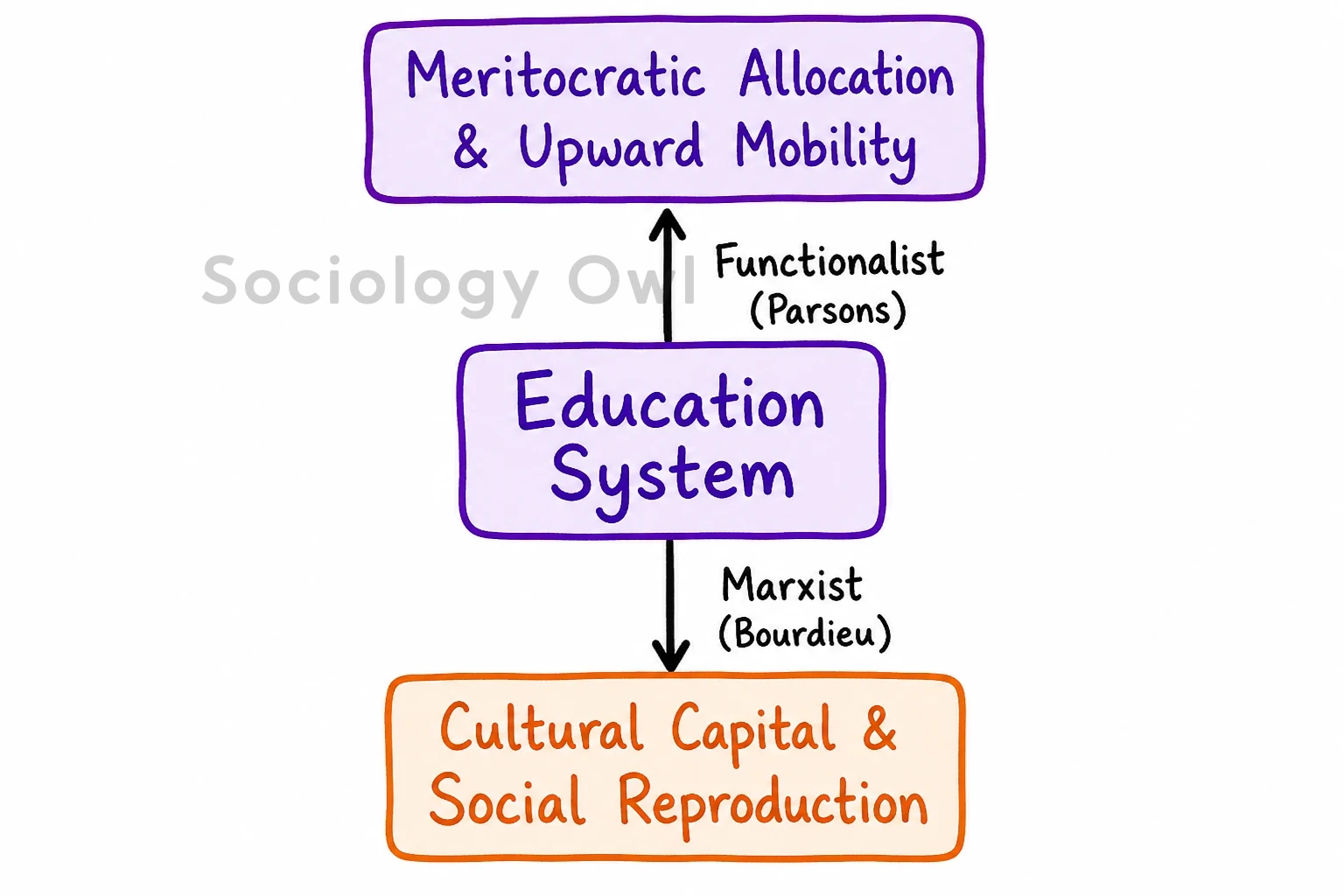
- Functionalist Perspective: Talcott Parsons views education as a meritocratic bridge allocating roles based on talent. Empirically, John Goldthorpe’s Oxford Mobility Study demonstrated that the expansion of the educational system significantly increased absolute mobility by filling new service-sector jobs. Furthermore, Ralph Turner categorized educational pathways into “Contest Mobility” (open competition, e.g., India/USA) and “Sponsored Mobility” (elite selection, e.g., the UK).
- Marxist & Neo-Marxist Perspective: Pierre Bourdieu argues that education reproduces inequality by exclusively rewarding the dominant class’s Cultural Capital. Similarly, Bowles and Gintis, outlining the “Correspondence Principle” in Schooling in Capitalist America, argue that schools mirror workplace hierarchies, socializing working-class students for subordinate roles rather than facilitating mobility.
Structural Barriers to Mobility
- Credentialism: Randall Collins, in The Credential Society, argues that expanding education merely leads to “Credential Inflation”, creating a moving finish line that protects elite status.
- Social Reproduction: Paul Willis’s Learning to Labour illustrates how working-class youth actively reject school culture, self-selecting into manual labor. Additionally, Raymond Boudon notes that mobility is structurally hindered by class-based primary and secondary effects.
- Indian Context: While education and affirmative action have successfully facilitated the rise of a “New Middle Class” (Satish Deshpande), disparities persist for marginalized communities.
The recent pandemic exposed the Digital Divide, revealing that while EdTech promised democratized learning, it actually exacerbated gaps in cultural and economic capital. Consequently, the WEF Global Social Mobility Index consistently links unequal access to quality education with stalled social mobility in developing nations.
Conclusion
While education remains the theoretical engine of an open stratification system, without active state intervention to equalize material and cultural disparities, it risks functioning as a tool that merely legitimizes and reproduces existing structural inequalities.