Introduction and Historical Context
Sociology and Psychology are sibling disciplines within the social sciences, often intersecting but maintaining distinct analytical focal points. The historical evolution of their relationship is characterized by an initial phase of strict boundary maintenance, followed by gradual convergence.
Historically, early sociologists had to fight intellectual battles to establish sociology as an independent discipline, free from psychological reductionism (the tendency to explain social phenomena purely through individual psychological traits). Emile Durkheim, in his seminal work The Rules of Sociological Method (1895), strictly differentiated the two, arguing that sociology studies Social Facts (external, coercive, and general), whereas psychology studies individual mental states. Durkheim’s study on Suicide (1897) was a masterful demonstration of how an apparently individual psychological act has profound sociological roots (e.g., anomie, integration).
Divergence: Key Differences and Theoretical Boundaries
While both disciplines study human behavior, their vantage points differ significantly. A comparative analysis highlights these boundaries:
| Parameter | Sociology | Psychology |
|---|---|---|
| Primary Unit of Analysis | Society, social institutions, groups, and structural networks. | The individual, cognitive processes, and the human psyche. |
| Core Subject Matter | Focuses on social stratification, culture, norms, power dynamics, and social change. | Focuses on perception, cognition, personality, memory, and psychopathology. |
| Theoretical Approach | Macro and meso-level theories (Functionalism, Marxism, Structuralism). | Micro-level theories (Behaviorism, Psychoanalysis, Cognitive Development). |
| Methodology | Surveys, participant observation, historical-comparative methods, and demographic analysis. | Clinical trials, psychometric testing, lab experiments, and neurological scans. |
Convergence: The Interdisciplinary Bridges
Despite Durkheim’s rigid boundaries, later thinkers realized that social structures and individual psyches are mutually constitutive. This gave rise to fields like Social Psychology.
- Max Weber: Bridged the gap through his concept of Social Action and Verstehen (Interpretative Understanding), arguing that sociology must understand the individual motives and meanings behind actions.
- Symbolic Interactionism: Thinkers like George Herbert Mead and Charles Horton Cooley (with his concept of the Looking Glass Self) demonstrated that individual identity and self-consciousness are entirely products of social interaction.
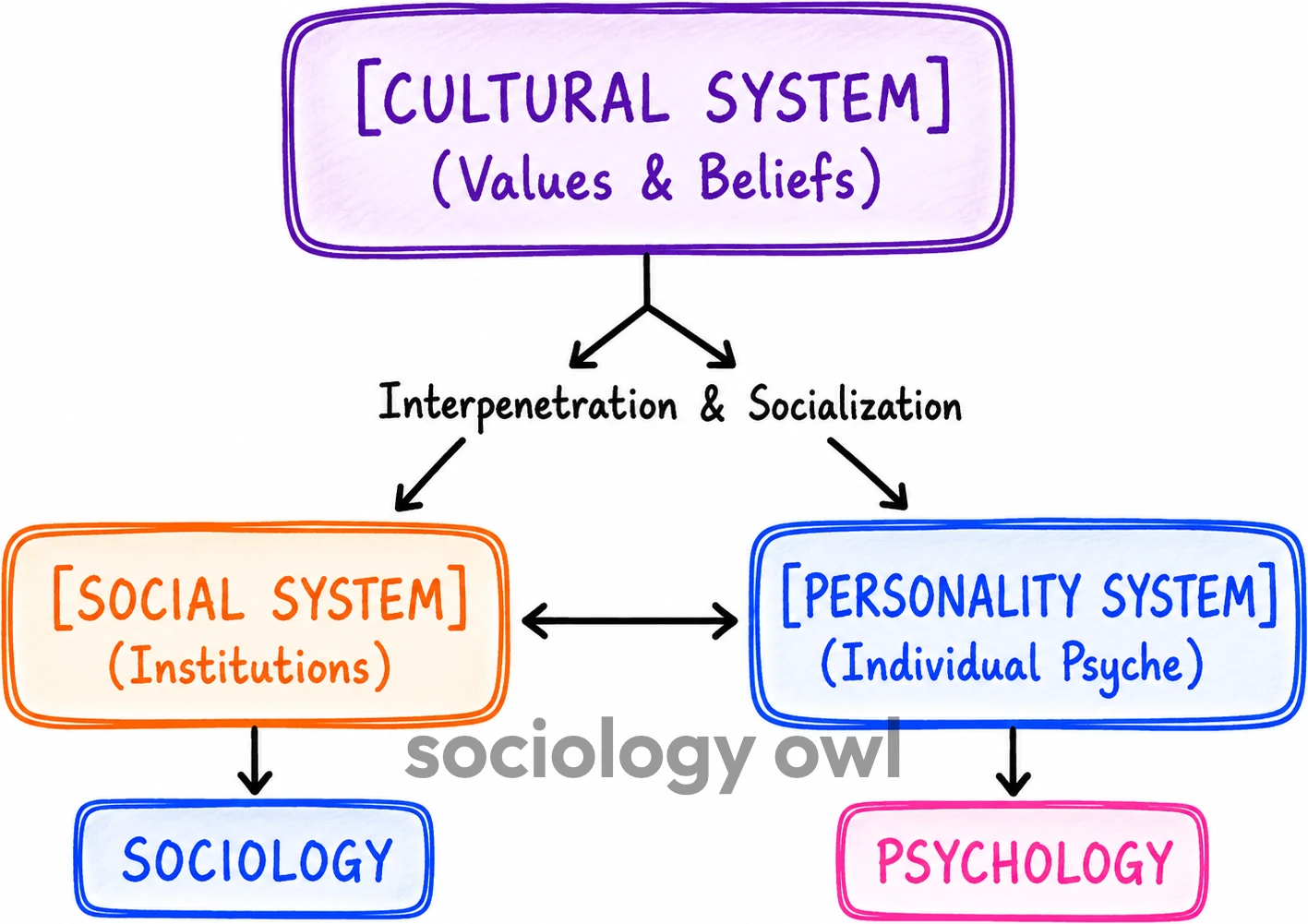
- Talcott Parsons: In his General Theory of Action, Parsons integrated both fields, arguing that the Social System (roles/institutions), the Cultural System (values), and the Personality System (individual psychological motivations) must interpenetrate for a society to function.
- The Frankfurt School: Thinkers like Erich Fromm and Herbert Marcuse synthesized Karl Marx (sociology) with Sigmund Freud (psychology) to explain how capitalist social structures lead to psychological alienation and mass neurosis.
The Indian Context: Psycho-Sociological Perspectives
In the UPSC context (Paper 2), the intersection of sociology and psychology is crucial for understanding the unique cultural and historical realities of India, especially concerning caste, family, and colonialism.
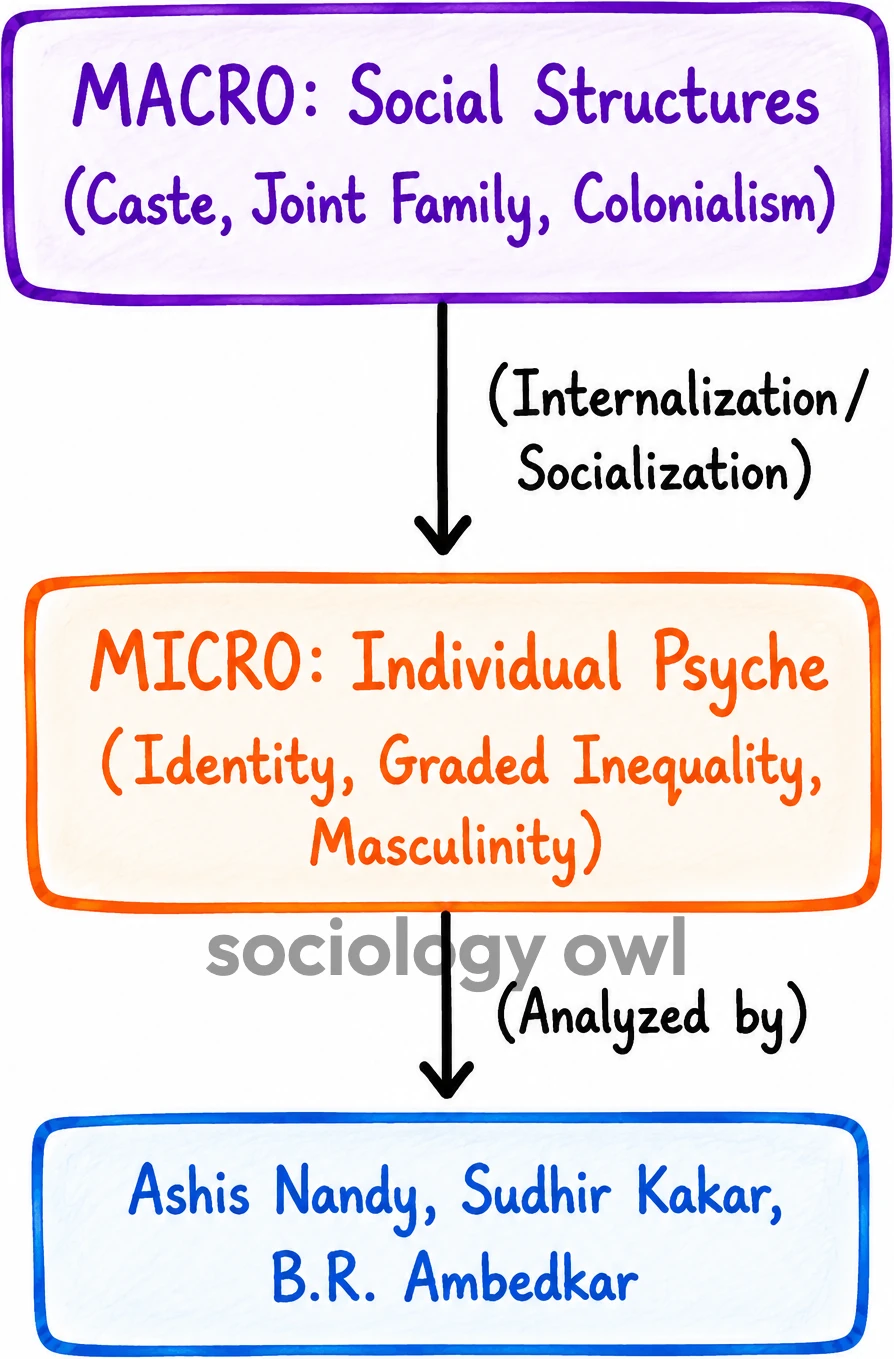
- Sudhir Kakar: A prominent psychoanalyst and sociologist, Kakar in his book The Inner World: A Psycho-analytic Study of Childhood and Society in India, brilliantly blends psychology and sociology to explain how the Indian joint family structure and Hindu cultural myths shape the unique psychological development of Indians.
- Ashis Nandy: In The Intimate Enemy, Nandy explores the psychological consequences of British colonialism on the Indian psyche, demonstrating how colonialism was not just a political/social structure, but a psychological state that altered notions of masculinity and cultural identity.
- B.R. Ambedkar & Caste Psychology: Ambedkar deeply analyzed the psychological dimensions of untouchability. He argued that the caste system survives not just through physical coercion, but through a deeply ingrained graded inequality that affects the psychological self-esteem of the depressed classes and creates a “caste consciousness” in the oppressors.
Contemporary Relevance in a Globalized World
In the modern, highly interconnected world, the boundaries between sociology and psychology are increasingly blurred, making interdisciplinary study essential:
- Mental Health Crisis and Modernity: The rise of depression and anxiety in contemporary urban societies cannot be understood merely clinically. It requires sociological analysis of the Gig Economy, urban alienation, and what modern sociologists call the “burnout society” (Byung-Chul Han).
- Social Media and Echo Chambers: The algorithms of social media platforms manipulate individual psychological vulnerabilities (dopamine loops) to create mass sociological phenomena like political polarization, social movements, and echo chambers.
- Public Policy and Behavioral Nudges: Policies in India like the Swachh Bharat Abhiyan or Beti Bachao Beti Padhao rely heavily on behavioral psychology (nudging) to bring about macro-sociological structural changes in sanitation and gender norms.
Conclusion
The relationship between Sociology and Psychology is not one of opposition, but of deep complementarity. While psychology provides the micro-foundations of human cognition and behavior, sociology provides the macro-context within which this behavior takes meaning. As the legendary sociologist C. Wright Mills articulated through his concept of the Sociological Imagination, the true task of the social sciences is to understand the profound intersection between “personal troubles of milieu” (psychology) and “public issues of social structure” (sociology).
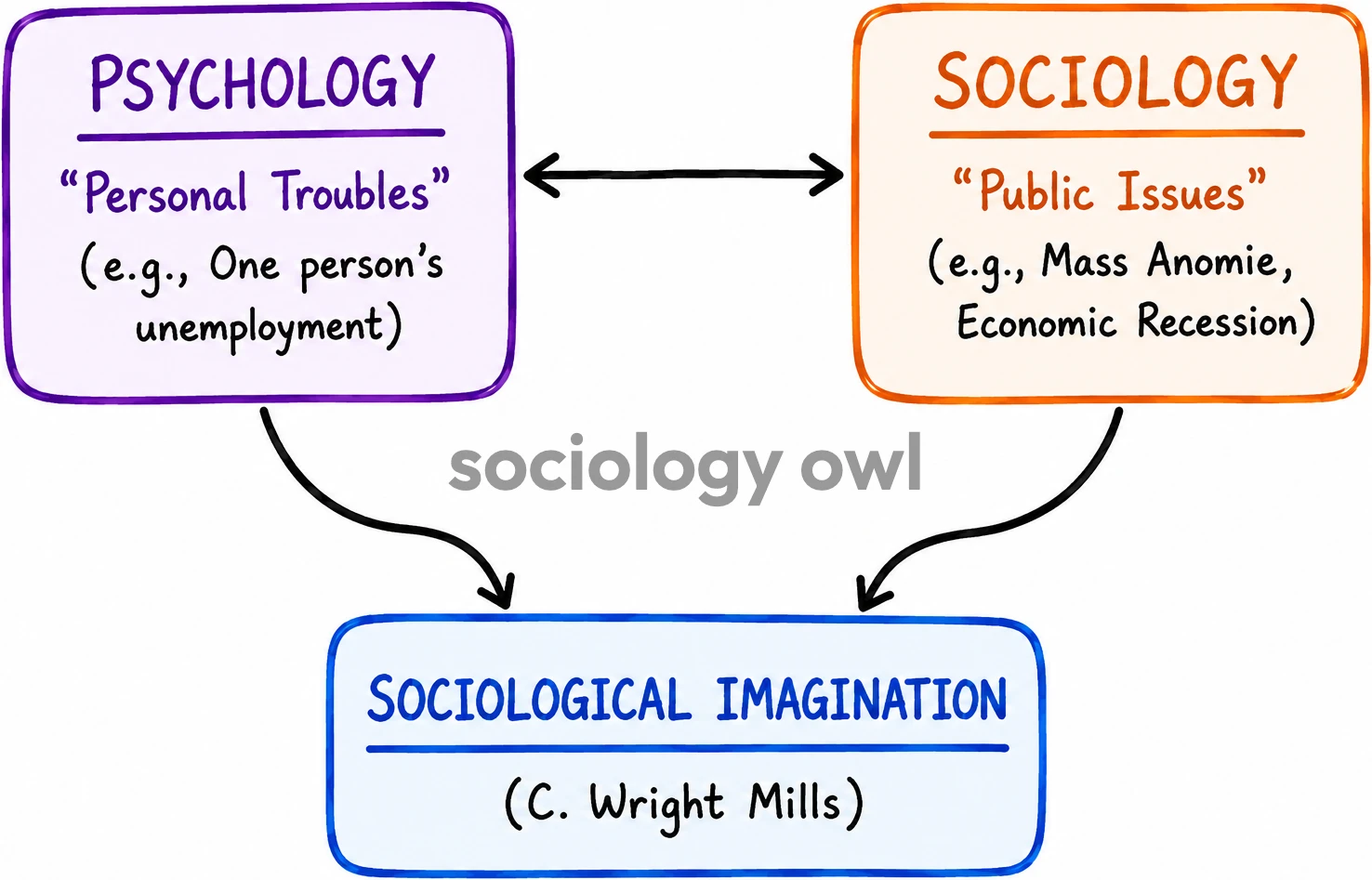
Mastering both is indispensable for a holistic understanding of the human condition.