Introduction
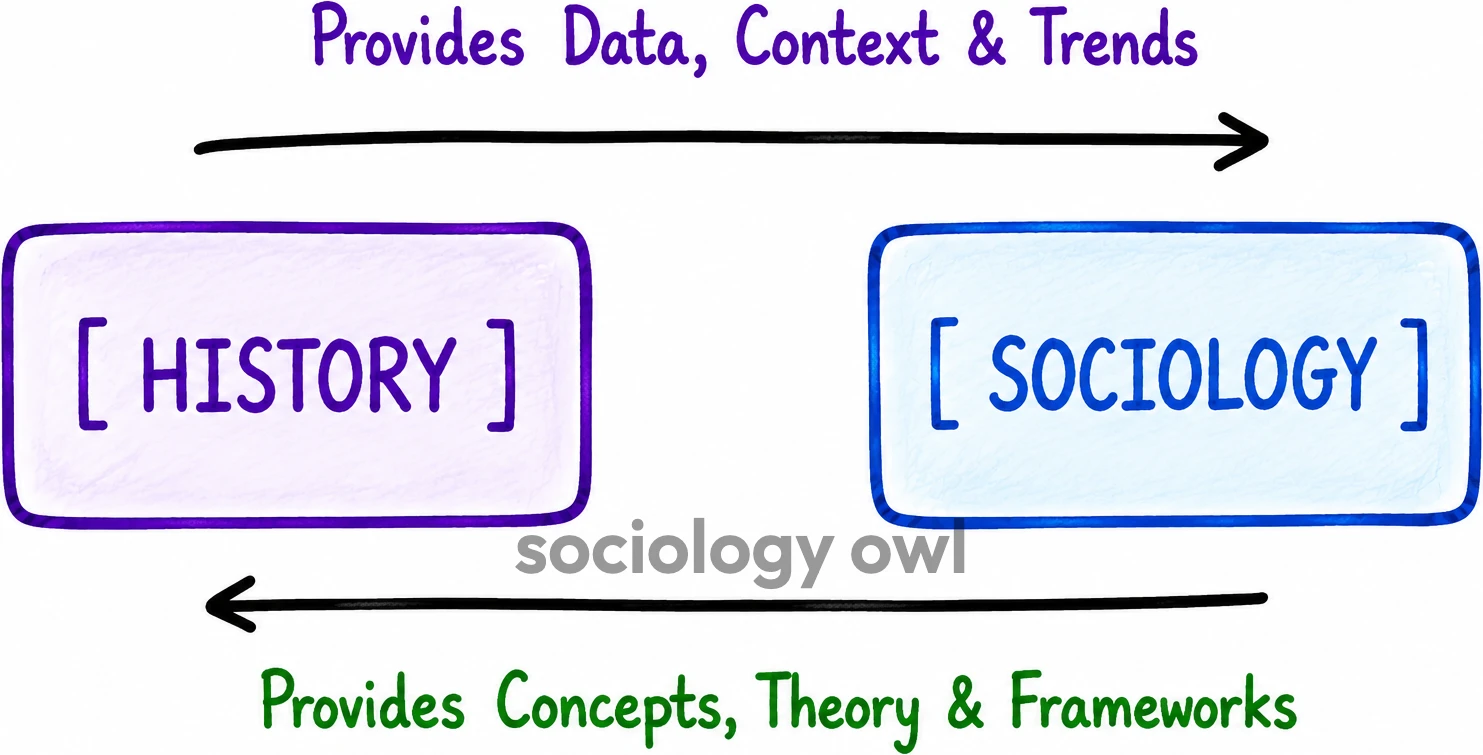
Sociology and history are closely intertwined disciplines that seek to understand human societies. While sociology focuses on the structure, functioning, and dynamics of society, history attempts to reconstruct the past to understand how present social structures have evolved. As the prominent scholar G.E. Howard famously remarked, “History is past Sociology, and Sociology is present History.” For a UPSC aspirant, understanding this relationship is vital for analyzing social continuity and change over time.
Historical Context: The Evolution of the Relationship
In the 19th century, early sociologists relied heavily on historical data to build grand evolutionary theories. Auguste Comte (Law of Three Stages), Herbert Spencer (Social Darwinism), and Karl Marx (Historical Materialism) all used historical trajectories to explain societal evolution.
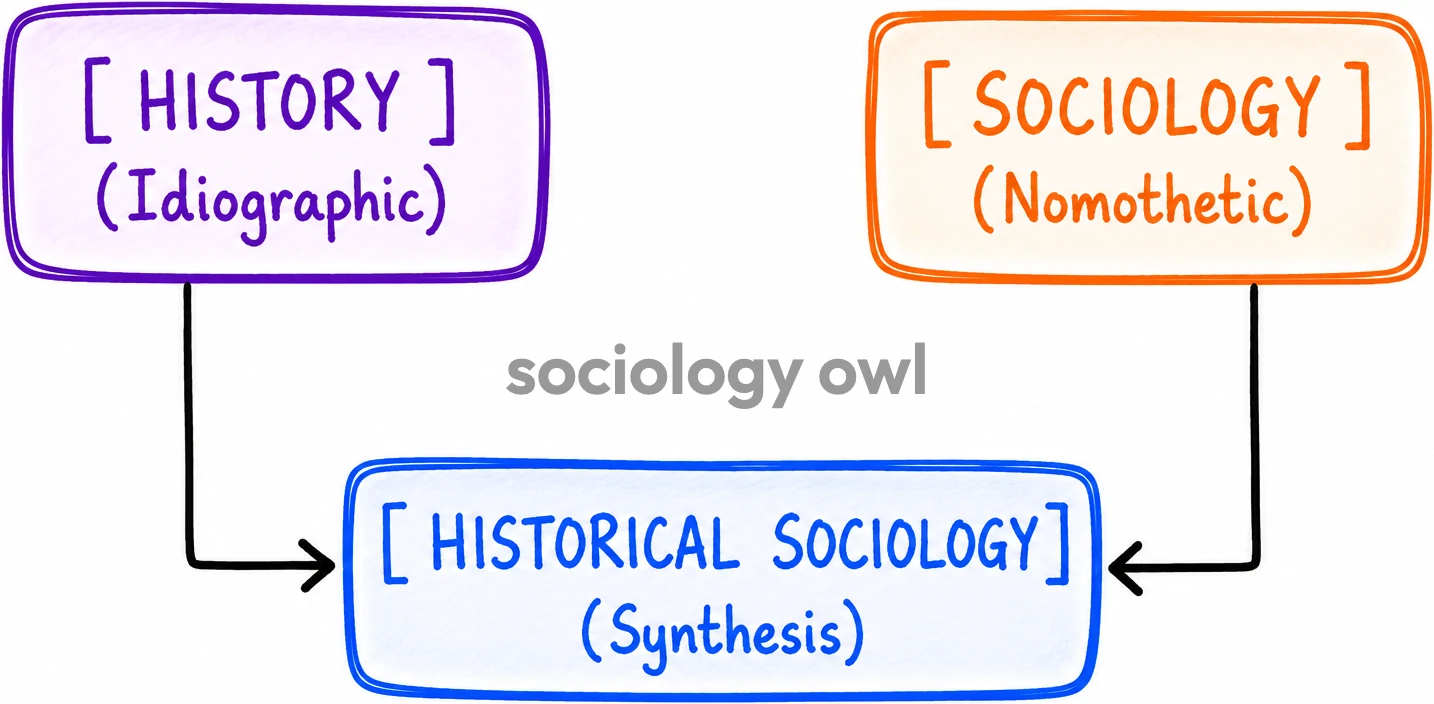
However, early 20th-century scholars like Wilhelm Windelband tried to separate the two by classifying history as an idiographic discipline (focusing on unique, specific past events) and sociology as a nomothetic discipline (focusing on formulating general laws of society). Over time, this rigid boundary blurred, giving rise to Historical Sociology, proving that understanding social phenomena requires historical depth.
Key Differences Between Sociology and History
Despite their interdependence, the two disciplines retain distinct methodological and epistemological approaches:
| Parameter | Sociology | History |
|---|---|---|
| Focus and Scope | Focuses primarily on contemporary society, social structures, and ongoing social processes. | Focuses on past events, their chronological sequence, and specific eras. |
| Nature of Study | Nomothetic: Aims to generalize and build universal theories or laws about human behavior. | Idiographic: Aims to describe unique, particular, and specific events of the past. |
| Methodology | Utilizes both qualitative and quantitative methods (surveys, participant observation, statistics). | Relies heavily on archival research, source criticism, and chronological documentation. |
| Attitude towards Time | Studies the “present” while using the past merely as a tool for context. | Studies the “past” as an end in itself to reconstruct what happened. |
Interdependence: The Confluence of Two Disciplines
How History Informs Sociology
- Providing Data for Sociological Theories: Sociologists often use history as a laboratory to test theories. For example, Max Weber utilized vast historical data in his seminal work, “The Protestant Ethic and the Spirit of Capitalism,” to trace the historical origins of modern capitalism.
- Understanding Social Change: Karl Marx’s concept of Historical Materialism argues that the history of all hitherto existing society is the history of class struggles, making history the bedrock of his sociological framework.
- Contextualizing the Present: C. Wright Mills, in his concept of Sociological Imagination, emphasized that one cannot understand the biography of an individual without understanding the historical epoch they live in.
How Sociology Informs History
- Shift from “Great Men” to “Ordinary Lives”: Sociological tools helped historians shift focus from political history (kings and wars) to Social History. The Annales School, particularly Fernand Braudel, used sociological concepts to study long-term social structures (longue durée) rather than episodic events.
- Providing Analytical Frameworks: The eminent historian E.H. Carr noted that the more sociological history becomes, and the more historical sociology becomes, the better for both. Historians now use concepts like class, gender, and social stratification to interpret the past.
The Indian Context (Integration with Paper 2)
In Indian sociology, the historical approach has been indispensable for understanding the complexities of caste, religion, and agrarian structures:
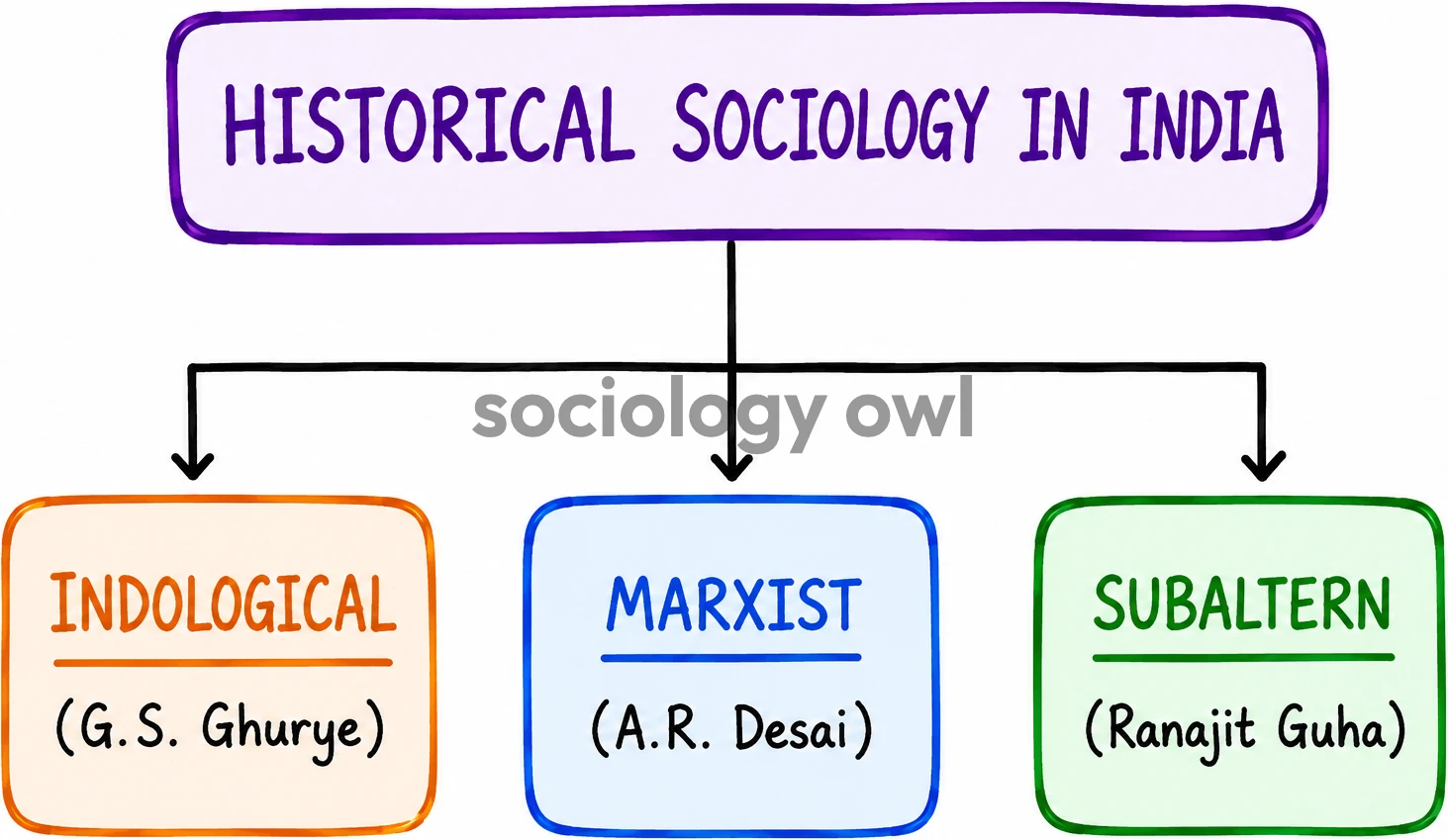
- G.S. Ghurye (Indological Approach): Often regarded as the father of Indian sociology, Ghurye heavily relied on historical and ancient Sanskrit texts (like the Vedas and Manusmriti) to trace the historical evolution of the caste system and kinship networks in India.
- A.R. Desai (Marxist Approach): In his classic book, “Social Background of Indian Nationalism,” Desai used historical materialism to analyze how British colonial history and emerging capitalist structures shaped the Indian national movement.
- Subaltern Studies (Ranajit Guha): Indian historical sociologists critiqued elite historiography and used sociological perspectives to write “history from below,” focusing on the peasant uprisings and tribal movements in colonial India.
- M.N. Srinivas: To develop his concept of Sanskritization, Srinivas utilized a historical understanding of how lower castes historically emulated the rituals and practices of the dominant castes over generations to achieve social mobility.
Contemporary Relevance
In the modern, globalized world, Historical Sociology (championed by scholars like Theda Skocpol and Charles Tilly) is highly relevant. Understanding contemporary global crises—such as the rise of right-wing populism, the structural inequalities exposed by the COVID-19 pandemic, or modern geopolitical conflicts—requires tracing their historical roots. Furthermore, issues like reservation policies, communalism, and secularism in India cannot be comprehended or resolved administratively without a deep sociological understanding of their historical baggage.
Conclusion
Sociology without history is rootless, and history without sociology is fruitless. The synthesis of both disciplines creates a rich, analytical framework that moves beyond mere dates and events to uncover the underlying social forces that shape human destiny. As John Howard noted, “Sociology is history with the hard work left out; history is sociology with the brains left out”—a humorous yet profound reminder that neither discipline can achieve its full potential without the other. For civil servants, this interdisciplinary mastery is crucial for drafting policies that are both historically informed and sociologically sound.