Model Answer:
India’s IT industry, contributing ~8% to the national GDP, has catalyzed the rapid “siliconization” of major urban centers (Bengaluru, Hyderabad, Pune), driving profound and complex socio-economic transformations.
Social Implications
- Cosmopolitanism & Cultural Fusion: Massive influx of skilled inter-state migrants fosters diverse, progressive, and multi-cultural urban micro-societies (e.g., Koramangala in Bengaluru).
- Women Empowerment: High female labor force participation in IT formalizes employment, promoting financial independence and delaying marriage ages.
- Gentrification & Spatial Segregation: Skyrocketing property values displace low-income residents, creating stark contrasts between luxury gated communities and sprawling slums.
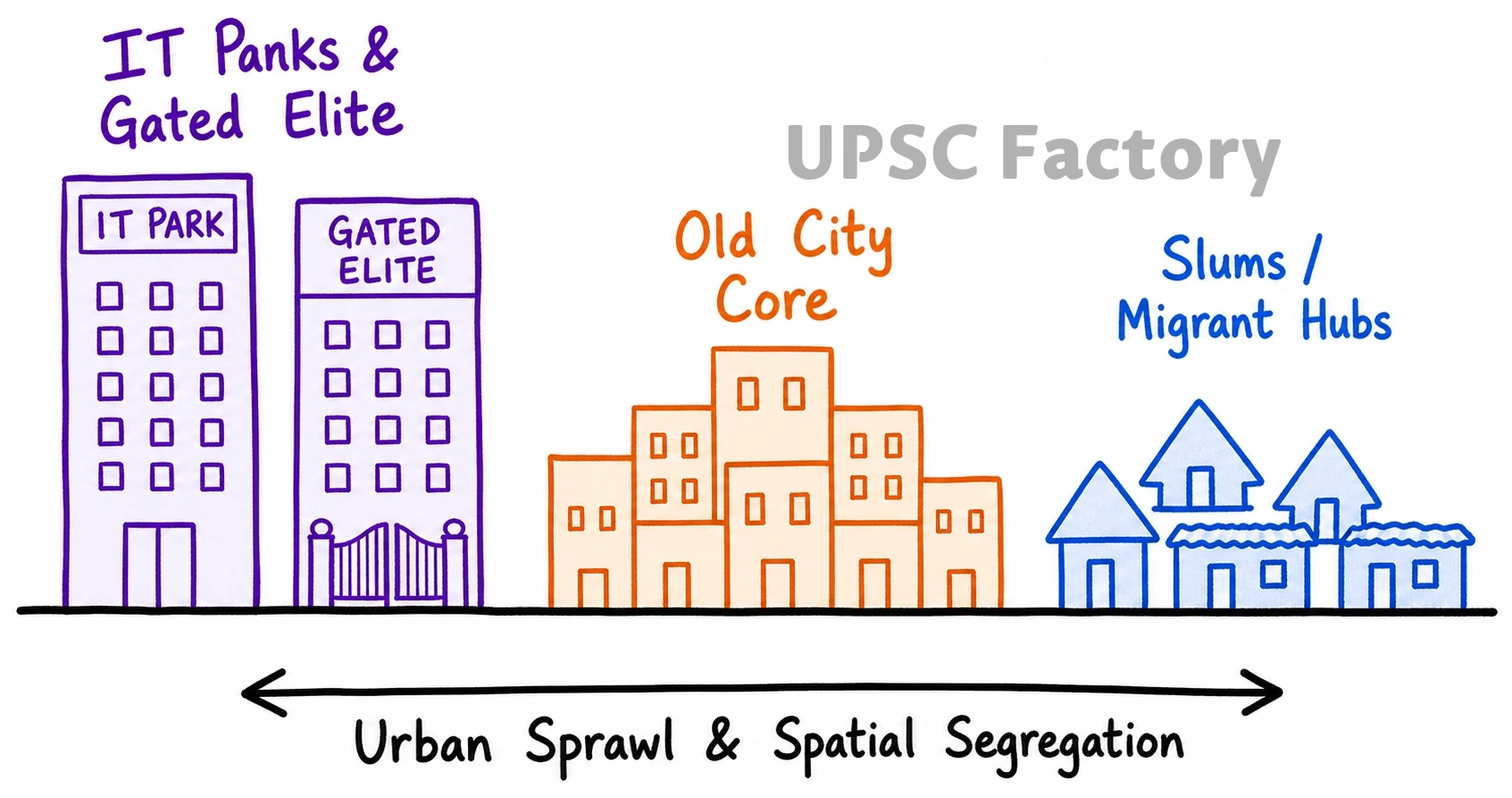
- Civic Infrastructure Strain: Rapid population influx outstrips urban carrying capacity, triggering severe resource deficits (e.g., Bengaluru’s traffic gridlocks and “Day Zero” water crisis).
- Lifestyle Transformations: Sedentary work cultures and high-pressure environments escalate stress, altering family structures and increasing lifestyle-induced diseases.
Economic Implications
- Mass Employment Generation: Directly absorbs millions, acting as a crucial pillar for realizing India’s demographic dividend (NASSCOM reports ~5.4 million direct IT workforce).
- Multiplier Effect on Ancillary Sectors: High disposable incomes spur exponential growth in gig economies, hospitality, retail, and urban transport.
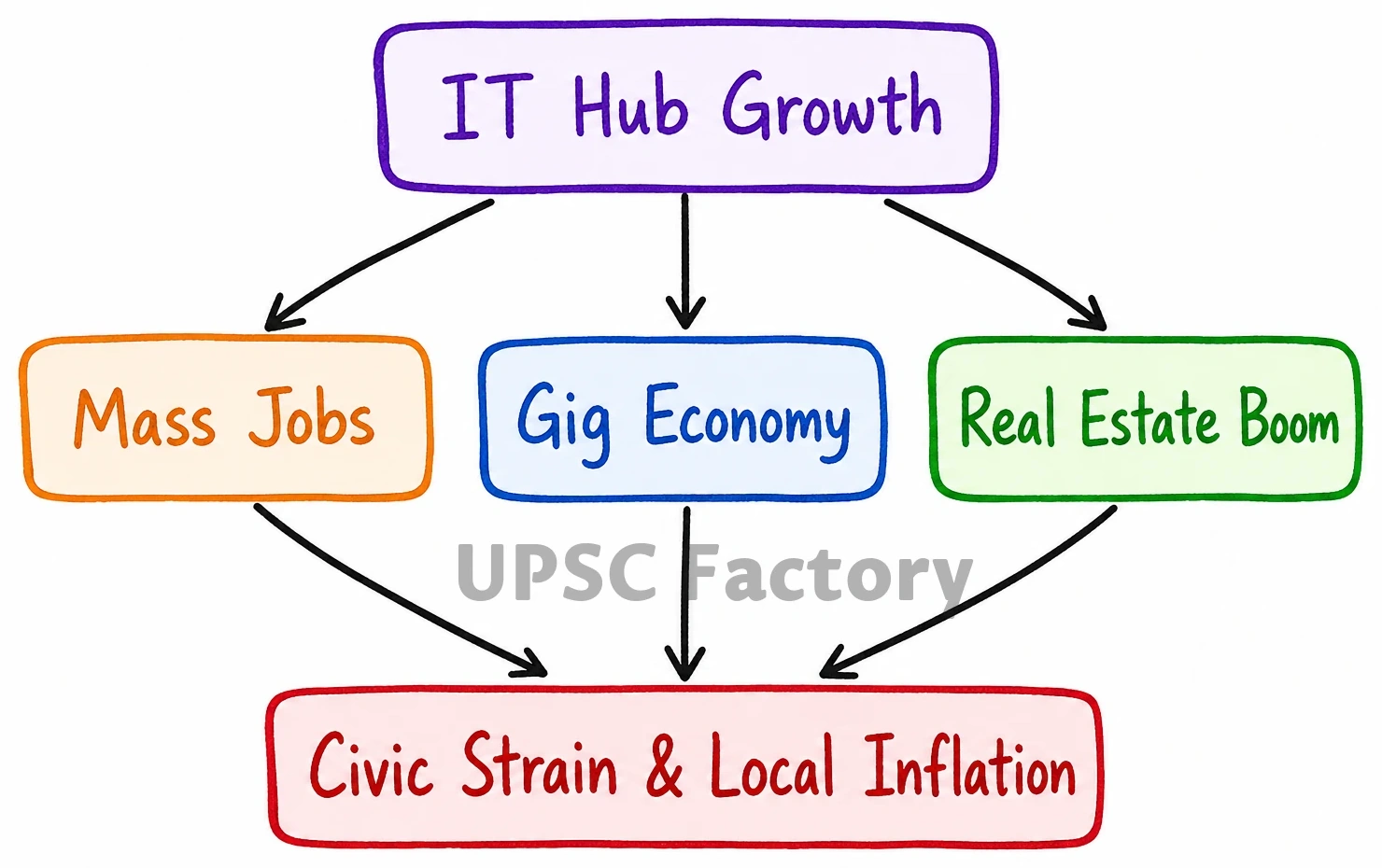
- Real Estate Boom & Urban Sprawl: Surging demand for commercial parks and residential spaces drives aggressive, often unregulated outward city expansion (e.g., Cyberabad, Gurugram).
- Regional Disparities: Hyper-concentration of wealth in a few Tier-1 nodes exacerbates the rural-urban divide and inter-state economic imbalances.
- Localized Inflation: High IT salaries inflate the localized cost of living, severely financially straining the non-IT middle class and unorganized workers.
To ensure equitable growth, India must decentralize IT infrastructure towards Tier-2 and Tier-3 cities (e.g., India BPO Promotion Scheme) while enforcing sustainable, ecologically sensitive urban planning in existing hubs.