Model Answer:
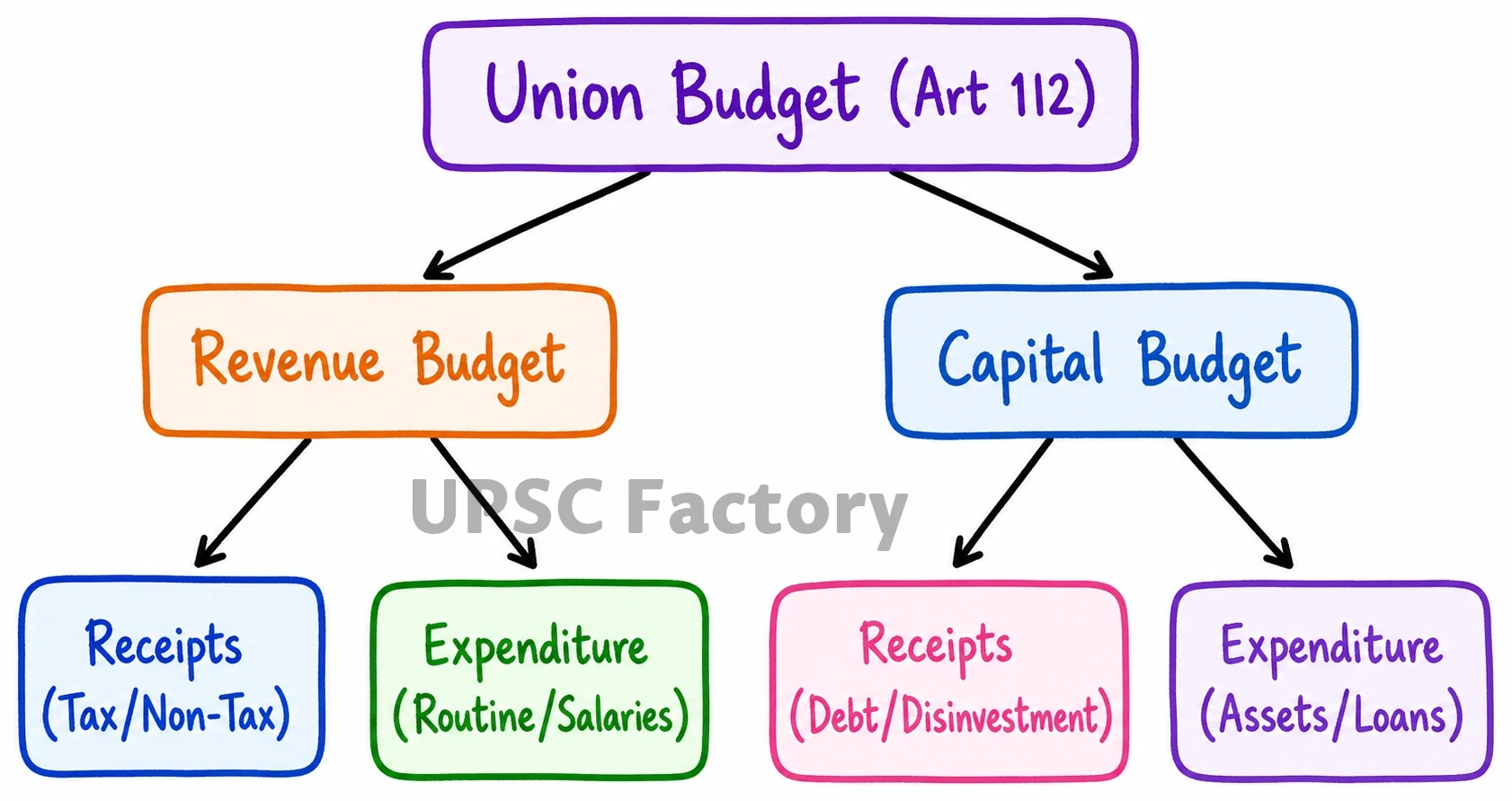
Under Article 112 (Annual Financial Statement), the Union Budget is structurally classified into Revenue and Capital budgets to ensure transparent fiscal management.
1. Capital Budget vs. Revenue Budget
- Asset/Liability Impact: Capital budgets alter government assets or liabilities; Revenue budgets do neither.
- Nature of Transactions: Capital transactions are non-recurring and long-term; Revenue transactions are routine and recurring.
- Economic Multiplier: Capital spending generates high macroeconomic multipliers (PM GatiShakti); Revenue spending facilitates immediate consumption and welfare (PM-KISAN).
2. Components of Revenue Budget
- Revenue Receipts: Funds that neither create liability nor reduce assets. Sub-divided into Tax Revenue (Income tax, GST) and Non-Tax Revenue (Dividends, spectrum fees, grants).
- Revenue Expenditure: Routine operational spending. Includes interest payments, government salaries, subsidies, and grants-in-aid to states.
3. Components of Capital Budget
- Capital Receipts: Funds creating liability or reducing assets. Includes Debt Receipts (Market borrowings, external loans) and Non-Debt Receipts (Disinvestment like Air India, loan recoveries).
- Capital Expenditure: Spending that creates physical/financial assets or reduces liabilities. Includes infrastructure creation (Highways, hospitals) and loans given to States/UTs.
Aligning with the FRBM Act 2003, India’s current fiscal glide path prioritizes eliminating the revenue deficit while expanding capital expenditure to ensure long-term, sustainable economic growth.