Model Answer:
India and Britain share the Westminster democratic model, yet their approaches to Parliamentary sovereignty fundamentally diverge due to distinct constitutional frameworks.
Similarities in the Parliamentary System
- Legislative Primacy: Parliament remains the highest law-making organ in both nations.
- Executive Accountability: The executive derives its power from and remains collectively responsible to the lower house.
Contrasting Approaches to Sovereignty
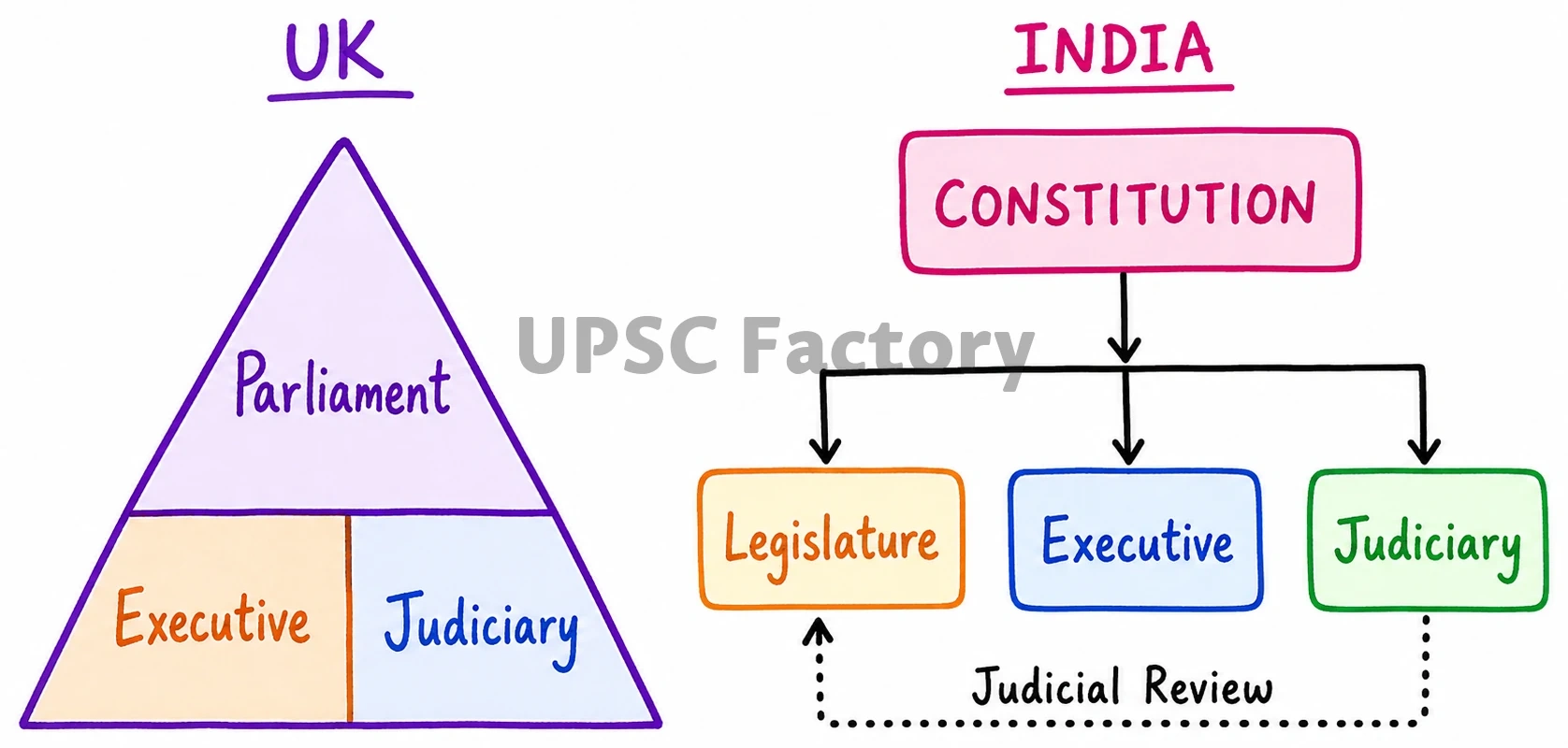
- Source of Supremacy: Britain’s unwritten constitution makes Parliament inherently supreme. In India, the written Constitution is supreme, acting as the ultimate master.
- Nature of Power: The British Parliament holds absolute, undivided legal sovereignty. India’s parliamentary power is subordinate and divided via federalism (Schedule 7).
- Judicial Review: UK courts cannot invalidate parliamentary acts. Indian courts can strike down unconstitutional legislation (Article 13).
- Amendment Constraints: The UK can amend constitutional laws via simple majority. India demands rigid, special majorities for constitutional amendments (Article 368).
- Substantive Limitations: The UK Parliament faces no doctrinal limits. India strictly restricts parliamentary amendments that destroy fundamental constitutional features (Kesavananda Bharati Case 1973; NJAC Act invalidation).
Unlike Britain’s absolute parliamentary sovereignty, India successfully harmonizes parliamentary authority with judicial supremacy, ensuring dynamic governance while upholding strict constitutionalism.