Model Answer:
Pressure groups are organized bodies that advocate for specific interests, acting as critical feedback loops bridging the state and citizens.
1. Role of Pressure Groups in Policy Making
- Expertise Provision: Supplying data-driven insights for evidence-based legislation.
- Consensus Building: Aligning diverse stakeholder demands before policy rollout.
- Feedback Mechanism: Highlighting implementation bottlenecks in existing laws.
2. Contributions of Business Associations to Public Policies
Business associations (like CII, FICCI, ASSOCHAM) utilize institutionalized channels to shape economic governance:
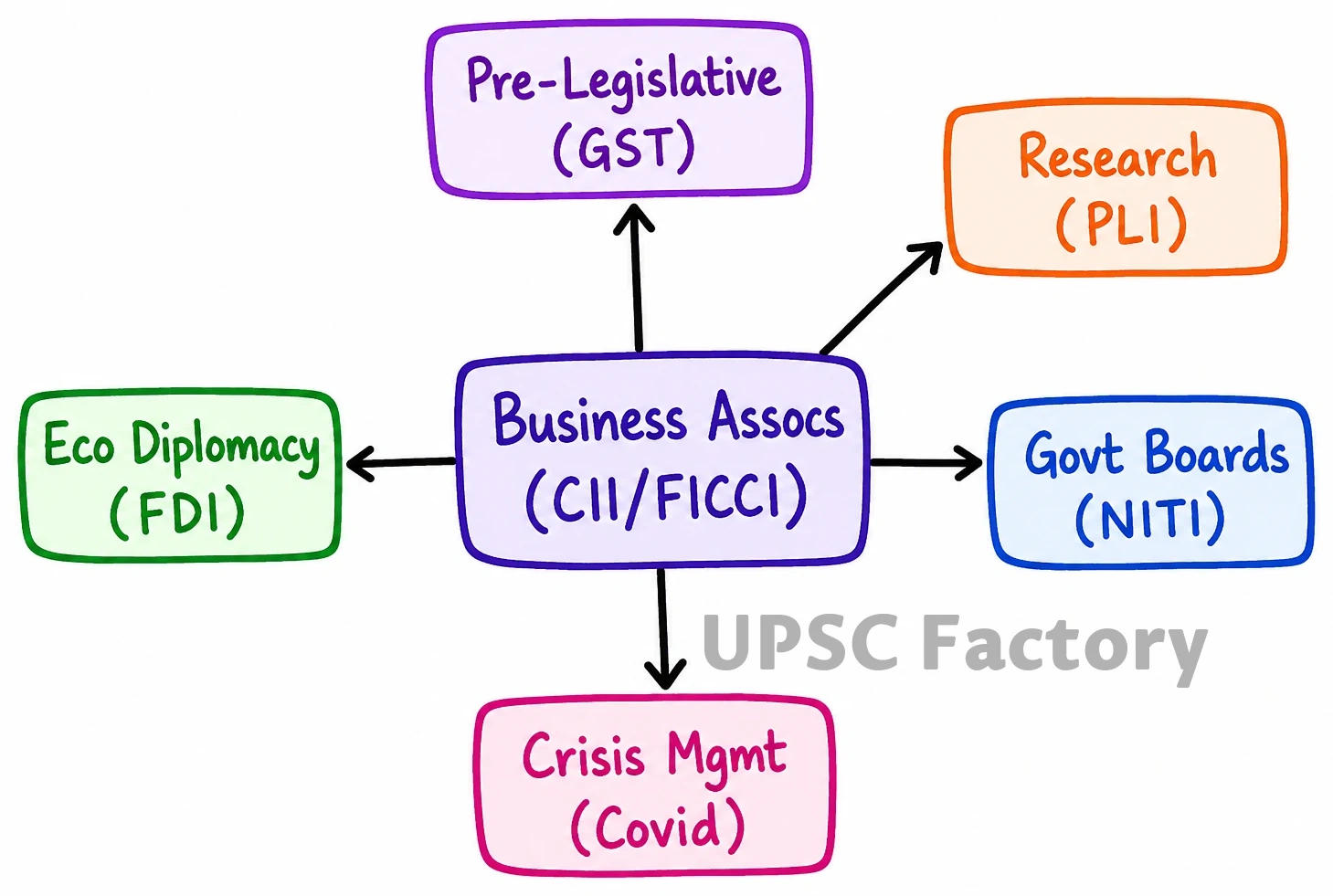
- Pre-legislative Consultation: Providing technical inputs and sectoral data to parliamentary committees (e.g., CII’s crucial role in shaping the GST framework).
- Institutional Representation: Serving on official government boards and task forces (e.g., NITI Aayog expert panels).
- Policy Advocacy & Research: Publishing white papers to influence future economic roadmaps (e.g., FICCI’s advocacy shaping PLI schemes and MSME policy revisions).
- Economic Diplomacy: Assisting the state in global trade negotiations through track-two diplomacy (e.g., ASSOCHAM advising on FDI guidelines).
- Crisis Management: Collaborating with the government to formulate targeted relief strategies during disruptions (e.g., interventions for Covid-19 economic stimulus packages).
While business associations are indispensable for pragmatic economic policymaking, institutionalizing formal lobbying regulations in India is necessary to ensure equitable representation and complete transparency.