Model Answer:
The “Principle of Subsidiarity” asserts decision-making should occur at the lowest competent level. Centralized models breed information asymmetry, fundamentally stymieing inclusive developmental objectives.
1. How Centralization Defeats Development Objectives
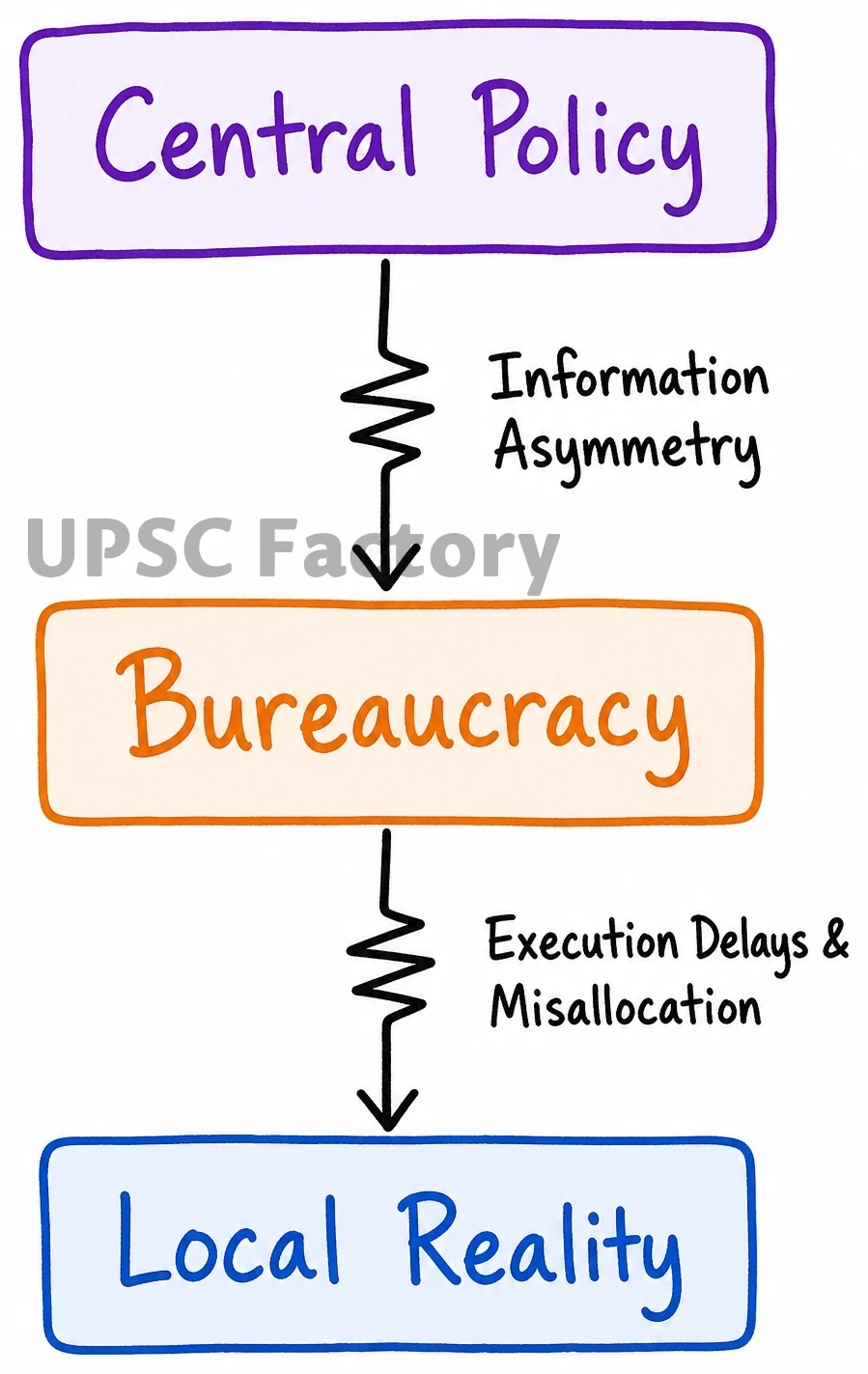
- Information Asymmetry: Top-down policies ignore hyper-local socio-ecological realities, yielding flawed designs (e.g., uniform crop schemes across diverse agro-climatic zones).
- Execution Bottlenecks: Distant bureaucratic hurdles and red tape delay critical fund releases (e.g., delays in MGNREGA material component disbursals).
- Resource Misallocation: Centralized budgeting often funds irrelevant infrastructure over urgent local necessities (e.g., building remote dispensaries lacking medical staff).
- Erosion of Ownership: Without community participation, project sustainability collapses post-implementation (e.g., abandoned sanitation assets lacking local behavioral integration).
- Weak Accountability: Beneficiaries cannot directly penalize distant policy-makers for localized execution failures, enabling persistent systemic apathy.
2. Critical Evaluation: Macro-Planning Realities & Bottom-Up Reforms
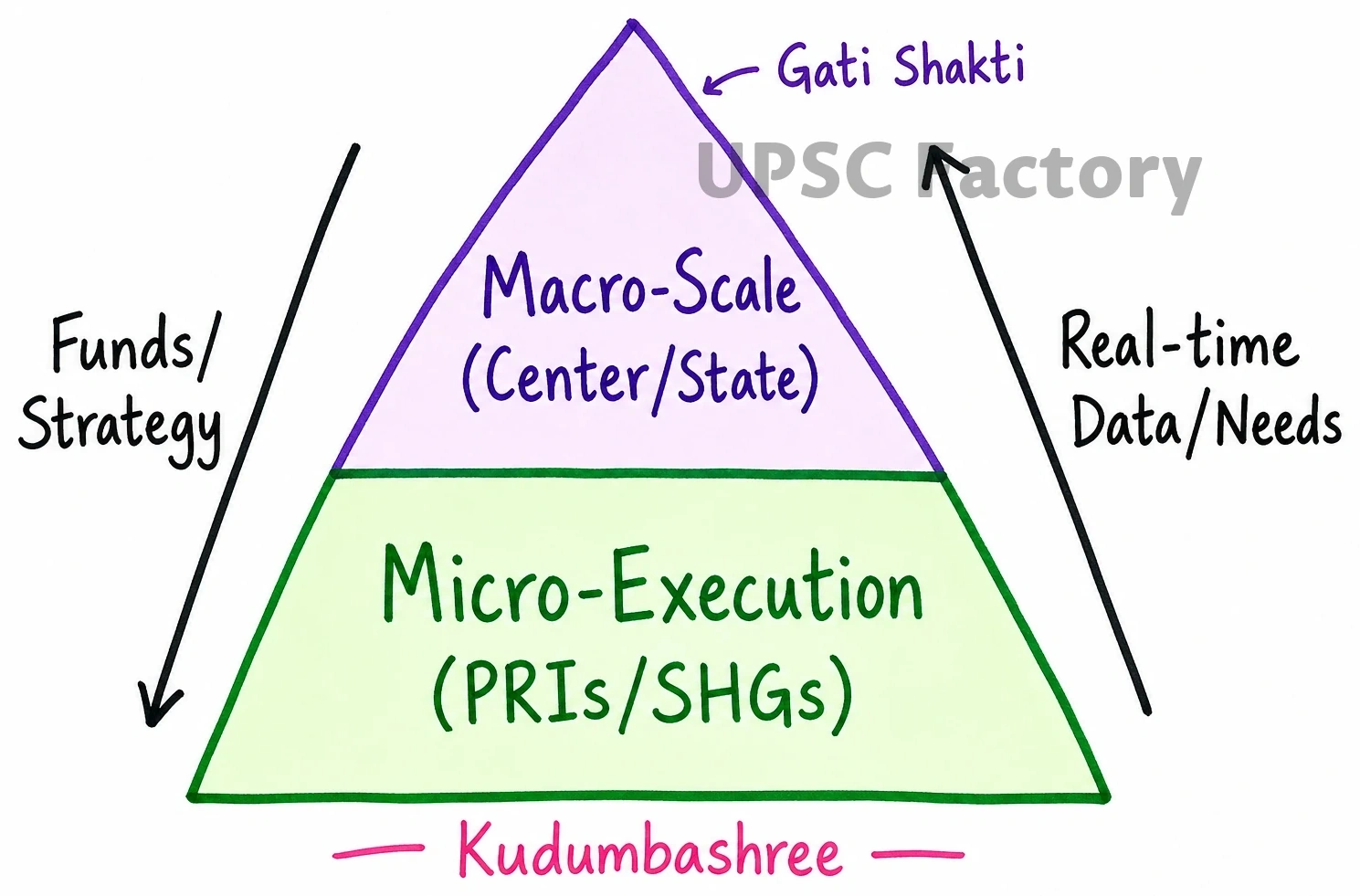
- Macro-Strategic Imperatives: Large-scale infrastructure and digital public goods necessitate centralized coordination and scale (e.g., PM Gati Shakti, UPI architecture).
- Local Capacity Deficits: PRIs often lack technical expertise and face elite capture, hindering complex local execution (e.g., 2nd ARC observations).
- Micro-Planning Successes: Empowered local models drastically improve socio-economic outcomes by bridging information gaps (e.g., Kerala’s Kudumbashree poverty eradication).
- Data-Driven Localization: Decentralizing execution by tracking real-time local metrics bridges policy-implementation gaps (e.g., Aspirational Districts Programme).
- Fiscal Devolution: Direct fund transfers empower local bodies to resolve immediate localized grievances (e.g., 15th Finance Commission local grants).
Achieving sustainable development requires a hybrid model—combining a macro-level strategic vision with decentralized execution through robust capacity building of PRIs and localizing the SDGs.