Model Answer:
Post-1991 reforms shifted the state’s role from direct production to welfare, fundamentally altering social sector expenditure trajectories.
1. Trends in Social Services Expenditure
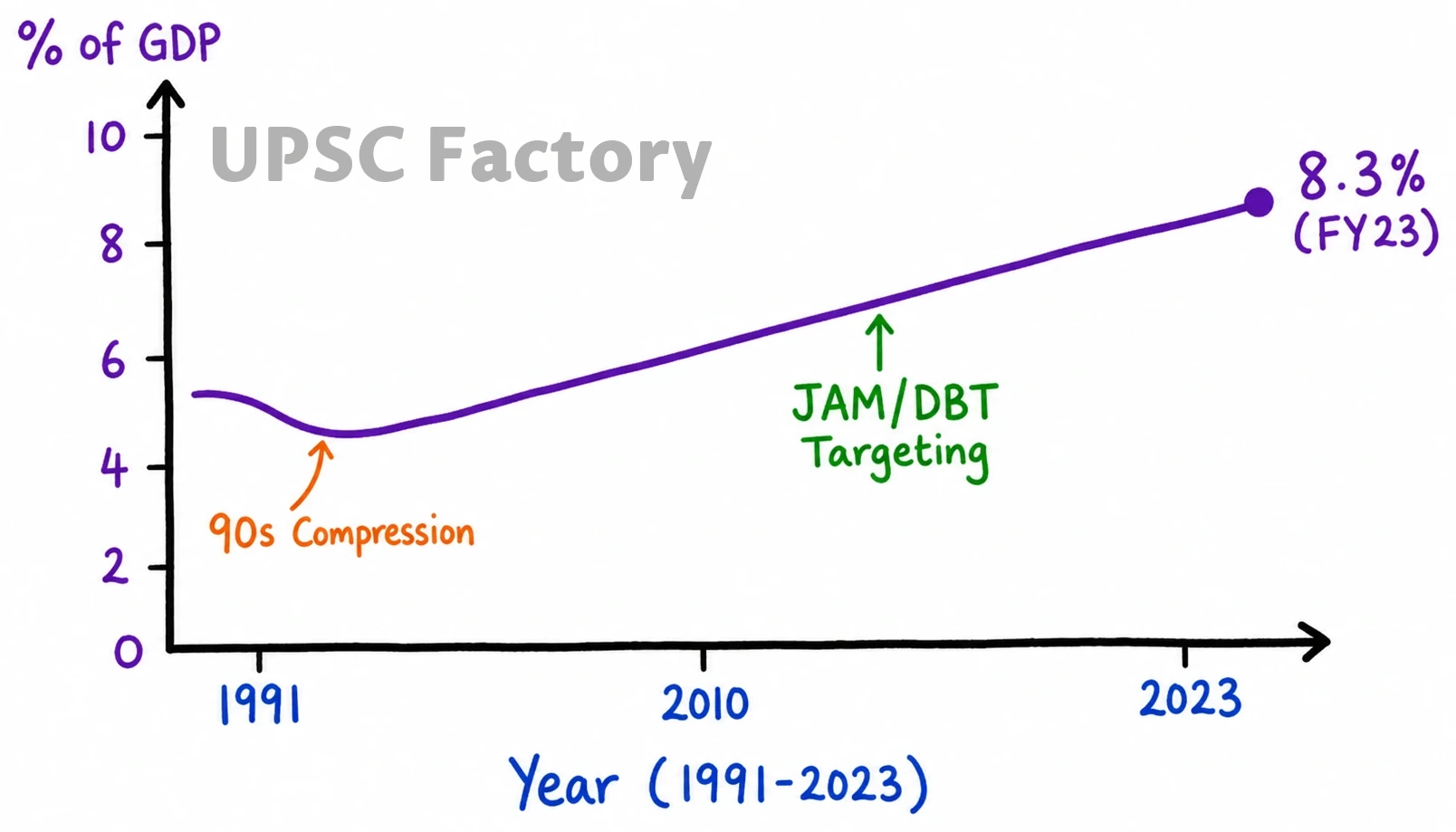
- Initial Compression: Spending dipped early in the 1990s due to structural adjustments and fiscal consolidation.
- Gradual Recovery: Steadily rose, accounting for ~8.3% of GDP by FY23 (Economic Survey).
- Targeted Delivery: Shifted from untargeted, broad-based subsidies to precision welfare delivery (DBT, JAM Trinity).
- Revenue Dominance: Expenditure remains heavily skewed towards revenue components (salaries/subsidies) over long-term capital asset creation.
2. Alignment with Inclusive Growth: Impact & Deficits
- Poverty Alleviation: Contributed to a steep decline in multidimensional poverty to 11.28% (NITI Aayog MPI).
- Safety Nets: Enhanced rural livelihood resilience and equitable healthcare access (MGNREGA, PM-JAY).
- Sub-optimal Funding: Health (~2.1% GDP) and Education (~2.9% GDP) persistently miss National Policy targets.
- Regressive Burden: High Out-of-Pocket Expenditure (~47%) continues to push vulnerable populations into debt.
- Regional Disparities: Poorer states lack the fiscal space to fund matched welfare grants, exacerbating inequalities (FRBM constraints).
Shifting focus from consumption-based subsidies to capability-enhancing social capital investments (health, education, skilling) is essential to actualize truly inclusive and sustainable growth.