Model Answer:
India considers the Central Asian Republics (CARs) its ‘Extended Neighbourhood’, making them increasingly vital for Eurasian connectivity, energy security, and regional stability.
Evolving Relations & Geopolitical Significance
- Diplomatic Elevation: Ties transitioned to structured strategic partnerships, highlighted by the institutionalization of the 1st India-Central Asia Summit (2022).
- Economic & Energy Synergy: Growing cooperation in critical minerals and energy security (e.g., Kazakhstan’s uranium supply) amidst global supply chain shifts.
- Strategic & Security Alignment: Enhanced joint counter-terrorism mechanisms and defense capacity building (e.g., Tajikistan’s Farkhor airbase) addressing Af-Pak instability.
- Geopolitical Pivot: CARs increasingly serve as an independent balancing force against dominant regional powers (Russia, China) in the Eurasian heartland.
Bottlenecks & Critical Limitations
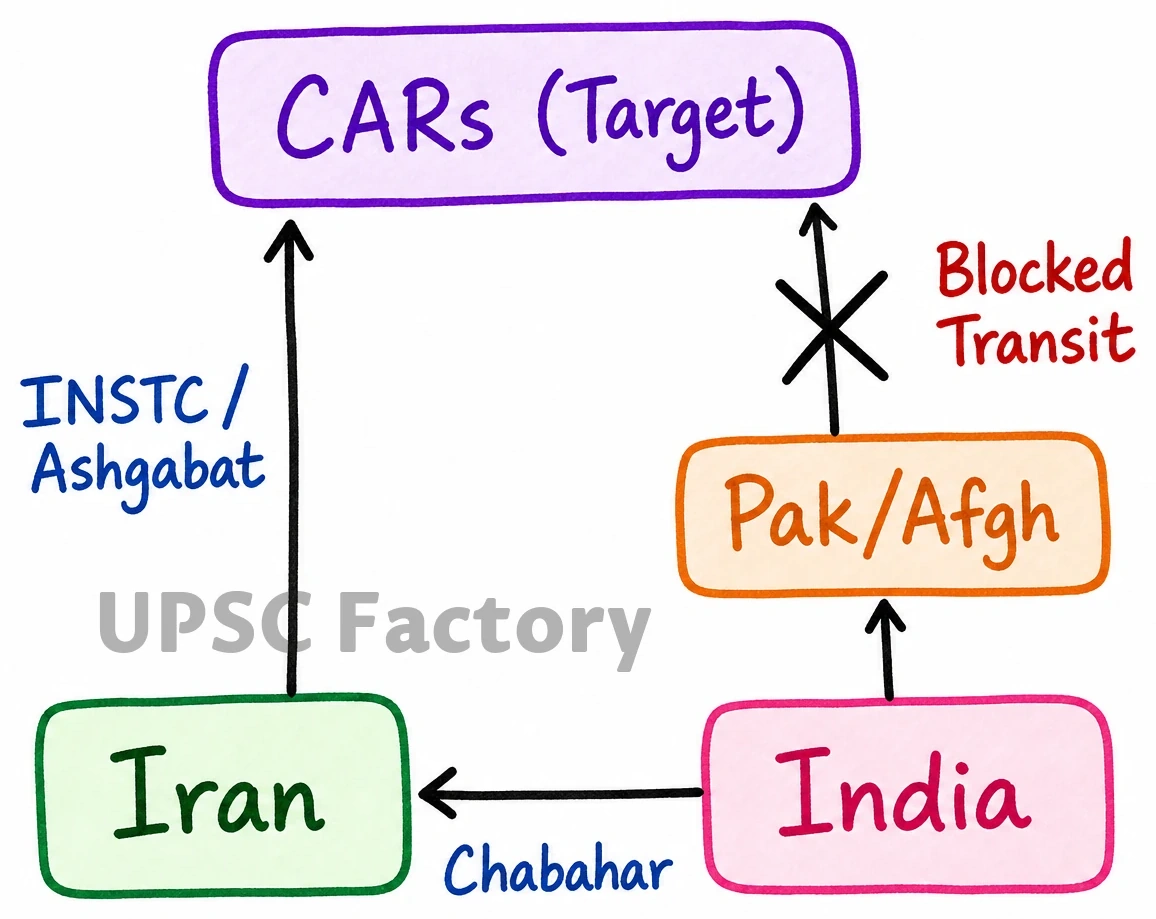
- Geographic Barriers: The lack of direct land transit via Pakistan restricts bilateral trade volume (currently stagnant at ~$2 billion).
- Execution Delays: Slow implementation of mega-projects hampers strategic reach (e.g., TAPI pipeline delays, sluggish INSTC integration).
- Chinese Dominance: Massive economic leverage through the Belt and Road Initiative (BRI) deeply entrenches Beijing, overshadowing India’s footprint.
- Regional Volatility: Proximity to the unstable Afghan theater creates persistent transit risks and cross-border radicalization threats.
Accelerating the operationalization of Chabahar Port and leveraging the Ashgabat Agreement are indispensable to actualize India’s “Connect Central Asia” policy effectively.