Model Answer:
Enacted amidst recent controversies (NEET/UGC-NET 2024), the Public Examination (Prevention of Unfair Means) Act, 2024 aims to strictly deter syndicates and restore integrity in central examination systems.
1. Aims and Objectives of the 2024 Act
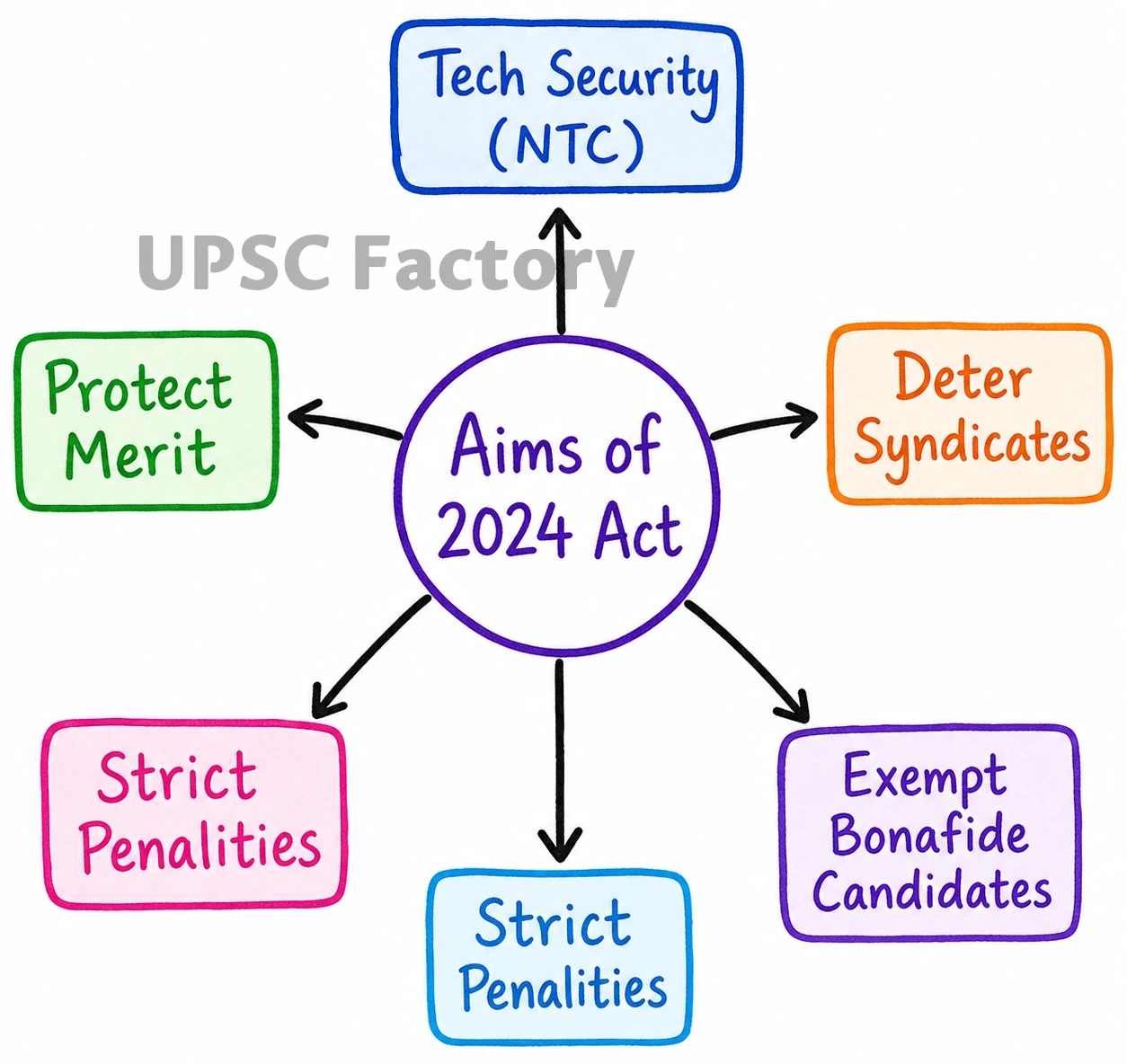
- Deterring Organized Crime: Targets mafias and syndicates disrupting exams via strict penal provisions (3-10 years imprisonment; up to ₹1 crore fine).
- Safeguarding Merit: Ensures transparency and fairness in central recruitment and entrance tests, protecting the future of millions of youth.
- Candidate Protection: Explicitly exempts bonafide candidates from its penal provisions, targeting only facilitators, insiders, and systemic operators.
- Codifying Unfair Means: Legally defines 15 specific offences (e.g., paper leakage, tampering with OMR sheets, hacking computer networks).
- Institutional Accountability: Holds contracted service providers and examination authorities financially and criminally liable for negligence or collusion.
- Technological Fortification: Mandates a High-Level National Technical Committee to formulate robust security protocols for computer-based testing.
- Stringent Enforcement: Makes offences cognizable, non-bailable, and non-compoundable, requiring investigations by officers not below the Deputy Superintendent of Police (DSP) rank.
2. Applicability to University and State Education Boards
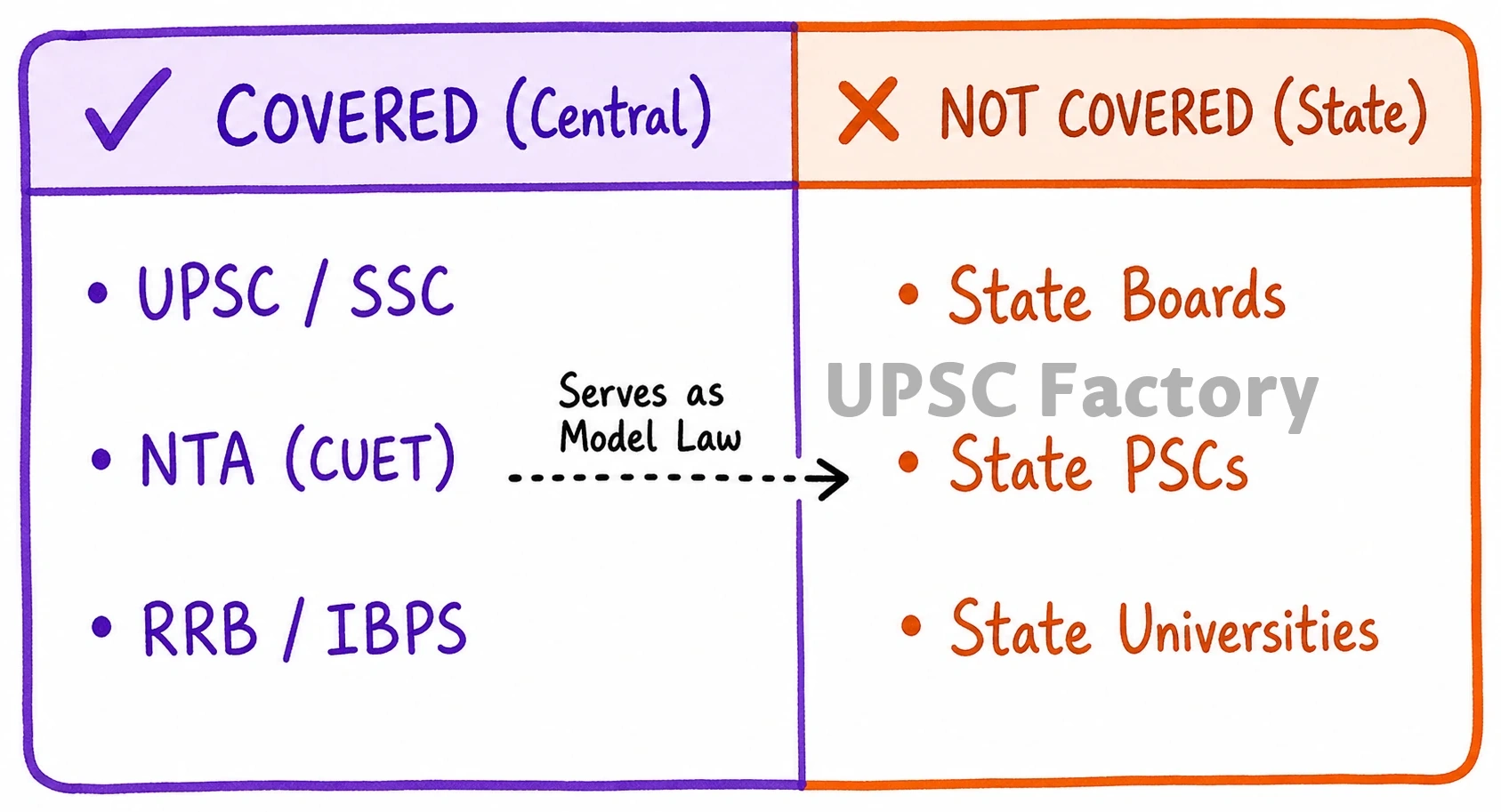
- Exclusion of State Boards: State education boards and state public service commissions are explicitly excluded from this Central Act’s jurisdiction.
- Federal Autonomy: State recruitment remains under state purview; states enact their own laws (e.g., Rajasthan Public Examination Act, 2022).
- Central Scope Limitation: Section 2(k) strictly limits applicability to designated central authorities (UPSC, SSC, RRB, IBPS, and NTA).
- University Coverage Nuance: State university exams are not covered. However, Central University admissions (e.g., CUET conducted by NTA) fall firmly under its purview.
- Model Legislation Role: While lacking direct state jurisdiction, the Centre intends for this Act to serve as a model framework for states.
While the Act robustly secures central examinations, achieving absolute systemic integrity requires a cooperative federal approach, prompting states to adopt parallel legislative safeguards.