Model Answer:
While its traditional ritual framework weakens, caste’s structural resilience persists in modern India. As Dipankar Gupta observes, caste has morphed from a system of hierarchy to one of difference and identity.
Factors Sustaining the Caste System
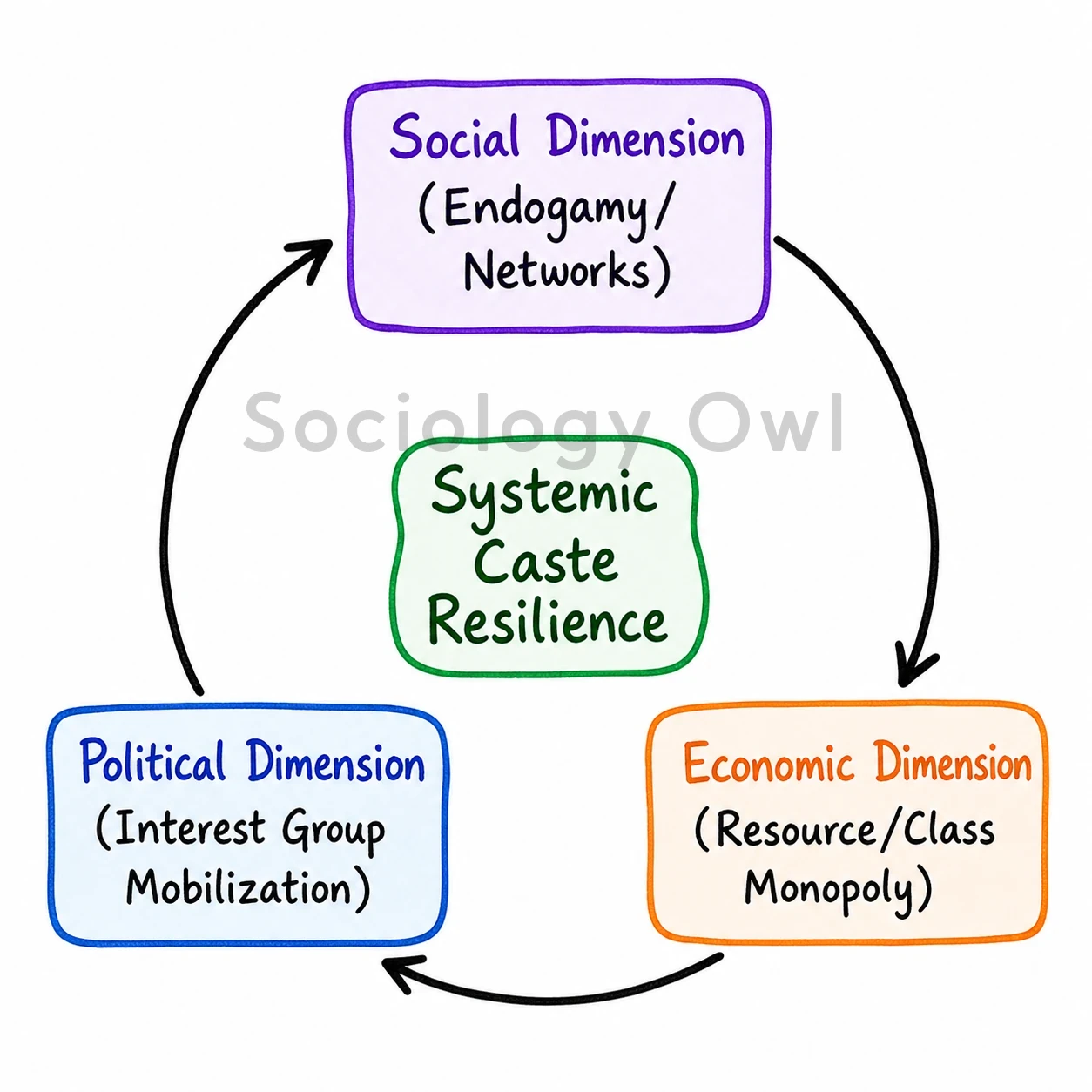
- Politicization of Caste: Rajni Kothari argues that democratic politics transforms castes into competing interest groups, sustained by “Vote Bank Politics” (M.N. Srinivas).
- Ethnicization: C.J. Fuller notes castes now compete as ethnic groups for secular resources, replacing traditional Jajmani interdependence.
- Economic Nexus: From a Marxist lens, A.R. Desai highlights how modern capitalism utilizes caste networks, trapping lower castes in the informal sector and sustaining a rigid Caste-Class nexus.
- Endogamy: Marriage restrictions preserve inherited wealth and social capital among dominant groups, reinforcing distinct boundaries (G.S. Ghurye).
Affirmative action has fueled the “Substantivization of Caste” (M.N. Srinivas), visible in recent dominant caste agitations (e.g., Marathas) seeking OBC status to counter agrarian distress. Furthermore, technology facilitates “Digital Endogamy” through caste-filtered matrimonial websites.
Conclusion
Caste persists not merely as a ritual order but as a modern tool of power. As B.R. Ambedkar diagnosed, it remains a deeply entrenched “division of labourers.” Eradicating its contemporary resilience requires the annihilation of endogamy and structural material inequalities.