Model Answer:
Aeolian processes—encompassing wind erosion, transport, and deposition—are primary geomorphic drivers of land degradation in arid and semi-arid zones, accelerating desertification by stripping productive soil and destabilizing fragile dryland ecosystems.
1. Mechanisms of Aeolian-Induced Degradation
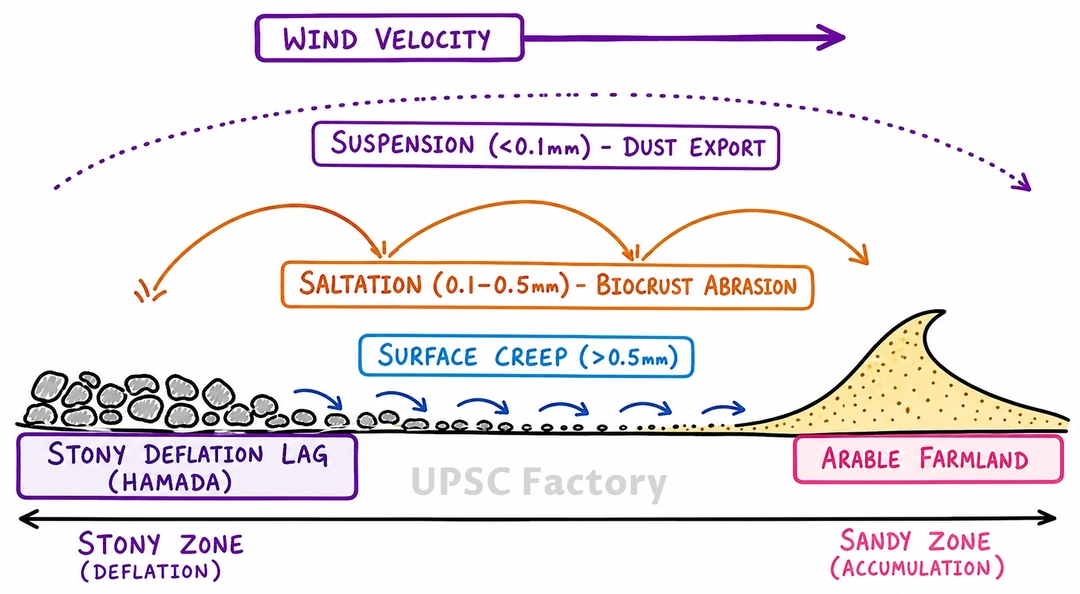
- Deflation & Nutrient Depletion: High-velocity winds lift and export light organic matter and fine silt, leaving behind barren, stony desert pavements (e.g., Hamada formation).
- Saltation & Surface Abrasion: Bouncing sand grains (saltation) mechanically pulverize biological soil crusts, destroying soil aggregate stability and increasing soil erodibility.
- Dune Migration & Sand Encroachment: Shifting sand dunes (barchans, seifs) smother fertile agricultural fields, grazing pastures, and water bodies (e.g., Thar Desert fringes in Rajasthan).
- Atmospheric Dust Loading: Suspension of fine particles creates severe dust storms, depleting regional hydrological retention and soil moisture (e.g., Bodélé Depression, Sahel).
2. Spatial Mitigation Strategies
- Vegetative Buffers: Establishing shelterbelts, windbreaks, and agroforestry to reduce surface wind shear (e.g., Great Green Wall of Africa).
- Mechanical Fixation: Constructing straw checkerboard barriers and sand fences to immobilize active dunes (e.g., Kubuqi Desert reclamation).
- Institutional Synergy: Enforcing Land Degradation Neutrality targets under UNCCD COP14 (Delhi Declaration) and SDG 15.3.
Mitigating aeolian degradation through vegetative stabilization and integrated dryland management is vital to check desert advance and preserve global arid ecology.